We need your help now

Support from readers like you keeps The Journal open.

You are visiting us because we have something you value. Independent, unbiased news that tells the truth. Advertising revenue goes some way to support our mission, but this year it has not been enough.

If you've seen value in our reporting, please contribute what you can, so we can continue to produce accurate and meaningful journalism. For everyone who needs it.


There has been an approximately 7% year-on-year increase in funding for NGOs in Ireland. Shutterstock

Unlike other countries, Ireland's funding for non-profit sector has continued to grow

Only now, we’ve no way to track how much is being spent.

IRELAND IS AMONG the few European countries who have bucked trends and have continued to increase public funding for the non-profit and charity sector.

It comes amid a push from member states across the continent to cut back on public funding for civic society groups and charities, who often assist and advocate for some of the most-vulnerable members of Irish society.

The most-recent available figures suggest there has been an approximately 7% year-on-year increase in funding for NGOs – an umbrella term for sports clubs, unions, churches, charities and similar bodies – on average.

But a decision by Government, in 2021, to stop issuing a grant to an independent body established to monitor this funding has meant that there is no longer analysis of potential funding gaps or an annually curated central database.

Independent researchers have since picked up the mantle in this area, but there are delays in the publication of this research, largely due to gaps in publicly available data.

This reduced transparency means that shortages or cuts in sectors cannot be actioned by government as quickly as possible. Overspending or waste funding could also be missed.

Funding cuts in Europe (but not here)

Governments in the Netherlands, Sweden, France, Germany and EU institutions have announced multi-year spending cuts, totalling in the billions, for global and local development programmes – critical for the work of NGOs – in the last number of years.

Non-profit organisations have also gotten less attention from the European Commission. The Commission met with over five times more commercial-interest groups than NGOs and international development organisations, from December 2024 to April 2025, analysis of the EU’s lobbying register shows.

Ireland has been an outlier in this trend. According to all available data, Irish non-profits and charities saw an average 7% year-on-year increase in public funding between 2019 and 2022.

Giving Ireland – a collaboration between the non-profit transparency advocacy group 2into3 and researchers from TU Dublin – monitors the funding since government pulled the plug on the central database in 2022.

According to its reports, government continued to support civic society groups and charities throughout the pandemic and into high-inflationary periods following the invasion of Ukraine in 2022.

It estimated that funds totalled €10.8bn in 2022. The accuracy of the reports may be slightly skewed by abridged versions of financial accounts from NGOs.

Dennis O’Connor, CEO of the non-profit transparency advocacy group 2into3, said: “The non-profit sector here is a product of its history. Historically, in Ireland, the state didn’t have the delivery capacity, so it relied on others to provide education and health services, in particular.

“Now, [the state] funds them, but in many cases they are still operated by or under the ownership of non-profit bodies. That would apply to a lot of our hospitals or our schools, they are in a non-profit structure given that history, even though they are substantially funded by the state.”

Lack of detail in financial reports

Giving Ireland makes frequent references to the lack of good-quality data in its reports.

O’Connor told The Journal the scarcely detailed financial reports of companies limited by guarantee and non-profits needs to be addressed by policymakers. He added this is the “biggest gap” in information for the sector currently.

Because they don’t produce an income or expenditure report, you cannot see where their money is coming from.

“They’re effectively producing a balance sheet. So that’s the biggest gap,” he said.

O’Connor added: “It’s not transparent, and that’s not a good thing. It would be important to know that these non-profits are viable, and it would be helpful to everyone to know how a non-profit is funded and what the trend is in that.”

Benefacts, an independent non-profit group, was previously tasked with conducting analysis on the central database between 2017 and 2021. It stopped producing reports after government stopped funding the project.

The Charities Regulator has stepped in to collect this information and is quickly making more and more details regarding the financial accounts and governance of charities public.

Many non-profits, such as sports clubs, are outside its remit, however.

The Department of Rural and Community Development is continuing “to explore options for the development of a centralised grantee database”, which would keep track of public funding to non-profits, a spokesperson told The Journal.

Funding gaps not identified quickly

Delays in the publication of new research, largely due to gaps in publicly available data, means funding cuts cannot be identified immediately and any gaps in particularly sectors are not actioned quickly. 

Giving Ireland’s 2022 report was published two years later, in 2024, after all the data had been collected.

O’Connor said that this delay will always be the case without a central database as charities typically file their, albeit limited, financial records up to six months after the end of the business year.

In 2022, the report highlighted that some sectors saw reductions in funding as pandemic assistance funds tapered off, while others saw increases from support packages implemented during high-inflationary periods following the Russian invasion of Ukraine.

This may have resulted in certain sectors, social care for example, receiving fewer public funds compared with the year before despite an increase in costs, such as energy bills.

It suggested that funding may need to be rebalanced in 2023, but the analysis was not provided to the public until 2024.

Since Benefacts’s closure, it has become more difficult to track funding to NGOs. It was awarded funding through a grant programme by the Department of Public Expenditure and Reform for this work.

It highlighted sectors with funding gaps – such as religious organisations and environmental NGOs – and pointed to which non-profits were more reliant on earned income or donations than others, to identify the best place for public funding.

Benefacts sought other funding options

Benefacts sought to get alternative funding before its closure in 2022, documents released to The Journal Investigates under freedom of information laws show.

Internal analysis provided to high-level officials in 2022, including then-Finance Minister Paschal Donohoe, shows the decision to pull the plug on the project in 2022 came after “business case for the grant” had changed.

Just a third of the information previously provided by Benefacts is published by the charities’ regulator, the internal study said.

It added, however, that there was no longer a policy reason to issue the specific grant by the department. It subsequently claimed that separate external analysis found “the non-profit sector do not derive sufficient quantifiable value from Benefacts’ data”. 

Benefacts director, Tom Boland, strongly disagreed with this in a letter to the Secretary General of the department.

At the time, Benefacts’ management was seeking to prevent its closure. Boland said there was “never a greater need for clear and coherent data” to support public officials to make informed decisions around non-profit funding.

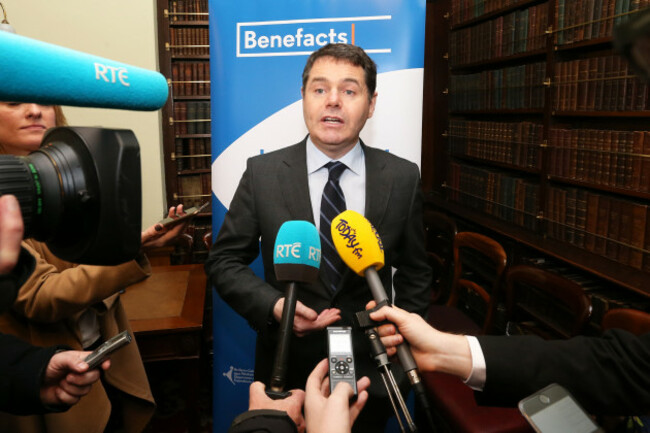
Pascal Benefacts Paschal Donohoe at the launch of the inaugural annual Benefacts nonprofit sector analysis in 2017 RollingNews.ie RollingNews.ie

In another letter, sent one month before its closure, Boland asked for a meeting with then-minister Michael McGrath.

Records show Benefacts prepared detailed briefs for department officials. The brief outlined a number of options for funding, including private ownership and the suggestion that there was a legal precedent to extend the grant, as the majority of its funds already came from government. 

In April 2022, Moloney wrote to Boland to confirm there was no longer an obligation to continue funding Benefacts. He said the director should see if other department bosses were willing to extend the funding.

Benefacts shut down shortly after.

The subsequent lack of details around this funding has contributed to a wave of misinformation around NGOs in Ireland, including accusations of the misuse of funds and claims of governance issues in the organisations.

Reduced transparency leads to misinformation

Occasionally, misinformation targets individual NGOs or non-profits.

This includes instances of anti-immigrant movements targeting groups who work to help refugees or failing charities being held up as examples of why the sector as a whole is corrupt.

Far-right commentary frequently makes false claims about NGOs, which have led to the targeting of some philanthropic organisations, according to The Journal‘s Knowledge Bank.

O’Connor said that a reduction in funding for the non-profit sector, particularly those working in international development, is both a political and fiscal decision.

He said that Ireland typically has greater capacity to continue to fund the organisations. Although an NGO’s headline work may be worthy or a necessary force for good in society, this does not mean it is automatically immune to poor practices or mistakes.

Proper governance and oversight, including by politicians and the media, are therefore necessary to ensure that the sector is performing properly, and that NGOs are deserving of public money and charitable status – as past scandals have shown.

“It’s a broad issue,” O’Connor said. “If you go back to the more high-profile financial governance scandals, the source wasn’t that their accounts were not available. It was something different.

“But, in broader terms, we do lag as other countries have more available data.”

Readers like you are keeping these stories free for everyone...
A mix of advertising and supporting contributions helps keep paywalls away from valuable information like this article. Over 5,000 readers like you have already stepped up and support us with a monthly payment or a once-off donation.

Close
JournalTv
News in 60 seconds