We need your help now

Support from readers like you keeps The Journal open.

You are visiting us because we have something you value. Independent, unbiased news that tells the truth. Advertising revenue goes some way to support our mission, but this year it has not been enough.

If you've seen value in our reporting, please contribute what you can, so we can continue to produce accurate and meaningful journalism. For everyone who needs it.

The eurozone economy contracted by 0.2% in the first quarter of the year.

Ireland’s economy shrank so much, it dragged the entire eurozone into reverse

Excluding Ireland, one economist said that the eurozone economy grew in the first three months of the year.

THE EUROZONE ECONOMY unexpectedly shrank in the first three months of 2026, and Ireland was to blame.

New figures from Eurostat show the combined economy of the 21 countries that use the euro contracted by 0.2% in the first quarter of the year, a sharp downgrade from an earlier estimate that suggested growth of 0.1%.

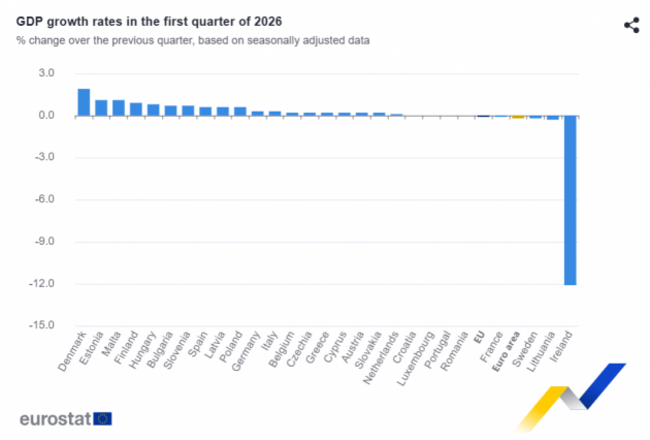
The main reason for the revision was Ireland, where GDP fell by a staggering 12.1% between January and March.

Screenshot (521) A chart from Eurostat which shows that Ireland was an outlier. Eurostat Eurostat

According to the Central Statistics Office (CSO), the drop was driven by a contraction in multinational-dominated sectors, which account for a large share of Irish economic activity.

That slump was significant enough to skew the figures for the entire eurozone.

Oxford Economics economist Rory Fennessy said that once Ireland is excluded from the calculations, eurozone growth appears much more stable.

“Excluding the effect of Irish GDP, eurozone growth remains remarkably steady at around 0.2% per quarter,” Fennessy said.

It’s not the first time Ireland has had an outsized impact on European growth data.

Last year, a sharp rise in Irish GDP boosted eurozone growth figures, and roughly half of the bloc’s reported growth in the first quarter of 2025 came from Ireland’s performance alone.

However, the headline GDP figure does not reflect what is happening in the domestic Irish economy.

While GDP fell sharply, the CSO said its preferred measure of underlying activity (Modified Domestic Demand, which tracks personal consumer spending, government expenditure, and domestic investment, while stripping out “globalisation” effects) increased by 0.6% during the quarter.

Personal spending also rose by 0.6%, while non-multinational sectors expanded by 0.4%, according to the CSO.

The CSO said multinational-dominated sectors contracted by 27.1% in the quarter, compared with growth of 0.4% in domestic sectors, which would explain the dip.

Fennessy pointed to the volatile activities of multinational pharmaceutical companies as a key factor behind the swing in Ireland’s GDP.

Some firms had increased exports last year ahead of anticipated US trade measures, but that trend has since reversed.

Fennessy noted that first quarter growth was likely boosted by companies “front-loading” purchases to try to get ahead of supply disruptions due to global conflict.

The revised figures mean Ireland recorded by far the steepest economic contraction in the EU during the first quarter, ahead of Lithuania (-0.3%), Sweden (-0.2%) and France (-0.1%).

With reporting from AFP

Readers like you are keeping these stories free for everyone...
A mix of advertising and supporting contributions helps keep paywalls away from valuable information like this article. Over 5,000 readers like you have already stepped up and support us with a monthly payment or a once-off donation.

Close
16 Comments
This is YOUR comments community. Stay civil, stay constructive, stay on topic. Please familiarise yourself with our comments policy here before taking part.
Leave a Comment
    Submit a report
    Please help us understand how this comment violates our community guidelines.
    Thank you for the feedback
    Your feedback has been sent to our team for review.

    Leave a commentcancel

     
    JournalTv
    News in 60 seconds