We need your help now

Support from readers like you keeps The Journal open.

You are visiting us because we have something you value. Independent, unbiased news that tells the truth. Advertising revenue goes some way to support our mission, but this year it has not been enough.

If you've seen value in our reporting, please contribute what you can, so we can continue to produce accurate and meaningful journalism. For everyone who needs it.

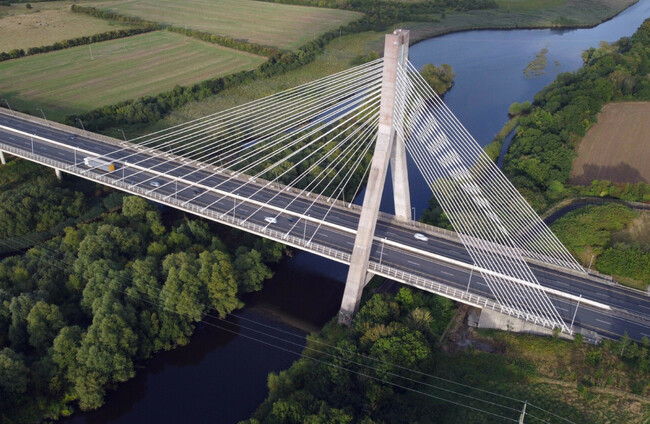
The Mary McAleese bridge on the M1 motorway that links Dublin and Belfast. Alamy Stock Photo

Ireland outperforms North on disposable income and life expectancy - but not on employment

It is the first in a series of reports by the ESRI comparing the two economies.

IRELAND HAS LONGER life expectancy and faster growing population compared to communities north of the Border have been highlighted in a new report launched today.

It is the first in a new series of annual reports by the Economic and Social Research Institute (ESRI) comparing the two economies.

The report found that Ireland outperforms Northern Ireland across “several measures of living standards”, including disposable income and hourly earnings.

But it also showed that unemployment was higher in the Republic at 4.4% compared to Northern Ireland’s at 1.8%, which reflects the differences in labour market dynamics.

The report found that Ireland had higher labour force participation and employment rates.

They stood at 78.5% and 75.1% retrospectively, higher than in Northern Ireland where the figures were at 75.7% and 74.3%.

Tánaiste and Finance Minister Simon Harris said the series would “spur debate” and highlight what areas could be focused on for better cooperation on the island.

Commenting on the findings, co-author of the ESRI report, Alan Barrett said: “Our goal is to assess over time how the two economies evolve and how policy is influencing those evolutions, always with a view to informing policy.

Life expectancy

One of the key factors which reflects the effects of income, education and access to health services, the report says, is life expectancy.

In 2022 it was 80.9 years for men and 84.2 years for women in Ireland, compared to 78.9 and 82.7 years in Northern Ireland, a gap of about two years for men and 1.5 years for women.

An area of notable contrast is population growth, the report outlines how between 2015 and 2024, Ireland’s population grew by 14.8%, while Northern Ireland’s population grew by 3.9%.

The report did note the difference between how policy is formed in the two jurisdictions, as Ireland is a sovereign state and Northern Ireland is a devolved nation.

But did say the programmes for government in both shared common themes of productivity, competitiveness and decarbonisation.

The work is part of a project between the ESRI and the Shared Island Unit in the Department of the Taoiseach and aims to “develop further joint understanding of the economies of Ireland and Northern Ireland in an effort to support policy development, inform future research, and encourage greater collaboration on shared challenges and opportunities across the island”.

Launching the report, Harris said the annual series would “build on” previous ESRI research done on behalf of the Shared Island programme.

He said the annual series would look at “broader and deeper” data comparisons to yield insights and “food for thought”.

The Fine Gael leader added that insight into the similarities and divergences north and south – such as differences on sectoral structure, labour market participation and overall rates of education attainment – were “vital” metrics needed to develop more cooperation on the island.

Close
7 Comments
This is YOUR comments community. Stay civil, stay constructive, stay on topic. Please familiarise yourself with our comments policy here before taking part.
Leave a Comment
    Submit a report
    Please help us understand how this comment violates our community guidelines.
    Thank you for the feedback
    Your feedback has been sent to our team for review.

    Leave a commentcancel

     
    JournalTv
    News in 60 seconds