We need your help now

Support from readers like you keeps The Journal open.

You are visiting us because we have something you value. Independent, unbiased news that tells the truth. Advertising revenue goes some way to support our mission, but this year it has not been enough.

If you've seen value in our reporting, please contribute what you can, so we can continue to produce accurate and meaningful journalism. For everyone who needs it.

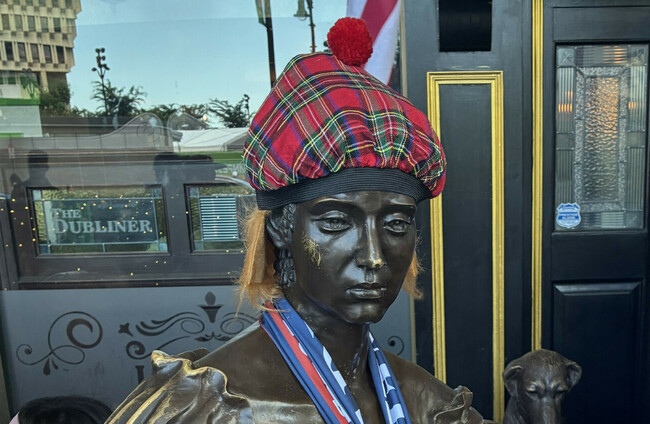
Molly Malone having an identity crisis at an Irish pub in Boston. David Sneyd/The 42

Tartan Army FOMO shows how Irish-American identity is Scot(ch)-taped together

If you’re looking at the Scots at the World Cup and think it should be us – some Americans appear to think it is.

In Calling 353, a new series for The Journal, bestselling Motherfoclóir author and podcaster Darach Ó Séaghdha casts a linguistic eye on how we talk about what it means to be Irish, the signs we post to each other about Irishness – and what really lies beneath it all. 

IT’S BEEN SAID that Macbeth was called The British Play until he lost a semi-final at Birnham Wood. Scottish athletes have had to endure versions of this indignity many times over the years, but it’s a different story when a Scottish team specifically representing Scotland start doing well.

At the time of writing (sorry if they’ve been kicked out in the hours between submission and publication), the Scottish team are having their best World Cup ever, on the verge of qualifying for the knockout rounds for the first time.

And they’re enjoying every minute of it. Best fans in the world, apparently. A joy to have in class. Cleaning up after themselves and charming the locals with their sexy accents and unlimited appetite for fun.

In other words, they’re out there having the World Cup that we were supposed to be having.

And to add insult to injury, they’ve been doing it in Boston. Our Boston. Get your own American city, Scotland!

Oh well. Speaking of Scotland and America, you may have noticed over the years that sometimes when Irish-Americans try to embrace their heritage, they lunge in a northeasterly direction and embrace Scottish culture instead. The kilts and bagpipes at Irish-American funerals. The interest in family tartans and clans, things which do exist in some cases but rarely register at all here. Calling the Irish language “Gaelic”. That sort of thing.

The Scots got there first

The first part of my explanation for this is the simplest: the Scots got to America first. And by already being there en masse, they established an aesthetic for what doing well while not being Anglo-Saxon could look like. While the critical mass of Irish emigrants to America arrived in the mid-19th century and started at the bottom, there had been Scots involved in the War of Independence and the formation of the United States at a high level.

Alexander Hamilton, James Wilson, John Witherspoon and other major figures in the Founding Fathers were of recent Scottish descent. Nine of the governors of the thirteen initial American states had Scottish ancestry. And the Bill of Rights, that addendum to the American constitution designed to protect citizens from the State, reads almost like a deliberate opposite of the Statures of Iona, the rules created to crush Gaelic culture in the islands by restricting free speech, free assembly, free religion, gun ownership, and demanding loyalty to the King.

The second part of the explanation is that Irish-American identity began to take shape prior to the Gaelic Revival, the foundation of the GAA, the Gaelic League, the Abbey Theatre, the codification of Irish dancing… all those movements which forged modern Irish identity as we now know it were not available as frames of reference to those first Irish NYPD cops who wanted to give their departed colleague a proper Irish send-off.

In fact, Ireland and Scotland were still under the rule of the same monarch and parliament, so it’s possible that certain Irish-Americans didn’t consider the differences between the two countries to be that big a deal.

A significant shared history

The third part is that Scotland and Ireland have a significant shared history: in music, poetry, sport, distilling, language, revolution and more. James Connolly. Ray Houghton. Margaret Skinnider. So it’s unusual for a Scottish phenomena to be unknown in Ireland and vice versa. It’s not like mixing us up with Iceland or Greenland (even though both of those have happened).

And yet, examples of people confusing Ireland with Scotland continue to exist and continue to stand out as inauthentic. John Kelly used to enjoy torturing his listeners on the Mystery Train with the Irish Mambo by Alma Cogan, a repulsive racket whose creation assumes that Irish people are keen on bagpipe music. More recently, Lindsay Lohan’s not-quite-so-bad-it’s-funny movie Irish Wish featured a supposedly Irish character saying distinctively Caledonian things like “tickedy-boo”.

However, the most enduring faux amis between Scottish and Irish culture is the whole business of referring to the Irish language as Gaelic. With Scotland having both Lowland Scots and Scots Gaelic in its linguistic heritage, it’s easy to see why they wouldn’t call one “Scottish” the way we say “Irish”. And yet Irish is, by and large, what we call our language, although it is worth mentioning that it’s not unusual for Irish speakers in the Donegal Gaeltacht to call Irish Gaelic (which is close to what they call Irish in Irish, Gaelig).

Personally I don’t think calling Irish “Gaelic” is the worst thing in the world, and there’s no harm in reminding ourselves that our two languages have much in common.

What did the Scottish ever do for us?

As much as I’d like to wrap this column up with some jokes about Irn-Bru or deep-fried batter Mars bars, there is another part of our recent history which we owe to Scotland which deserves a mention.

It was a BBC 2 Scotland news report in 1993, Washing Away the Stain, that drew public attention to the scandal of the Magdalene Laundries, leading to the last remaining laundries in Ireland to be closed and all the investigations and personal accounts that followed. And it was a Scotsman who directed The Magdalene Sisters nine years later, lest anyone dare to forget.

Sometimes a great friend is the one who looks you in the eye and tells you when you’ve messed up. I for one am grateful for Scotland’s friendship.

Darach will be back next Sunday with more thoughts on the words and Irish cultural phenomena that unite us.

Readers like you are keeping these stories free for everyone...
A mix of advertising and supporting contributions helps keep paywalls away from valuable information like this article. Over 5,000 readers like you have already stepped up and support us with a monthly payment or a once-off donation.

Close
7 Comments
This is YOUR comments community. Stay civil, stay constructive, stay on topic. Please familiarise yourself with our comments policy here before taking part.
Leave a Comment
    Submit a report
    Please help us understand how this comment violates our community guidelines.
    Thank you for the feedback
    Your feedback has been sent to our team for review.

    Leave a commentcancel

     
    JournalTv
    News in 60 seconds