We need your help now

Support from readers like you keeps The Journal open.

You are visiting us because we have something you value. Independent, unbiased news that tells the truth. Advertising revenue goes some way to support our mission, but this year it has not been enough.

If you've seen value in our reporting, please contribute what you can, so we can continue to produce accurate and meaningful journalism. For everyone who needs it.

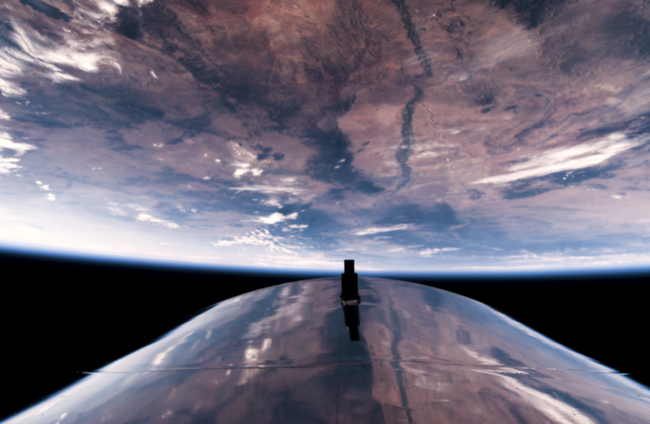
The Virgin Galactic is scheduled to lift off in late 2026 or early 2027. Virgin Galactic

Ireland needs a space agency to share in industry which could be worth €3 trillion by 2040

Dr Norah Patten from Mayo is scheduled to be Ireland’s first person in space when the Virgin Galactic lifts off in late 2026/early 2027.

(Foireann Gaeltachta The Journal a chuir an scéal seo ar fáil. Tá leagan as Gaeilge anseo.) 

WE NEED OUR own space agency in Ireland so that Irish companies can share in the economic windfall of an industry which experts estimate will be worth between €1.5 and €3 trillion by 2040.

That is the view of Dr. Norah Patten, the Mayo born aeronautical engineer chosen to be the first Irish astronaut, who will be joined on the Virgin Galactic flight by Canadian astronaut, Dr Shawna Pandya, when it lifts off in late 2026 or early 2027. 

Both Patten and Pandya will be flying on the Delta mission of the International Institute for Astronautical Sciences.

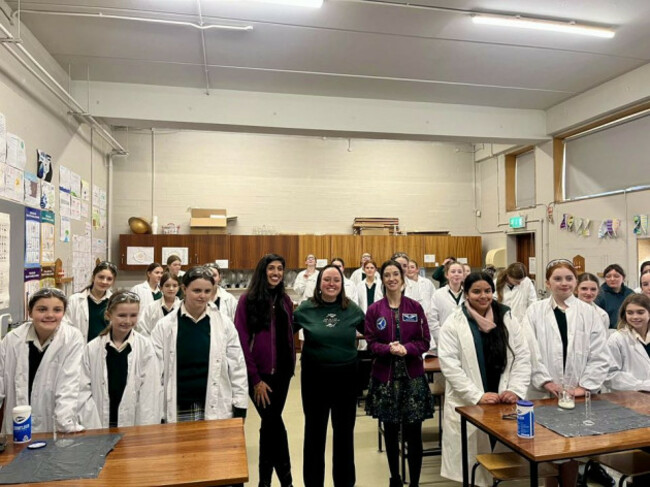
585341456_25365906559706340_4376183102359243401_n Dr Norah Patten and Dr Shaena Pandya visited Coláiste Íosagáin this week, an event organised by the Comhairle na nDaltaí at the school with the support of the Canadian Embassy in Ireland. Coláiste Íosagáin Coláiste Íosagáin


Patten and Pandya were on a visit to Coláiste Íosagáin in south Dublin this week to talk to the students at the renowned Irish-language secondary school about their own careers and the opportunities that would be available to them in the space sector.

During her talk, the Mayo woman revealed that her interest in space travel began when she visited the NASA headquarters in Cleveland, Ohio, in the United States when she was 11 years old.

She later went to the University of Limerick and obtained a doctorate in aeronautical engineering. She now works with Réaltra Space Systems Engineering in Dublin while also training and conducting research in Canada.

As their journey into space approaches, the pair are on a mission to lobby for space travel and investment in the Irish space sector.

“We are the world’s first and only right now, dedicated suborbital astronautics research space flight program, which is, you know, we say we don’t say it lightly, we say it with a lot of pride,” Pandya said.

She also referred to the growing global interest in space and cited the growth in the number of countries with space agencies as evidence of this.

After the Cold War, there were five superpowers in space – the Americans, the Soviets/Russians, the European Space Agency, the Japanese and the Canadian Space Agency.

“And so now, you know, when you look at the evolution every few years, I have to go to the CIA World Factbook and say, How many space agencies are there in the world? Because, you know, every 510, 1520, years, you know, it’s evolved, and that when I last looked, it was something like 96 plus space agencies.” Pandya said.

“We don’t see 96 nations sending humans to space, but the reasons it’s important is having access to space is a way of developing infrastructure, of advancing economically, of developing the STEM workforce of tomorrow.”

According to Patten, there was a need to look at a broader picture than just space travel and the economic and research opportunities associated with being involved in the space sector.

She gave as an example the participation of Irish companies in the first satellite launched by the European Space Agency, a project that provided research and other opportunities for Irish students.

She said that more than fifty students, PhD and master’s students, were working on that project. “They have experience in designing missions, they have experience in flight hardware, testing and flying,” she said.

Some of them have gone from there to the space industry in Ireland, they didn’t have to go overseas because more and more companies in Ireland are working in this industry now.

Her colleague said that the global industry is now estimated to be worth between €1.5 and €3 trillion by 2040. She also referred to her home country, Canada, where there is an organization called Space Canada that is urging the Government to have a Space Council in Canada that would, as has been done in the United States and Britain, develop an integrated strategy that brings together the space agency, the defense sector and industry.

Coláiste Íosagáin students Kate Ní Ghiolla Dheacair and Éabha Scollard, who were present at the interview, welcomed the optimistic messages and said that they had invited the astronauts because they wanted to have high-profile female speakers. They expressed the hope the visit would inspire students to consider space as their future.

Among the guests who recently visited the school were equestrian Rachel Blackmore and well-known politicians and the reason they were invited was so they could inspire the students.

The students also pointed out that, while there was a growing interest in STEM subjects, Coláiste Íosagáin didn’t have its own physics laboratory at the moment and shared the laboratory of Coláiste Eoin, its sister school for male students on the same Booterstown campus.

Before the two astronauts left, Pandya answered the fateful question. Star Trek or Star Wars. She said she imagined Star Wars with warfare and powerful games but Star Trek was something different.”Star Trek is this ambitious view of a very peaceful, technologically advanced, respectful, sustainable future in space.

And we are at that crossroads, because we do see this increasing dialog about space domain awareness, you know, space debris management, that. National security. And, you know, it’s a great metaphor for what kind of future do we want to choose for ourselves as species, on Earth and off Earth” she said.

 The Journal’s Gaeltacht initiative is supported by the Local Democracy Reporting Scheme


Readers like you are keeping these stories free for everyone...
A mix of advertising and supporting contributions helps keep paywalls away from valuable information like this article. Over 5,000 readers like you have already stepped up and support us with a monthly payment or a once-off donation.

Close
40 Comments
This is YOUR comments community. Stay civil, stay constructive, stay on topic. Please familiarise yourself with our comments policy here before taking part.
Leave a Comment
    Submit a report
    Please help us understand how this comment violates our community guidelines.
    Thank you for the feedback
    Your feedback has been sent to our team for review.

    Leave a commentcancel

     
    JournalTv
    News in 60 seconds