We need your help now

Support from readers like you keeps The Journal open.

You are visiting us because we have something you value. Independent, unbiased news that tells the truth. Advertising revenue goes some way to support our mission, but this year it has not been enough.

If you've seen value in our reporting, please contribute what you can, so we can continue to produce accurate and meaningful journalism. For everyone who needs it.

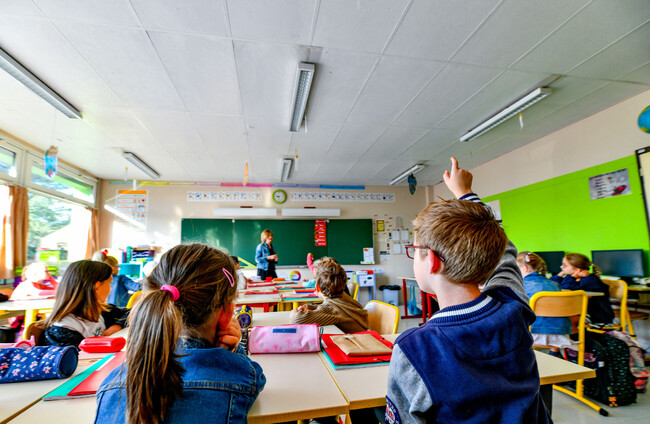
Bíonn dearcadh dearfach ag páistí i leith na Gaeilge Alamy Stock Photo

New research shows that children want to learn Irish but that their needs are not being met

Over 200 primary and post-primary students were surveyed about their opinions on learning Irish.

(Seo alt ónár bhfoireann nua Gaeltachta. Is féidir an bunleagan as Gaeilge a léamh anseo.)

SCHOOL CHILDREN HAVE a positive outlook when it comes to learning the Irish language and want to improve their language skills — but their needs are not being met.

That’s according to a consultation done by Sealbhú, DCU’s research centre, in partnership with the Department of Education and Youth.

It was carried out as part of the Policy for Irish-Medium Education and Action Plan for Irish in English-Medium Schools, which was published in November.

Two reports were prepared by Dr Aisling Ní Dhiorbháin and Dr Patrick Burke with recommendations for the government. 

Over 200 school students were surveyed in various focus groups at primary school, junior cycle in post-primary and senior cycle in post-primary levels.

They were asked their various opinions on different aspects of the Irish language curriculum, such as if they believed that they had enough contact time with the language and what they felt motivated them to engage with Irish.

The responses showed that young people wanted to learn Irish and be able to speak the language, but that the current education system is not meeting their needs. 

At primary school level, students preferred active learning through music and play and at secondary school level, it was shown that students lost motivation due to the emphasis on rote-learning and text books in Irish lessons.

Speaking to The Journal, Dr Aisling Ní Dhiorbháin said that the new Irish language education policy, which aims to put more emphasis on the spoken language, is a “step forward”.

“Children understand the cultural, identity, cognitive and employment benefits associated with the Irish language, but they are frustrated with the amount of time they have to speak Irish in-and-outside of school,” she said.

“The biggest challenges are probably the lack of contact they have with Irish in-and-outside of school, which makes it hard to solidify their grasp of the language.”

You acquire a language when you have ample opportunities to communicate in that language, she said, but that is not how Irish is currently being taught in schools. 

An effective way to help children learn is through play and through music and by actively  using Irish in the day-to-day, for example by asking children about their lunch or what they did outside of school.

Ní Dhiorbháin says there is a lot of emphasis put on Irish language literature, and the education system currently depends too much on textbooks and exams, without an emphasis being put on spoken Irish.

Students also have to take too many notes and rote-learn in secondary school when they are preparing for state exams, which is seen as a barrier to their Irish language education.

Literature supports Irish language learning 

However, reading and writing in Irish supports language acquisition and it would do more harm than good to remove literature from the curriculum.

“I think we need to think about the range of texts on the curriculum, and the ways in which we are tackling those texts,” she said. 

“Reading and writing helps with strengthening your language skills, and it is important that there is a variety there in the teaching and the learning, to ensure we are meeting the needs of every learner,” she said. 

“The recommendations that came up is that there should be a separate policy for Irish that helps connect it to the Common European Framework of Reference for Languages to help with the structured continuation of language learning.

“It is written in the action plan that there will be a group working to make that happen, which is a positive thing.”

Over 100 parents, teachers and principals at primary school and secondary school level also shared their opinions as part of the consultation and many had the same frustrations with the education system as the students surveyed.

“The majority of teachers are minority language learners, in a way similar to how young people are minority language learners,” said Ní Dhiorbháin, “and teachers don’t get many opportunities to use Irish outside of school either.”

The reports recommend that more supports be given to teachers and Ní Dhiorbháin says it would be great if teachers were given the opportunity to spend a period in the Gaeltacht to help improve their Irish. 

“What we see in the research, at primary school level, is that a lot of teachers lack confidence [when it comes to Irish],” said Ní Dhiorbháin.  

“In the Basque country and in Wales, teachers have the opportunities to spend a year learning Basque or Welsh to do a little upgrade of sorts.

“I would say the biggest thing would be to give more opportunities to teachers in Ireland and to encourage them to accept those opportunities.”

Readers like you are keeping these stories free for everyone...
A mix of advertising and supporting contributions helps keep paywalls away from valuable information like this article. Over 5,000 readers like you have already stepped up and support us with a monthly payment or a once-off donation.

Close
108 Comments
This is YOUR comments community. Stay civil, stay constructive, stay on topic. Please familiarise yourself with our comments policy here before taking part.
Leave a Comment
    Submit a report
    Please help us understand how this comment violates our community guidelines.
    Thank you for the feedback
    Your feedback has been sent to our team for review.

    Leave a commentcancel

     
    JournalTv
    News in 60 seconds