We need your help now

Support from readers like you keeps The Journal open.

You are visiting us because we have something you value. Independent, unbiased news that tells the truth. Advertising revenue goes some way to support our mission, but this year it has not been enough.

If you've seen value in our reporting, please contribute what you can, so we can continue to produce accurate and meaningful journalism. For everyone who needs it.

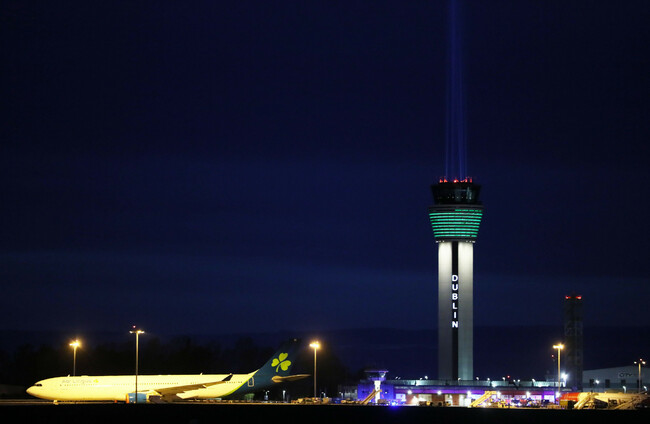
A large beam of light shines out of the new air traffic control tower. Alamy Stock Photo

Air traffic controller shortage has closed areas of Irish airspace more than 10 times in six weeks

Sources with a knowledge of the air traffic control situation have said that the incidents are linked to an ongoing problem of low staff numbers.

AREAS OF IRISH airspace have been closed more than 10 times since the beginning of the year due to staff shortages in air traffic control, The Journal has learned. 

The problem has particularly affected airspace over Dublin Airport.

Sources with a knowledge of the air traffic control situation have said that the incidents are linked to an ongoing problem of low staff numbers.

News of the other closures comes after Cork Airport was forced to close overnight in the early hours of Wednesday because just one air traffic controller phoned in sick. 

It is understood the cause of much of the various incidents is a crippling shortage of controllers, not just here in Ireland but globally.

Officials have been using overtime call-ins to fill the gaps, but the situation is getting worse and now Fórsa, a union representing the staff has said it is at crisis point.

“Fórsa is aware that there is currently a very high global demand for air traffic controllers (ATCs), and this has created capacity challenges for Irish air traffic control.

“Retention of ATCs appears to be an issue, leading to an over-reliance on overtime to fill any gaps.

“While the union is aware of multiple airspace closures in January and February 2026, it is not possible to comment on the operational decisions that led to those closures,” it said in a statement. 

It is not the first time airspace has been closed. Multiple aviation industry sources have told The Journal that it has become a regular occurrence in recent years. In 2023, Dublin Airport flights were reduced to what is known in the industry as a “zero flow rate”. 

A source, working in Dublin Airport, has said that the current situation is being handled by shutting down airspace from midnight to 7am, as had happened in Cork this week. 

Much of the work done by air traffic controllers in Ireland is enabled by members of staff coming in on rest days and being paid a premium or overtime payment. 

A source said that disquiet has grown in the service, which is managed by AirNav Ireland, and staff morale means that it is likely to escalate into a serious industrial dispute. 

While the fix of shutting the impacted airspace is keeping the high volume peak time running, the problem is that large numbers of transatlantic flights are due to arrive in Ireland in the early hours, the source said.

These flights are then suffering the knock effect of being delayed or forced to circle awaiting airspace to reopen. 

Pilots are notified of the closures through a Notice to Airmen (NOTAM) which is internationally issued to all aircraft operators warning them of the “zero flow rate”.

We contacted AirNav Ireland for a statement today.

Yesterday it said in a statement that it “continues to implement a recruitment campaign to attract suitable candidates to work as air traffic control officers, engineers and radio officers”.

It said 32 students graduated in January after completing their 18-month training programme.

Readers like you are keeping these stories free for everyone...
A mix of advertising and supporting contributions helps keep paywalls away from valuable information like this article. Over 5,000 readers like you have already stepped up and support us with a monthly payment or a once-off donation.

Close
JournalTv
News in 60 seconds