We need your help now

Support from readers like you keeps The Journal open.

You are visiting us because we have something you value. Independent, unbiased news that tells the truth. Advertising revenue goes some way to support our mission, but this year it has not been enough.

If you've seen value in our reporting, please contribute what you can, so we can continue to produce accurate and meaningful journalism. For everyone who needs it.

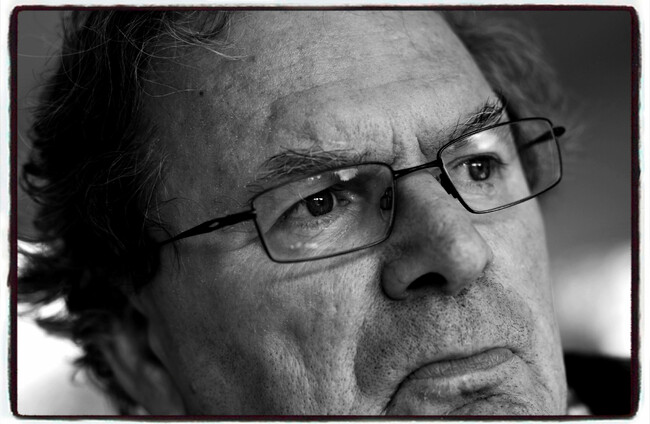
Gabriel Rosenstock is one of ireland's major literary figures, having written over 400 books throughout his life Jason Symes

A rare conversation about death between a father and son to be broadcast on Easter Monday

Author and poet Gabriel Rosenstock talks to his son Tristan about a devastating diagnosis.

(Seo alt ó fhoireann Gaeltachta The Journal.  Is féidir an bunleagan as Gaeilge a léamh anseo.)

IRISH POET AND writer Gabriel Rosenstock has been writing every day of his adult life.  Now facing a difficult cancer diagnosis, the author of over 400 books has begun writing a diary to chronicle and make sense of his illness. 

One of the most significant figures in Irish-language literature, Gabriel traces his roots to Kilfinane in County Limerick, though he has lived in Dublin for many years.

As a young man, he was part of a group of poets who launched an influential literary journal at University College Cork — the now-legendary INNTI — in the early 1970s, and he has barely stopped writing since.

His output spans children’s books, poetry collections, haiku anthologies and travel writing, and he has picked up numerous awards along the way.

When Gabriel sent his cancer diary to his son Tristan — a well-known broadcaster and musician — it set something larger in motion. A documentary based on conversations between father and son will be broadcast on RTÉ Raidió na Gaeltachta this Easter Monday.

Tristan admitted he was surprised to hear his father had been keeping a diary at all, given that he had never kept a journal throughout his life — there simply wasn’t time, given the sheer volume of his other writing. But Tristan says he understands why he is writing now.

“Self-knowledge and writing have always been bound up together for Gabriel — he writes to make sense of the world and to know himself,” Tristan said.

“He mentioned that this was the first time in his life he had kept a diary, as a way of trying to understand the illness and what lies ahead.”

Gabriel had known for some time that he had cancer, and had understood that he had perhaps a couple of years before the disease would take its final course. But recently he received a starker diagnosis from his doctor — his time was considerably shorter than that.

At present, Gabriel, 76, is receiving aire na h-uibe/the care you’d expect for an egg from his wife Eithne, Tristan said.

The diary prompted Tristan to record a series of conversations with his father about his thoughts on the illness and on his life more broadly. Through those two recorded conversations about the diary, Tristan said, he came to know his father far better than he had before.

He described how it all began over a cup of tea, before he produced a microphone and they embarked on “a conversation that a father and son wouldn’t often have”.

There were in fact two conversations — one after Christmas, when Gabriel first mentioned he was writing the diary, and a second more recently, after the bleaker diagnosis about the direction of the illness and how much time he had left.

The diary and the conversations range across the biggest questions of existence. “As he went on, he began to explore the great questions — what lies ahead of us, is there another life, is there renewal?”

Tristan said his father returns again and again to a line from the beautiful hymn that Seán Ó Riada set to music, Ag Críost an Síol — the line ‘Ní críoch ach athfhás’, or ‘Not an end but a renewal’.

Tristan was also struck to learn that his father describes himself as a Catholic and holds a strong faith — though it is equally clear that the great philosophers and spiritual thinkers of the wider world have had a profound influence on him.

The title of the documentary comes from the words of the Indian philosopher Osho, also known as Rajneesh, who gave his most celebrated book the title Never Born Never Died. That phrase gives the programme its Irish name: An Fear Nár Saolaíodh Riamh — The Man Who Was Never Born.

Despite having written hundreds of books himself, Gabriel has read even more than he has written.

“I’m not talking about poetry or literature only,” Tristan said, “but books dealing with spiritual matters and faith. Because when you consider the life he has lived as a reader, the amount he has absorbed, and the extraordinary insight that gives him — it’s something else.”

Gabriel Rosenstock — An Fear Nár Saolaíodh Riamh will be broadcast on RTÉ Raidió na Gaeltachta at 5.05pm this Easter Monday.

Tá tacaíocht á fháil ag Beartas Gaeltachta The Journal ón Scéim Tuairiscithe ar Dhaonlathas Áitiúil

Readers like you are keeping these stories free for everyone...
A mix of advertising and supporting contributions helps keep paywalls away from valuable information like this article. Over 5,000 readers like you have already stepped up and support us with a monthly payment or a once-off donation.

Close
JournalTv
News in 60 seconds