We need your help now

Support from readers like you keeps The Journal open.

You are visiting us because we have something you value. Independent, unbiased news that tells the truth. Advertising revenue goes some way to support our mission, but this year it has not been enough.

If you've seen value in our reporting, please contribute what you can, so we can continue to produce accurate and meaningful journalism. For everyone who needs it.

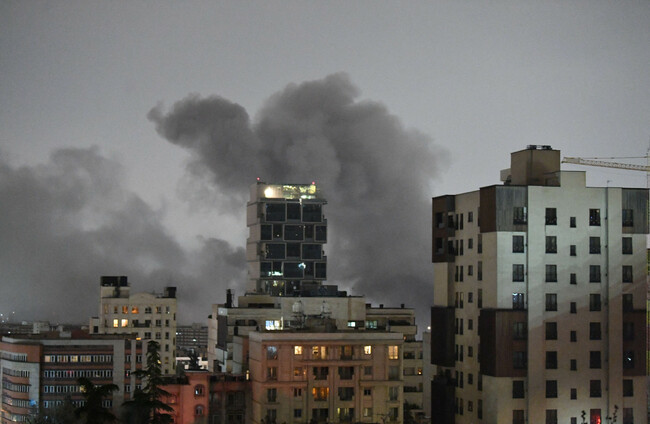
Smoke billows after explosions heard in Tehran, Iran, 28 March Alamy Stock Photo

Israel hits Iran naval research site as fresh blasts rattle Tehran

The fresh attacks came after Yemen’s Houthi rebels announced their entry into the Middle East war by launching a missile towards Israel.

THE ISRAELI MILITARY said it had struck an Iranian research facility for naval weapons, while a series of loud explosions rattled Tehran as night fell on Saturday.

The fresh attacks on the capital came after Yemen’s Houthi rebels announced their entry into the Middle East war by launching a missile towards Israel.

The intervention of Iran’s Yemeni allies is sure to spark concern about disruptions to Red Sea shipping, which would only compound the widening economic fallout from the effective closure of the vital Strait of Hormuz off Iran.

Israel’s military said today that it hit the headquarters of Iran’s Marine Industries Organisation during a wave of overnight attacks across Tehran, saying the facility developed “a wide range of naval weaponry, including surface and sub-surface vessels, (and) manned and unmanned equipment”.

An AFP journalist in Tehran reported intense explosions and a plume of black smoke overnight.

An Israeli military spokesman said attacks on Iranian military industry had intensified, and “within a few days, we will complete attacks on all critical components”.

This evening, another wave of blasts rang out in the capital for several minutes, though it was not clear what was targeted.

“I miss a peaceful night’s sleep,” an artist in Tehran told AFP, adding that the previous night’s strikes were “so intense it felt like all of Tehran was shaking”.

“We are powerless to change a government that kills, and we don’t want this war either. We just want a normal, simple life.”

Pakistan mediation

The conflict began when the United States and Israel launched airstrikes across Iran that killed supreme leader Ayatollah Ali Khamenei, engulfing the region in conflict, sending oil and gas prices soaring and prompting diplomatic efforts to halt the fighting.

Pakistan, which has been a go-between between US and Iranian officials, will host foreign ministers from regional powers Saudi Arabia, Turkey and Egypt in Islamabad on Monday for talks on the crisis.

Iran’s President Masoud Pezeshkian has thanked Islamabad “for its mediation efforts to stop the aggression”, and Germany’s Foreign Minister Johann Wadephul had said yesterday he expected a direct US-Iran meeting in Pakistan “very soon”.

US President Donald Trump’s special envoy Steve Witkoff said Friday he believed Iran would hold talks with Washington within a week. “It could solve it all,” he said.

With no end to the conflict in sight despite Trump’s optimism that US forces have obliterated Iran’s military, a spokesman for the Houthis released a video declaring that the group had fired ballistic missiles towards Israeli bases.

The Israeli military had said earlier it had “identified the launch of a missile from Yemen”, which was reportedly intercepted.

Red Sea shipping

During Israel’s recent war in Gaza the Houthis, claiming solidarity with the Palestinians, attacked shipping in the Red Sea and Gulf of Aden, forcing shipping companies to take costly detours.

Until today, they had sat out the latest conflict, even as the Red Sea shipping lane grew more vital.

Saudi Arabia has rerouted much of its oil exports via the Red Sea port of Yanbu to avoid the Strait of Hormuz, which Iran says it has closed to shipping from hostile powers.

With Hormuz all but impassable, many shipments to and from the Gulf have gone through the Omani port of Salalah, on the Arabian Sea, but Danish shipping giant Maersk said operations had been temporarily suspended there after a drone attack injured one worker and damaged a crane.

Iran’s military said today that it had targeted a US logistics vessel near Salalah. Oman said a drone attack on the port wounded a foreign worker.

Air travel has also been disrupted. Today, authorities in Kuwait and in the city of Erbil in Iraqi Kurdistan said airport facilities had been damaged in strikes.

Fire also broke out after Iranian missiles and drones hit the Khalifa Economic Zone Abu Dhabi in the United Arab Emirates, injuring six people. The firm Emirates Global Aluminium (EGA) reported significant damage from the attack.

In Iran, production was shut down at a major steel plant in the southwest after US-Israeli strikes, according to a statement from the Khuzestan Steel Company, cited by the Shargh newspaper.

Iran’s Revolutionary Guards have warned they will retaliate for economic damage by striking industrial sites across the region, after earlier warnings for US military bases and hotels hosting American troops.

The Guards also said they had found and dismantled more than 120 unexploded cluster bombs, alleging they were dropped during US and Israeli attacks several days ago on the southern province of Fars.

Pezeshkian sent a message to other countries in the region, warning: “If you want development and security, don’t let our enemies run the war from your lands.”

© AFP 2026 

Close
JournalTv
News in 60 seconds