We need your help now

Support from readers like you keeps The Journal open.

You are visiting us because we have something you value. Independent, unbiased news that tells the truth. Advertising revenue goes some way to support our mission, but this year it has not been enough.

If you've seen value in our reporting, please contribute what you can, so we can continue to produce accurate and meaningful journalism. For everyone who needs it.

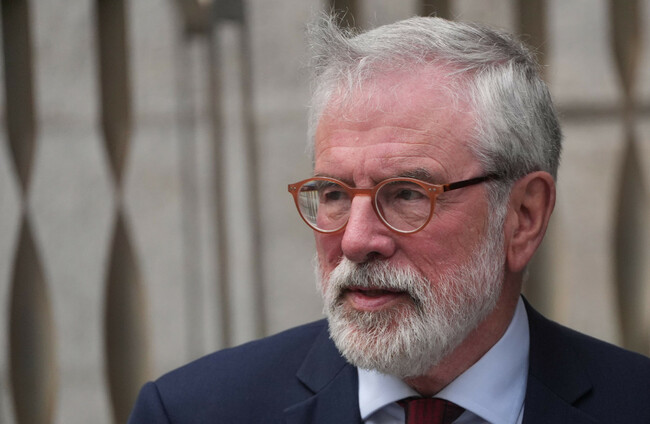
Gerry Adams pictured outside the High Court. PA

Judge tells jury in Gerry Adams libel trial not to give 'a verdict on Irish history’

The former Sinn Féin leader is suing the BBC over a claim in a documentary alleging that he sanctioned the murder of an MI5 informer in 2006.

JURORS IN THE Gerry Adams libel action against the BBC are not being asking to pass verdict on Irish history, a judge has said.

Delivering his instructions to the jury members today, Judge Alexander Owens told them they were not being asked to make a decision as journalists, but as “ordinary members of the public”.

In his charge to the jurors, the judge made clear they were not tasked with making a “historical judgment” on Adams’ role in the peace process.

“No jury, in my view, should be asked to give a verdict on Irish history,” he added.

Former Sinn Finn leader Gerry Adams alleges a BBC Spotlight programme, and an accompanying online story, defamed him by alleging he sanctioned the killing of former Sinn Féin official Denis Donaldson, for which he denies any involvement.

Donaldson was shot dead in Co Donegal in 2006, months after admitting his role as a police and MI5 agent for 20 years.

In the programme broadcast in September 2016, an anonymous source given the pseudonym Martin claimed the shooting was sanctioned by the political and military leadership of the IRA and that Adams “gives the final say”.

In 2009, the dissident republican group the Real IRA claimed responsibility for the killing and a Garda investigation into the matter is ongoing.

Adams claims he was subject to a “grievous smear” while the BBC has described the legal action as a “cynical attempt to launder his reputation”.

The high-profile republican is seeking damages of at least €200,000 from the BBC.

However, the British public service broadcaster has argued it would be a “cruel joke” to award the former Sinn Féin president any damages.

On Thursday, Declan Doyle, SC, for Adams, said damages awarded to his client should be “very substantial indeed”.

In his closing statement, Doyle said the “widespread circulation of a national broadcaster of an allegation of a cold-blooded cynical murder” could not be a defamation of anything other than “very serious or exceptional”.

The BBC has stood by the programme and has argued it was entitled to put forward matters raised in the documentary, which it says were of public importance and done in good faith.

The corporation has argued the meaning of the programme and article was not that Gerry Adams had sanctioned and approved the killing, and that the claim had to be taken in context of the whole report.

In his closing statement, Paul Gallagher SC, representing the BBC, said the claim made by Martin was presented as an allegation and was immediately followed by Adams’ denial, the claim of responsibility by the Real IRA and the state of the Garda investigation.

Gallagher also argued that the reputation of Adams is important for the case, contending that it was “universally held” that he had a reputation of being in the IRA and on its Army Council.

Adams denies ever being in the IRA.

On Friday, Justice Owens outlined the key issues in the case for the jurors.

On the issue of whether Adams has a bad reputation, the judge said the “onus of proof” was on the BBC to make that case.

He then referred to the evidence of a witness called by the BBC – former attorney general and Irish government minister Michael McDowell.

Earlier this week, McDowell told the court that Adams was “reputed to have become a member of the Army Council of the IRA”.

The judge said McDowell’s view and Adams’ view on the former Sinn Féin leader’s role in the peace process are “poles apart”.

“But if you come to assess damages in the trial, you’re not concerned with that, or to make a historical judgment on that, you do what the evidence tells you about Gerry Adams’ public reputation, about the reputation he enjoyed in 2006 and now, in relation to those matters,” he added.

He said an historical analysis and theory about the peace process was “irrelevant”.

“No jury, in my view, should be asked to give a verdict on Irish history,” he added.

The judge later emphasised to the jurors they were not being asked to adopt the mindset of a journalist or judge when making their decision.

“You’re asked, of course, to make the decision, not as journalists, but as ordinary members of the public, using your common sense,” he added.

Justice Owens is continuing his charge to the jury on Friday afternoon.

Close
JournalTv
News in 60 seconds