We need your help now

Support from readers like you keeps The Journal open.

You are visiting us because we have something you value. Independent, unbiased news that tells the truth. Advertising revenue goes some way to support our mission, but this year it has not been enough.

If you've seen value in our reporting, please contribute what you can, so we can continue to produce accurate and meaningful journalism. For everyone who needs it.

MEP urges reversal of Irish language sidelining in EU Parliament as Ireland's presidency looms

Agus Uachtaránacht na hÉireann ar an Aontas Eorpach ag teannadh linn, tá brú ag dul i dtreis mar gheall ar easpa ateangairí.

(This article is produced by our Gaeltacht team. You can read an English version of this piece here)

PRESSURE IS MOUNTING to bring an end to a derogation in the European Parliament that has been criticised for sidelining the Irish language due to a shortage of interpreters to translate Irish-language contributions from Irish MEPs, it emerged at a meeting held in Dublin yesterday.

Cynthia Ní Mhurchú, Fianna Fáil MEP for Ireland South, said she intends to raise the derogation on Irish — one that will remain in place until the end of the current parliamentary term in 2029 unless it is revisited — with the President of the Parliament, Roberta Metsola.

Irish has held the status of an official working language since 2022 and, officially, it and Maltese stand on an equal footing with the other 22 official working languages. However, MEPs in the previous Parliament voted to put in place a derogation that would restrict the services that could be provided until 2029.

As a result of this, interpretation is only available in the Parliament during plenary sessions in Strasbourg.  Twelve four day sessions are held annually with other part sessions being held in Brussels.   Irish language interpreters aren’t available for these 

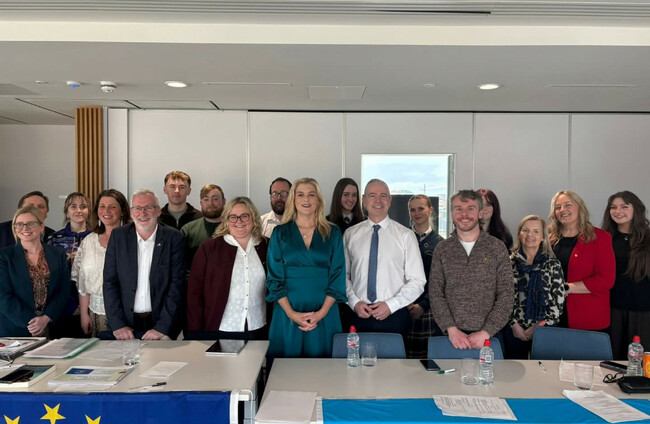
The MEP was speaking at a meeting she convened at the European Parliament Office in Dublin yesterday, at which representatives from the Parliament and Conradh na Gaeilge addressed attendees, and the Irish Language Commissioner from Northern Ireland was also among the speakers.

The meeting was focused on discussing the current shortage of interpreters and developing proposals to apply pressure on the European Union to adopt an alternative policy on Irish.

“Ireland’s Presidency of the European Council is a particular opportunity to make progress in moving Irish — which has been left on the sidelines in the European Parliament — towards the centre,” said Ní Mhurchú.

“The current derogation must be brought to an end in 2029 and the Parliament must not be allowed to renew it as happened during the last mandate in 2024.”

The MEP said she was sending a letter to the President of the Parliament, Roberta Metsola, to raise the issue with her, and that a delegation of senior officials from the Parliament would be returning to Dublin in May to meet with Irish Government officials and politicians from the various parties to apply pressure regarding the case for Irish and to seek the cancellation of the derogation on the language.

During yesterday’s meeting, Dáithí Mac Carthaigh, Legal Language Officer in the Irish Language Unit of the Parliament’s Translation Service, indicated that three interpreters would be needed in order to provide a service through Irish at plenary and committee meetings of the Parliament. In total, eleven people would be required in the unit, including six translators.

“When committee meetings are taking place, that is where the bulk of the work is done — similar to the committee stage in the Dáil and the Seanad,” he said.

“Those amendments are not made available in Irish; they are made available in the other languages,” he said. He also confirmed that interpretation is not available in Irish for committee meetings.

Another speaker at the meeting indicated that ten Irish-speaking interpreters in total are employed between the Commission and the Council of Ministers.

Earlier this week, a delegation from DG LINC — the European Parliament directorate responsible for organising conferences and providing interpretation services — visited Connemara, where they called to the offices of the Language Commissioner, Údarás na Gaeltachta, and at the headquarters of the Department of Rural and Community Development and Gaeltacht Affairs in An Forbacha.

Following that meeting, a spokesperson for the Department confirmed to The Journal that a working group has been established, on which representatives from the Department and the Directorate will sit, with the aim of finding a resolution to the question of interpreters. 

The Journal’s Gaeltacht initiative is supported by the Local Democracy Reporting Scheme


Readers like you are keeping these stories free for everyone...
A mix of advertising and supporting contributions helps keep paywalls away from valuable information like this article. Over 5,000 readers like you have already stepped up and support us with a monthly payment or a once-off donation.

Close
Comments
This is YOUR comments community. Stay civil, stay constructive, stay on topic. Please familiarise yourself with our comments policy here before taking part.
Leave a Comment
    Submit a report
    Please help us understand how this comment violates our community guidelines.
    Thank you for the feedback
    Your feedback has been sent to our team for review.

    Leave a commentcancel

     
    JournalTv
    News in 60 seconds