We need your help now

Support from readers like you keeps The Journal open.

You are visiting us because we have something you value. Independent, unbiased news that tells the truth. Advertising revenue goes some way to support our mission, but this year it has not been enough.

If you've seen value in our reporting, please contribute what you can, so we can continue to produce accurate and meaningful journalism. For everyone who needs it.

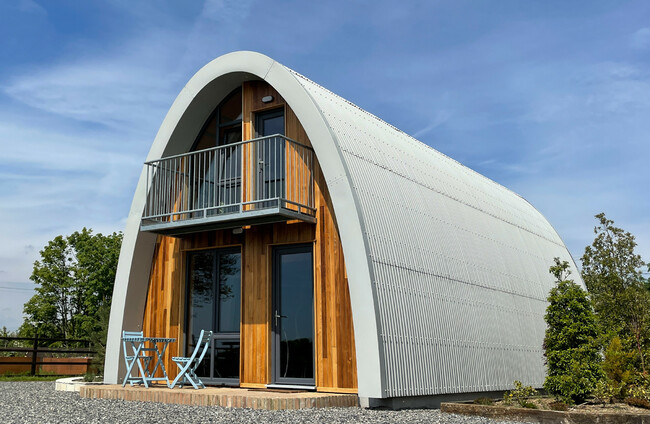
Aviator Haus Exterior

This craftsman hand-built his own aviation-inspired home, now he's creating modular lodges

Designer and leatherworker Garvan de Bruir draws inspiration from his home to design a stylish modular lodge with the potential to upscale for others an an ‘Additional Dwelling Unit’.

Ruth Maria Murphy. Ruth Maria Murphy.

Kildare-based designer and craftsman Garvan de Bruir is best known in design and fashion circles as the maker of exquisite leather bags and accessories. What’s less well known, perhaps, is that he works in a variety of materials and at different scales – as revealed in the creation of his handmade ‘Aviator Haus’ as well as much of the furniture and fixtures therein. Having designed and built his own home, he tells Ruth O’Connor about his ‘Aviator Lodge’ – an exciting template for a modular home or studio.

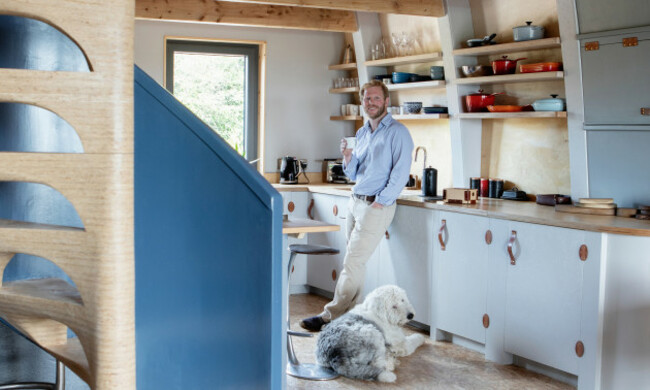
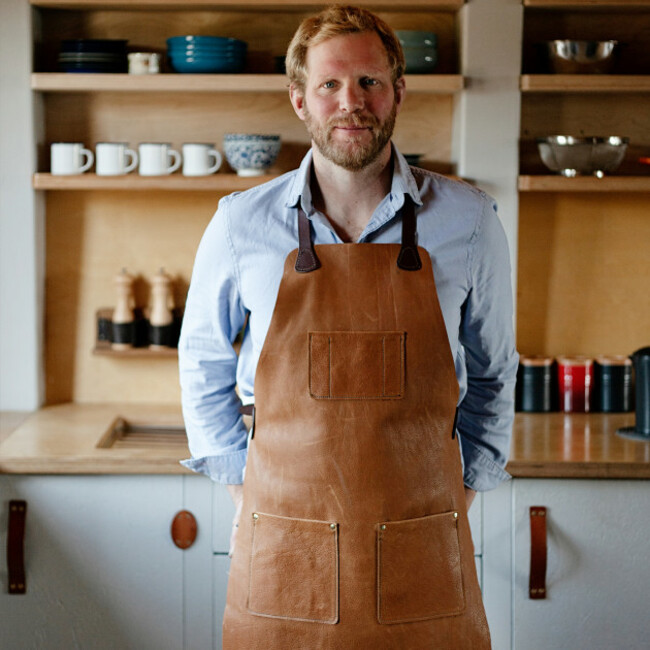
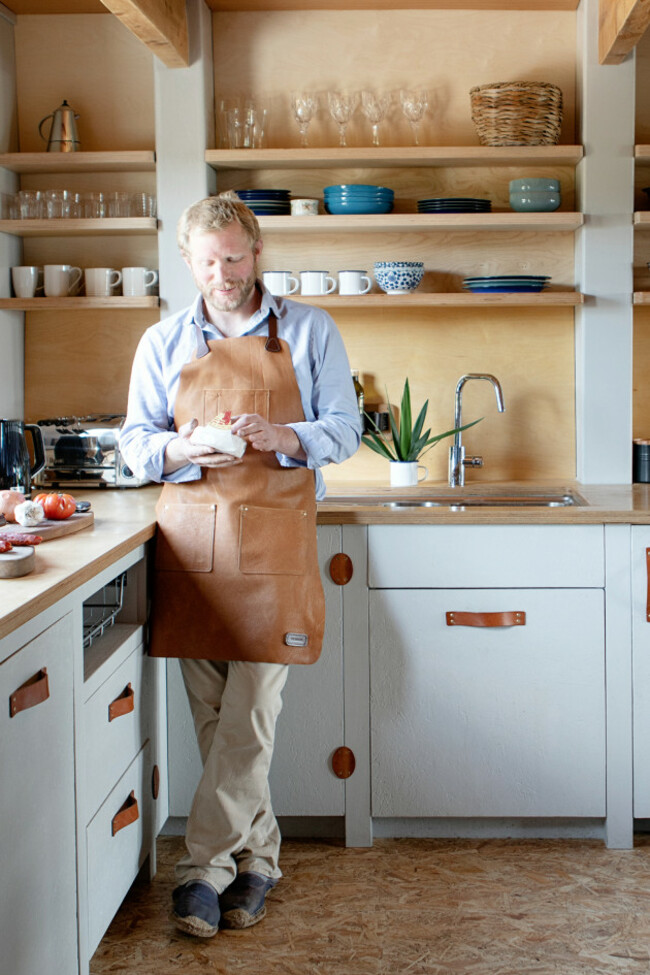
DE BRUIR Haus - Interiors (Ruth Maria Murphy) Crop 31 Designer and craftsman Garvan de Bruir in the handmade kitchen of his self-built house in Kildare. Ruth Maria Murphy. Ruth Maria Murphy.

Garvan’s formal training began at Buckinghamshire New University High Wycombe in the “old furniture making heartland of the UK”. “The emphasis at university was on furniture design in decorative hardwoods, but really it gave us a working knowledge and appreciation of many craft materials and techniques,” says Garvan. “Cast metals were a feature of my work for a period of time and I often used leather to upholster a chair or finish a complete table top.”

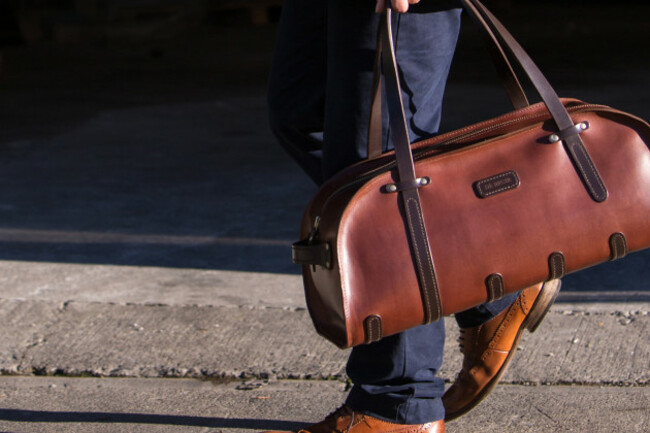
DE BRUIR Atelier - Lifestyle 14 (1) De Bruir's handcrafted Aviator bag. Cormac Dunne. Cormac Dunne.

The skills learned at university he says he still uses today: “Really the skills I use to make the templates for my leather bags today are an evolution of the patternmaking I once learned for upholstery,” he says. “As a designer-maker, you can consider any built object as a structure – a table or chair has to stand and bear a load, a bag hangs and also bears a load.”

Garvan’s business originally began as a broad artisan studio making bespoke furniture and installations in wood and leather. He made a number of leather bags for himself which gained attention and he began to list them for sale online. This was in the early days of online retail and craft websites like Etsy.com, and, with orders coming in from across the world, his handmade leather bags began to dominate his making schedule.

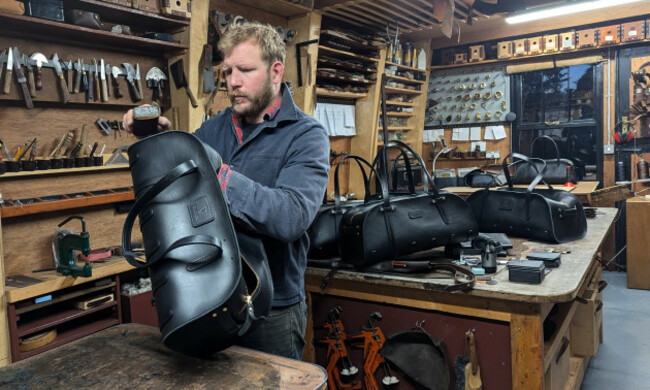
DE BRUIR Desktop - Guinness 26 Working on a range of limited edition bags for Guinness at his Co. Kildare workshop. Garvan de Bruir. Garvan de Bruir.

One of his early popular products was a handmade leather backpack ‘The Parachuter’ bag. “A once-off order from a company called AVIREX, the makers of the classic flight jacket made famous by Tom Cruise in Top Gun, really made me take the idea of bag-making seriously,” he says and for a short period of time Garvan saw his leather bags on sale in stores in Milan and Bologna.

Unlike classic luxury Italian leatherworkers, however, the Irish designer was using heavy duty sewing machines and thick bridle leathers influenced by his Co. Kildare location and the skills practiced by local saddle makers. These materials and construction style would begin to determine a very particular aesthetic for his bags and help his DE BRUIR Atelier to develop its own distinct identity. At the other end of the scale, meanwhile, Garvan’s skills in furniture and woodworking were also evolving into ideas for a large-scale building design project – his own handmade home.

DE BRUIR Haus - Interiors (Ruth Maria Murphy) 64 Some of Garvan de Bruir's own clothing, furniture and accessory designs. Ruth Maria Murphy. Ruth Maria Murphy.

Following his degree, Garvan had trained with furniture maker Philip Koomen in Oxfordshire where he was heavily influenced by Koomen’s sustainable use of local hardwoods.  Returning to complete an MA in Furniture Design, his own spin on sustainability was to focus on the consumption of materials and it was during this time that he began to home in on the use of shape and engineered construction techniques to create structures that are economical as possible from an environmental perspective.

The location of his training has been significant in his work and has heavily influenced both the methods and motifs in his designs. “The old furniture factories in High Wycombe had all been drafted into Britain’s war effort. In the old Ercol factory you could even see the spindles on the wall where hand-shaped wooden propellers were tested for balance during the making process,” he says.

“Most significant though, was the local involvement in the all-timber DeHavilland Mosquito -  a fighter bomber from 1942 whose components were completely made by furniture makers in the area,” he says. “Moving from metal back to wood to construct an aircraft seemed like a retrograde step, but the strength and comparable lightness of the plywood they used made a revolutionary aircraft that was even faster than the Spitfire. I loved that furniture-making techniques could create the ‘monocoque’ fuselage of the airplane and that the tensile forces within the curving timber generated immense strength.”

In an architectural context, achieving great strength, while being economical with materials, held great potential for Garvan in the design of his own sustainable, airplane-inspired home. “The house is essentially a jigsaw of parts,” he says. “The very large component parts could be prefabricated at the workshop alongside my other projects and stored as each component was made. In theory the house was a rapid build but self-funding gave it more of a slow and steady approach. However the method I developed, and which is echoed in my new lodge design, was the concept for a modular unit with the potential for quick on-site assembly.”

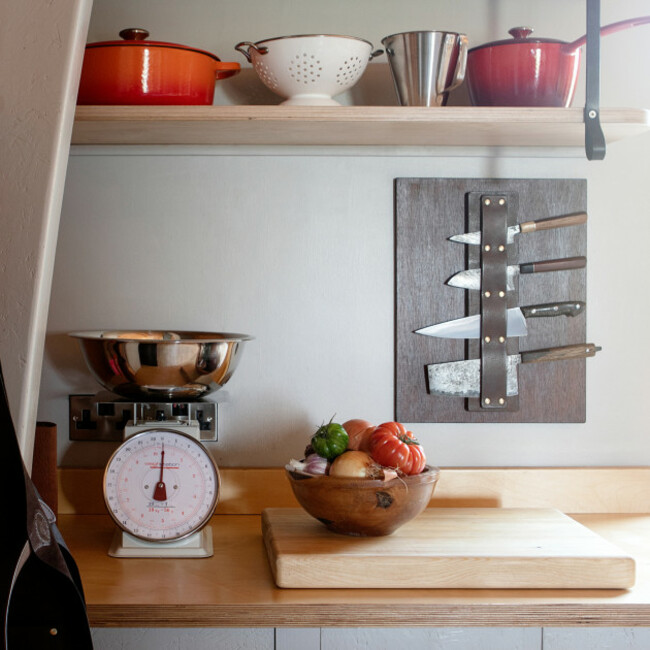
DE BRUIR Haus - Interiors (Ruth Maria Murphy) Crop 16 Elements of leather appear throughout the house - seen here to corral knives in the kitchen. Ruth Maria Murphy. Ruth Maria Murphy.

The interior of the Garvan’s home is also characterised by built-in cabinetry, a handmade staircase and beautiful furniture items made by the maker’s hands. His trademark leather also features – as the hinges of cupboards, the handles of doors and even to hold knives in place on the kitchen wall. 

Ever modest about his design and making skills, Garvan says that the interior fit-out originally focused on “functionality more than comfort” but has “become more homely over the years”.  “The build features a lot of Smartply OSB for its structure as well as for the interior fit out. It’s a product from Coillte and therefore a local Irish material,” he says. “All of the larger OSB offcuts got used to stack-laminate the spiral staircase inside, and, of course, it was just convenient to use leather to make all the cupboard hinges and handles.”

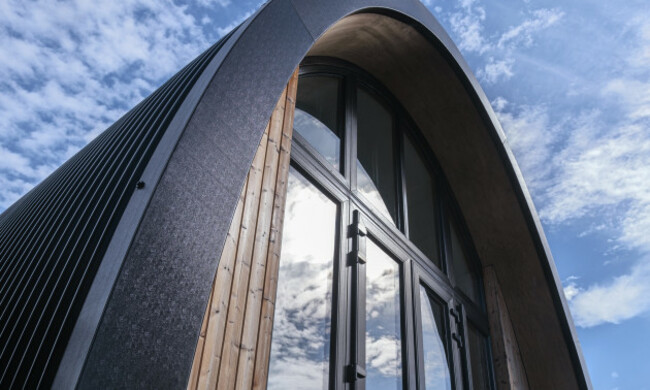
Aviator Lodge Exterior - B14 An external shot of the new 'Aviator Lodge' design which draws inspiration from the original two-storey house. Seoirse O'Mahony. Seoirse O'Mahony.

Having completed his own home, Garvan has now created a single storey lodge which has the potential to be rolled out as an exciting alternative to other modular buildings on the market at a time when the government is considering changing the legal restrictions around modular homes/ buildings. 

“The Aviator Haus has been very satisfying to live in over the past few years,” the designer says of his own home. “The two-up, two-down layout works nicely. It’s great to be surrounded by wood and the cocoon-like shape when you’re upstairs is particularly pleasing. 

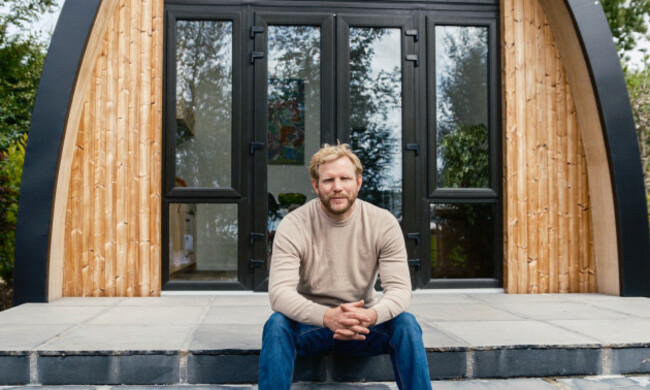
Aviator Lodge Exterior - B25 Garvan outside his Aviator Lodge - the design of which, he believes, has potential to be rolled out as a beautifully designed modular building or Additional Dwelling Unit (ADU). Seoirse O'Mahony. Seoirse O'Mahony.

Investigating the concept further, Garvan has now created a single storey lodge which has the potential to be rolled out as an exciting alternative to other modular buildings on the market at a time when the government is considering changing the legal restrictions around modular homes and detached buildings in back gardens. 

 “At 30sqm, the prototype lodge design has the ‘Additional Dwelling Unit’ potential for adding space to a family home and garden. With a few more design refinements, it’s close to being a finished product that could offer people a design-led modular dwelling or office solution,” says the designer.

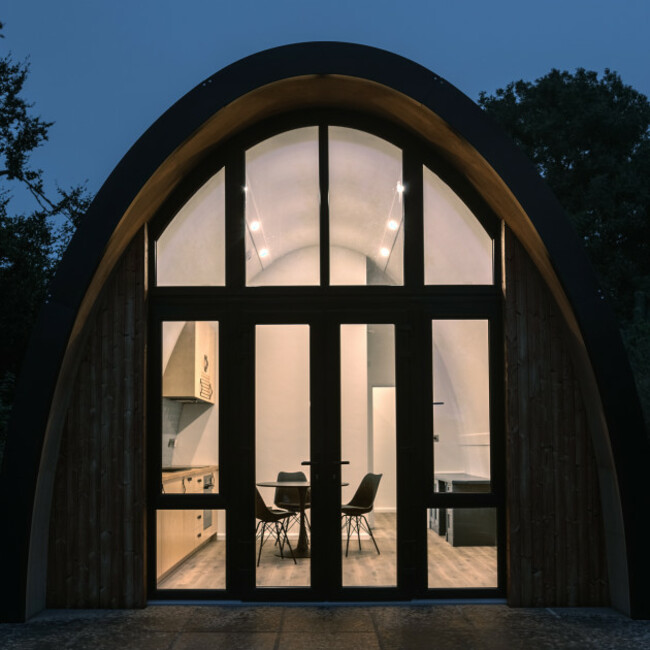
Aviator Lodge Exterior - S41 The Aviator Lodge at night. Seoirse O'Mahony. Seoirse O'Mahony.

And the Aviator Lodge is very much design-led: despite having a relatively small floor area, inside there is a dramatic sense of space generated by the tall curving interior. From the outside, particularly when illuminated in the evening, it surpasses most expectations of ‘modular’ architecture. 

Notebook:

To find out more about De Bruir leathergoods go to debruir.com and for more information on the Aviator Haus visit AviatorHaus.com.

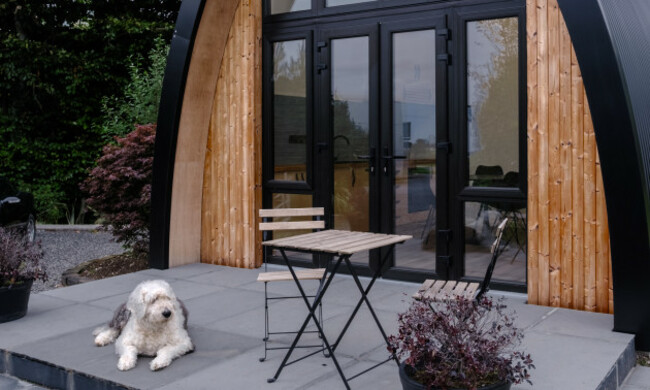
Aviator Lodge Exterior - B43 The designer's Old English Sheepdog Ralph outside the newly built lodge. Seoirse O'Mahony. Seoirse O'Mahony.

Close