Sign in. It’s quick, free and it’s up to you.
An account is an optional way to support the work we do. Find out more.
Sign in. It’s quick, free and it’s up to you.
An account is an optional way to support the work we do. Find out more.
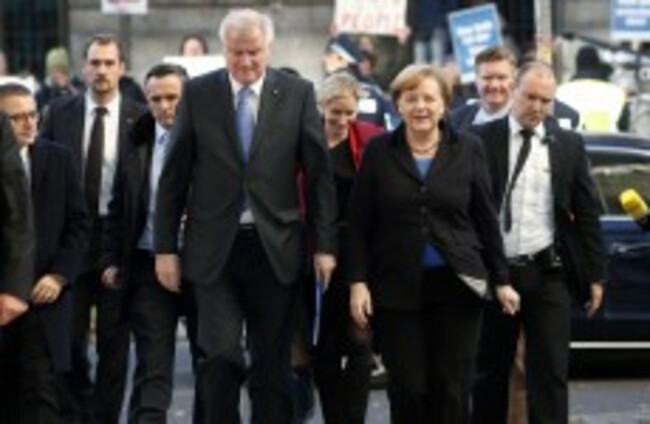
GERMAN CHANCELLOR ANGELA Merkel agreed Wednesday to form a coalition government with campaign rivals the Social Democrats, two months after her conservatives won elections but fell short of a full majority.
Merkel’s Christian Democratic Union (CDU), their Bavarian allies the CSU and the centre-left Social Democratic Party (SPD) held 17 hours of marathon talks before bleary-eyed party leaders delivered the deal before dawn.
In the tense final round of talks that capped five weeks of political horse-trading, the SPD scored key concessions, including a national minimum wage from 2015, while Merkel stuck to her guns on her own red-line issues, blocking higher taxes for the rich and opposing new debt.
The chancellor hopes to be sworn in for a third term on December 17 as leader of Europe’s biggest economy, but a key hurdle remains: a binding SPD membership ballot next month must still sign off on the proposed left-right “grand coalition”.
“We negotiated hard till the end,” said SPD general secretary Andrea Nahles, emerging from the Berlin talks in the early hours, and adding that “for us it’s a package that, I believe, we can present to our members”.
“The result is good for our country and carries a strong Christian-Democratic imprint,” said CDU secretary general Hermann Groehe, while his CSU counterpart Alexander Dobrindt voiced satisfaction that “all our key elements are reflected in the coalition contract”.
Despite the late-night breakthrough, another political nail-biter looms in coming weeks.
The outcome of the SPD rank-and-file postal ballot, expected 14 December, remains far from certain because many party members reject the notion of their traditionally blue-collar party again governing in the shadow of powerful Merkel, as it last did in 2005-09.
SPD chief Sigmar Gabriel, who would be Merkel’s vice chancellor, hopes to convince the base of his 150-year-old party with the policy trophies his team has wrested from the conservatives.
Negotiators have only said that the CDU and SPD are set to get six ministerial posts each, and the CSU three.
In the protracted talks, the SPD scored a victory on its core demand, a minimum wage of €8.50 an hour from early 2015 to help the country’s army of working poor, despite the CDU/CSU’s fear that it will cost jobs.
The SPD also pushed through a demand for a 30 percent women’s quota on the boards of listed companies to be phased in from 2016, and the scrapping of a ban on dual nationality, a key demand of Germany’s large Turkish immigrant community.
Both sides also agreed on pension increases to protect retirees in rapidly ageing Germany, and to boost financing for education.
Bavaria’s CSU also brought home the bacon on its own pet issue — charging foreign drivers a toll for using Germany’s famed autobahn highways, as long as this is in line with EU rules.
Merkel, Gabriel and CSU chief Horst Seehofer were due to present details of the more than 170-page coalition deal at 11am today.

To embed this post, copy the code below on your site








have your say