Sign in. It’s quick, free and it’s up to you.
An account is an optional way to support the work we do. Find out more.
Sign in. It’s quick, free and it’s up to you.
An account is an optional way to support the work we do. Find out more.
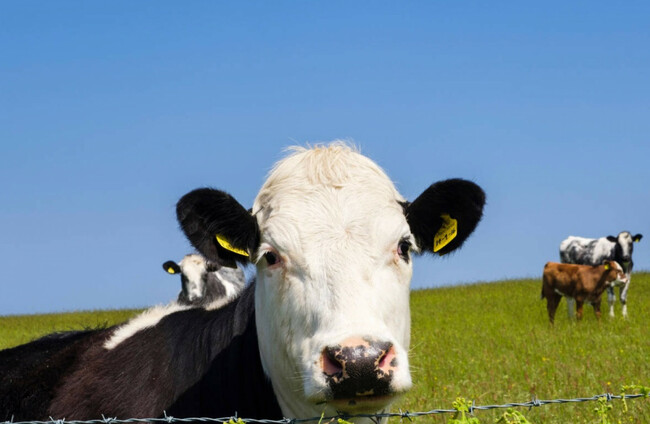
LEVELS OF NITROGEN – the chemical that can be highly damaging for Ireland’s rivers – are going in the wrong direction and have jumped by 16% this year.
That’s according to the latest research by the Environmental Protection Agency (EPA) which compared the concentration of nitrogen in rivers for the first six months of this year with last year.
The results indicate a backsliding following improvements seen last year.
This comes at a crunch time for the government and Irish farming as they face changes to its derogation from EU nitrates limits – a key exception that allows farmers keep denser cow herds.
It is set to expire for Ireland – impacting around 7,000 farmers – later this year.
Speaking on RTÉ’s Morning Ireland, Agriculture Minister Martin Heydon said the government was determined to have the derogation extended for Ireland in its talks with the European Commission.
“We are working really, really intensively to tell that story around the efforts we’re making, the ongoing efforts that our farmers are taking, the positive impact that’s having, and the fact that we need time to implement a new approach here that they’re looking for,” Heydon said.
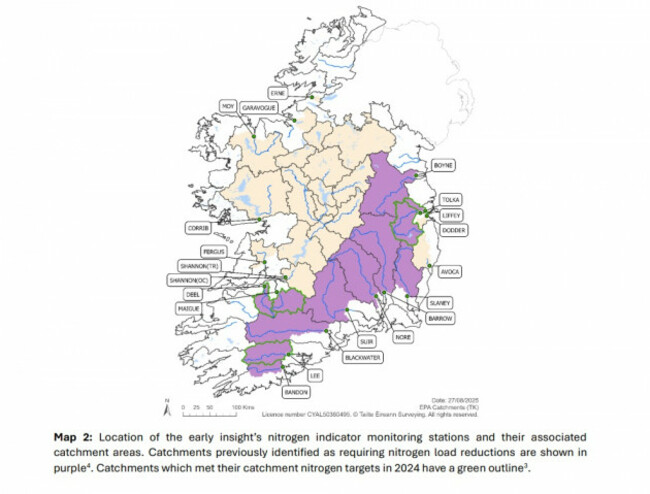
The EPA said that nitrogen “remains too high” in the south-eastern half of the country and warned that further action will be needed to reduce concentrations to levels that support healthy ecosystems.
Under the EU Nitrates Directive, farmers can’t allow the total amount of nitrogen from organic manure applied to their land to exceed 170 kilograms per hectare annually.
Too much nitrogen in a river can lead to the over-growth of algae that cause damage to other flora and fauna, and deplete oxygen in the river overall.
While the EPA said it accepted that significant work is underway in agriculture to reduce nitrogen levels, it stressed that the “scale and pace” of action needs to increase.
Commenting on today’s publication of the latest results, EPA director Dr Eimear Cotter said that it was disappointing to see this increase in nitrogen levels for the first six months of 2025 following reductions in 2024.
“It is important that the sector implement sustained actions to reduce nutrient losses in a targeted way,” Cotter said.
Year-on-year, the EPA said nitrogen levels fluctuate due to agricultural land management and weather patterns, as heavier bouts of rain can cause a runoff into rivers. It added agriculture is the “primary source” of nitrogen in our waters.
The issue of water quality arose again last month following a mass fish kill in Co Cork, which remains under investigation by a number of State agencies.

To embed this post, copy the code below on your site














have your say