We need your help now

Support from readers like you keeps The Journal open.

You are visiting us because we have something you value. Independent, unbiased news that tells the truth. Advertising revenue goes some way to support our mission, but this year it has not been enough.

If you've seen value in our reporting, please contribute what you can, so we can continue to produce accurate and meaningful journalism. For everyone who needs it.

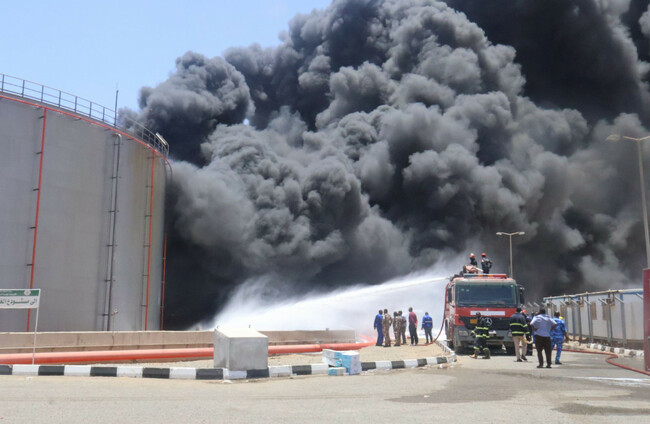
Firefighters battling a fire at a fuel depot in Port Sudan after the strikes Alamy

Paramilitary drone strikes hit airport and knock out power in Sudan city

Air traffic was halted at the war-torn country’s only airport still handling international civilian flights.

DRONES STRIKES HIT an airport and knocked out power in the city of Sudan Port, the third straight day the Sudanese army-aligned government’s seat of power has come under attack.

The strikes, which also targeted an army base, come a day after the country’s main fuel depot was hit, causing a massive blaze just south of the eastern city which had until Sunday been considered a safe-haven for hundreds of thousands of displaced people fleeing the two-year war.

Loud explosions were heard at dawn and plumes of smoke were seen over the Red Sea coastal city, with one blast heard from the direction of the port and another from a fuel depot just south.

One drone hit “the civilian section of the Port Sudan airport”, an airport official told AFP, two days after the facility’s military base was first attacked in drone strikes the army blamed on the paramilitary Rapid Support Forces.

Air traffic was halted at the war-torn country’s only airport still handling international civilian flights, the source said.

Another drone targeted the main army base in the city centre, an army source said, and witnesses said a nearby major hotel was hit.

Both sites are close to the residence of army chief Abdel Fattah al-Burhan, who has been at war with his former deputy Mohamed Hamdan Daglo, the RSF commander, since April 2023.

A third drone hit a fuel depot near the southern port in the densely populated city centre, where the UN, aid agencies and hundreds of thousands of displaced people have relocated from Khartoum.

Later in the morning, drones hit Port Sudan’s main power substation, the national electricity company said, causing a blackout across the city.

A third drone hit a fuel depot near the southern port in the densely populated city centre, where the UN, aid agencies and hundreds of thousands of displaced people have relocated from Khartoum.

AFP photos showed thick black smoke billowing over Port Sudan’s skyline after the strikes.

Witnesses in the city’s north reported anti-aircraft fire from a military base. There were no immediate reports of casualties.

The attacks have disrupted daily life in the city.

Car queues stretched for more than a kilometre outside the few fuel stations still operating as motorists scrambled to fill their tanks amid growing fears of supply disruptions.

The RSF has increasingly relied on drones since losing territory including nearly all of Khartoum in March, attacking deep into army-held territory.

Yesterday, UN chief Antonio Guterres said reports of paramilitary attacks on Port Sudan were a “worrying development threatening the protection of civilians and humanitarian operations”.  

Nearly all humanitarian aid into Sudan, where famine has already been declared and nearly 25 million people suffer dire food insecurity, arrives through Port Sudan.

From the airport, where Sudanese airlines had resumed flights after the first drone strike on Sunday, “fires broke out in multiple buildings” following the latest explosion, a traveller told AFP.

The army source said that strike had also “targeted fuel depots at the airport”.

The RSF has in recent weeks attacked civilian infrastructure across the army-controlled northeast, causing widespread blackouts for millions of people.

Sudan’s war has killed tens of thousands of people, uprooted 13 million and created the world’s largest hunger and displacement crises.

It has effectively split the country in two, with the army controlling the centre, north and east while the RSF holds nearly all of the vast western region of Darfur and, with its allies, parts of the south.

According to experts, the RSF’s increased reliance on drones after it lost Khartoum serves to both telegraph its reach and hinder the army’s supply lines.

Egypt, which shares a border with Sudan, condemned the latest attacks. It warned of “the danger of the latest escalation” and its severe impact on “ceasefire efforts, protection of civilians and boosting the delivery of humanitarian aid” to Sudan.

© AFP 2025

Close
JournalTv
News in 60 seconds