We need your help now

Support from readers like you keeps The Journal open.

You are visiting us because we have something you value. Independent, unbiased news that tells the truth. Advertising revenue goes some way to support our mission, but this year it has not been enough.

If you've seen value in our reporting, please contribute what you can, so we can continue to produce accurate and meaningful journalism. For everyone who needs it.

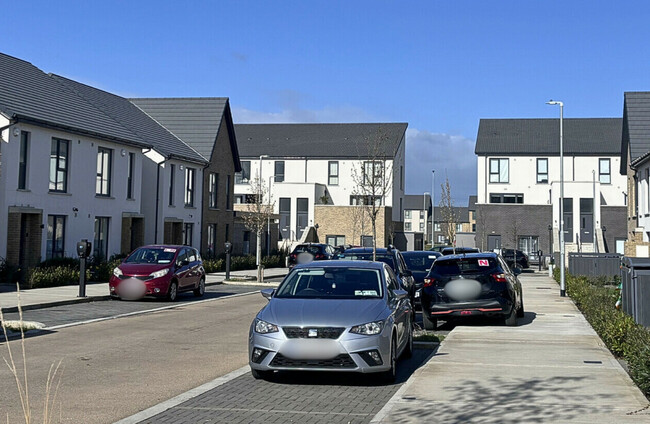
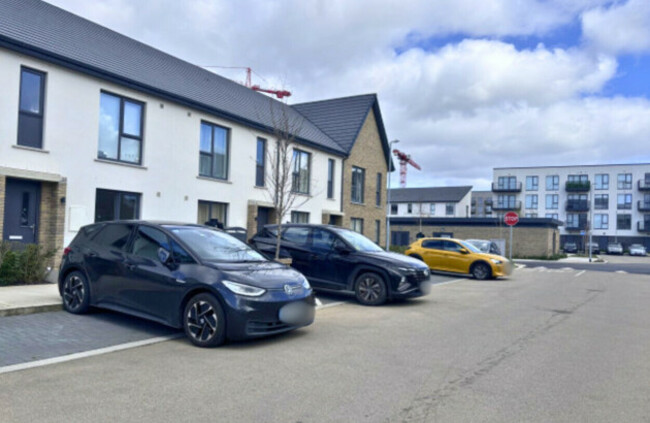
Residents are trying to squeeze two parking spots out of one in many cases in Seven Mills, West Dublin. The Journal

'People are keying cars and letting air out of tyres': The war over parking in new estates

Inadequate public transport coupled with government policy to reduce car spaces has led to war among neighbours in many of Ireland’s newest housing estates.

RESIDENTS IN NEW-build housing estates across Dublin and surrounding commuter belt towns say there is increasing tension in their communities over a lack of adequate car-parking facilities. 

In some instances, residents have reported cars being keyed and air being let out of tyres due to the parking disputes, while some homeowners have opted to install cameras to monitor their assigned parking spots. 

The tension is down to planning policy, which increasingly restricts the number of parking spaces allowed in new developments on the assumption that residents will rely more on public transport – but residents say transport services have not kept pace and are overcrowded and too infrequent. 

Some parts of Dublin have just over half a car parking space designated for every new home. 

In south-west Dublin, Seven Mills has been marketed as one of the country’s newest towns. The pretty rows of houses, apartment blocks and duplexes are a short walk from Clondalkin Fonthill train station, where trains can get residents to the city centre during rush hour in under 30 minutes. 

But for many residents, capacity issues on the train and an infrequent service outside of core commuting times mean that a car is still a necessity. 

When The Journal went to the area this week to speak to residents, the issues with parking were immediately visible. 

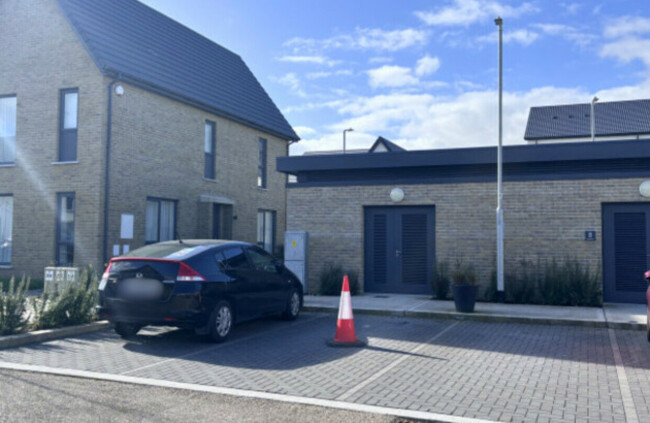
Many houses and duplexes had red traffic cones in place beside their front doors, ready to be used to secure their parking spots when leaving home, while lots had CCTV cameras placed on their windowsills, keeping a watchful eye over the comings and goings of the well-manicured streets. 

Seven Mills blurred 2 (2) The Journal The Journal

On a number of streets, cars parked horizontally in parallel spots in an effort to squeeze two spots out of one.

Lorna McEvoy is one such homeowner who has resorted to installing CCTV over the parking issue. 

She and her fiancé bought a house in the development for €480,000, moving in just over a year ago. 

The initial excitement of owning their first home quickly wore off as the issues with parking came to light. 

McEvoy and her partner paid extra to get what was sold to them as “exclusive” use of two parking spaces – but due to what she described as a poor parking management system and a shortage of spaces, they often come home to find their spots have been taken by other residents whose properties did not come with designated parking.

Respond, the approved housing body that manages the social and cost-rental housing units in the estate, has a permit parking and clamping system in place, but only for the spots under its remit. 

McEvoy said that she frequently sees people on her CCTV camera parking in the spots assigned to her home, and then going into the Respond apartments. 

“So what’s happening is people are moving into the apartment blocks, they might register one car with Respond and get a permit for one car, but they might have two or three cars. So to save themselves from getting clamped, they’re then parking in the private homeowner spots where cars can’t be clamped. It’s insane, and it’s just causing so much tension,” McEvoy explained. 

Local TD and Sinn Féin housing spokesperson Eoin Ó Broin told The Journal that it is an issue he has received a series of complaints about.

Ó Broin argued that these different parking arrangements for social or cost-rental tenants versus private homeowners are inequitable and unacceptable. 

Under the government’s national planning framework, car parking is more restrictive in higher-density housing developments. This is because they are typically close to high-frequency public transport links.

“The problem, however, is that the public transport facilities are nowhere close to meeting the needs of the increased residential population,” Ó Broin said.

“So if you take Adamstown, for example, yes, it’s on the train line, but the trains are full by the time they get to Adamstown city-bound at rush hour. And the Dart+ South West extension is delayed by another five years.

“So the difficulty is, the logic of the car parking in the planning scheme is dependent on the provision of public transport, but the public transport isn’t being provided, and that’s leaving people in very, very difficult situations.”

McEvoy and other residents in Seven Mills have reached the point where they are now exploring what legal recourse they may have against the developer of the estate. 

“The only sort of outcome that the management company has got to is to potentially put signage on the car parking spaces. But it will have to be on the actual paving; they can’t put them on the kerbs, because South Dublin County Council owns the kerbs,” McEvoy said, adding, however, that she doesn’t believe signage alone will solve the problem. 

“We’re all just so deflated by it,” she said.

The issue has become so contentious that some cars have even been keyed, and others have had their tyres deflated over disputes. 

A special WhatsApp group for the estate has been set up to deal specifically with the parking issues. It has 400 members, with messages posted daily asking for cars to be moved. 

McEvoy said the situation is so stressful that one year on from moving in, they now “hate” living there.

“And it’s solely to do with the parking.

“I work in James’s Hospital, so it would be ideal for me to get the train into work, but like, half the time you can’t even get onto the bloody train because it’s packed.

“So there’s your public transport.

“We wouldn’t have bought this house if it didn’t come with parking. We used the Help to Buy grant, and there’s a bit of a claw back with that when you go to sell, so we’re like, okay, four years time we can sell this house and get out of here. It’s terrible,” she said. 

Pradeep and Nisha Kandel, who also live in Seven Mills with their young family, told The Journal that they are experiencing the same issues as a result of poor public transport infrastructure and a shortage of parking spaces. 

They are a one-car family who wish they could be a two-car family because they find the public transport in the area does not work for their lifestyle needs. 

Because the trains are so infrequent outside of rush hour, Pradeep told The Journal he often ends up staying at home with the kids when he is finished work and while his wife is at work. 

A few rows over, Jonathan, who preferred to just give his first name, keeps a red traffic cone outside the front door of his duplex. 

“Every time I go out, I get my cone and put it in my spot,” he said. 

“It is a pain, but it’s worse for the house owners. We have a community WhatsApp to try and resolve it, but people don’t care.

“Sometimes there are fights in the WhatsApp and in person.” 

Seven Mills blurred 3 Residents in Seven Mills use traffic cones in an effort to stop others parking in their spots. The Journal The Journal

It’s not just an issue in this part of Dublin: over in Shankill, residents in Shanganagh Castle estate report the same problems. 

Local TD and People Before Profit leader Richard Boyd Barrett told The Journal that the parking issue was one flagged by public representatives at the planning stage of the estate, but the concern was ignored. 

“If we had adequate public transport infrastructure, this would be less of a problem, but we’re still well short of all that. And in the case of Shanganagh, although there is Dart access, for those working who aren’t on the Dart line, the bus infrastructure is far from what’s needed in order to allow people to give up their cars,” he said. 

Likewise, People Before Profit councillor for Dún Laoghaire-Rathdown, Dave O’Keeffe, said while he understands the rationale behind reducing car parking, it isn’t yet a reality for everyone to be able to comfortably walk, cycle or get public transport to work. 

“The way it’s being rolled out is all stick and no carrot,” he said. 

A spokesperson for Dún Laoghaire-Rathdown County Council told The Journal that parking provision at the estate is limited and reflects the County Development Plan standards adopted in 2022, which provide for approximately 0.56 spaces per unit in new developments.

It said it is not responsible for parking arrangements within the estate, which are instead handled entirely by the owners’ management company.

Likewise, in relation to the issues at Seven Mills, a spokesperson for South Dublin County Council told The Journal that it has no role in the general management of car parking spaces within the development, and as such cannot comment on private purchase contracts, including any conditions relating to parking spaces.

A spokesperson for Cairn Homes said that it is aware of residents’ “frustrations”about parking at Seven Mills and that it is “actively engaging with South Dublin County Council, residents and the management company to assist in developing and implementing a solution”.

A spokesperson for Respond, the approved housing body, said it was aware of the concerns raised by some residents but that “parking arrangements in the development are ultimately a matter for the owners’ management company”.

Respond said discussions are ongoing about possible solutions and that it was recently agreed that plaques marking individual spaces would be put in place. 

“Housing and planning policies are deliberately encouraging a limited number of parking spaces relative to the number of homes within a development, the use of public transport, cycling, and higher-density housing to help address the housing crisis. This can create challenges at busy times,” the spokesperson said.  

The Department of Housing has washed its hands of the issue. A spokesperson told The Journal:  

“There is no role for this department in this matter and I suggest that you contact the local authority who has responsibility for traffic management bye-laws, Respond or the management company for a comment.” 

Asked what the solution is to these issues in new-build estates, Sinn Féin’s Eoin Ó Broin said it comes down to two things. 

Firstly, reviews are needed of car parking policy and parking ratios, particularly in higher-density developments. He noted that South Dublin County Council has agreed to one on foot of a motion taken by Sinn Féin councillors.

His second recommendation was for a comprehensive review of the issue at government level via the Department of Housing.

“It’s both central government and local government that need to work through this stuff, particularly as we’re getting an increased volume of higher-density, multiple-unit developments with significantly mixed tenure,” he said.

Readers like you are keeping these stories free for everyone...
A mix of advertising and supporting contributions helps keep paywalls away from valuable information like this article. Over 5,000 readers like you have already stepped up and support us with a monthly payment or a once-off donation.

Close
164 Comments
This is YOUR comments community. Stay civil, stay constructive, stay on topic. Please familiarise yourself with our comments policy here before taking part.
Leave a Comment
    Submit a report
    Please help us understand how this comment violates our community guidelines.
    Thank you for the feedback
    Your feedback has been sent to our team for review.

    Leave a commentcancel

     
    JournalTv
    News in 60 seconds