We need your help now

Support from readers like you keeps The Journal open.

You are visiting us because we have something you value. Independent, unbiased news that tells the truth. Advertising revenue goes some way to support our mission, but this year it has not been enough.

If you've seen value in our reporting, please contribute what you can, so we can continue to produce accurate and meaningful journalism. For everyone who needs it.

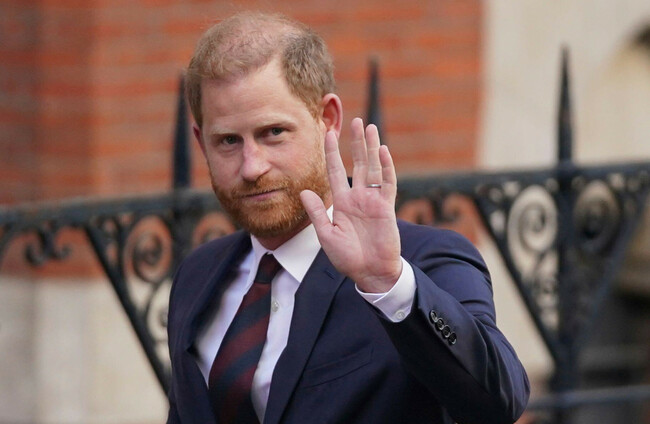
Prince Harry Alamy Stock Photo

Prince Harry wants reconciliation with family but says he 'doesn't know how much longer my father has'

He was speaking to the BBC in the aftermath of losing a Court of Appeal challenge over his security arrangements while in the UK.

LAST UPDATE | 2 May 2025

BRITAIN’S PRINCE HARRY has said he would “love a reconciliation” with his family but that his father, King Charles, won’t speak to him “because of this security stuff”.

Harry also said he did not want to fight with his family any longer because he does not “know how much longer my father has”.

He was speaking to the BBC in the aftermath of losing a Court of Appeal challenge over his security arrangements while in the UK.

CBS News / YouTube

A Buckingham Palace spokesperson said: “All of these issues have been examined repeatedly and meticulously by the courts, with the same conclusion reached on each occasion.”

But after today’s ruling, Harry said: “I can’t see a world in which I would bring my wife and children back to the UK at this point.”

“There have been so many disagreements between myself and some of my family,” he added.

Harry said he had now “forgiven” them and that while he would “love a reconciliation”, the dispute over his security had “always been the sticking point”.

He said the decision to remove his automatic security entitlement impacts him “every single day”, and that he can only safely return to the UK if invited by the Royal Family – as he would get sufficient security in those circumstances.

High Court appeal

Harry, 40, had appealed against the dismissal of his High Court claim against the Home Office over the decision of the Executive Committee for the Protection of Royalty and Public Figures (Ravec) that he should receive a different degree of protection when in the UK.

His barristers told a two-day hearing in April that he was “singled out” for “inferior treatment” and that Ravec did not follow its own “terms of reference” when deciding his security.

The Home Office, which is legally responsible for Ravec’s decisions, opposed the appeal, with its lawyers telling the court that a “bespoke” process was used for Harry and he had “no proper basis” for challenging Ravec’s decision.

In a ruling on Friday, Geoffrey Vos, Lord Justice Bean and Lord Justice Edis dismissed Harry’s appeal.

Reading a summary of the decision, Vos said: “The duke (Prince Harry) was in effect stepping in and out of the cohort of protection provided by Ravec.”

“Outside the UK, he was outside the cohort, but when in the UK, his security would be considered as appropriate.”

He continued: “It was impossible to say that this reasoning was illogical or inappropriate, indeed it seemed sensible.”

Vos also said Ravec’s decision was “understandable and perhaps predictable”.
The judge added that arguments from Harry’s barrister were “powerful and moving”, and that it was “plain that the duke felt badly treated by the system”.

But he continued: “I concluded, having studied the detail of the extensive documentation, I could not say that the duke’s sense of grievance translated into a legal argument for the challenge to Ravec’s decision.”

Harry was not present at Friday’s short hearing at the Royal Courts of Justice in London.
Ravec has delegated responsibility from the Home Office over the provision of protective security arrangements for members of the royal family and others, with involvement from the Metropolitan Police, the Cabinet Office and the royal household.

Last year, retired High Court judge Sir Peter Lane ruled that its decision, taken in early 2020 after the Duke and Duchess of Sussex quit as senior working royals, was lawful.

Harry attended both days of last month’s appeal against the ruling, where his barrister, Shaheed Fatima KC, said his safety, security and life are “at stake”, and that the “human dimension” of the case should not be forgotten.

She added: “We do say that his presence here, and throughout this appeal, is a potent illustration, were one needed, of how much this appeal means to him and his family.”

Judges were told Harry’s case was not that he should be automatically entitled to the same protection he was given as a working royal, and instead he should be subjected to the same processes as other people being considered for protective security, unless there was a “cogent” reason not to.

Lawyers for the Harry also said that Ravec did not get an assessment from an “expert specialist body” called the risk management board.

However, in the 21-page written judgment, Vos said he did not think Harry had been “able to demonstrate that the judge was wrong to determine” that Sir Richard Mottram, then chairman of Ravec, had “good reason to depart” from policy.

He said: “In this area of high political sensitivity, the court will inevitably have considerable respect for Mottram as a decision maker, whose expertise and experience in the field of royal protection is probably unrivalled.”

The judge also said that the decisions made “were not to deprive the claimant of all protection for all time”, adding: “The decision letter recorded that decisions would be made about the appropriate protection for him on a case-by-case basis when more was known about his visits to the UK.”

During the delivery of the summary of the Court of Appeal’s decision, loud noises thought to be from a nearby animal could be heard in the courtroom.

Close
JournalTv
News in 60 seconds