We need your help now

Support from readers like you keeps The Journal open.

You are visiting us because we have something you value. Independent, unbiased news that tells the truth. Advertising revenue goes some way to support our mission, but this year it has not been enough.

If you've seen value in our reporting, please contribute what you can, so we can continue to produce accurate and meaningful journalism. For everyone who needs it.

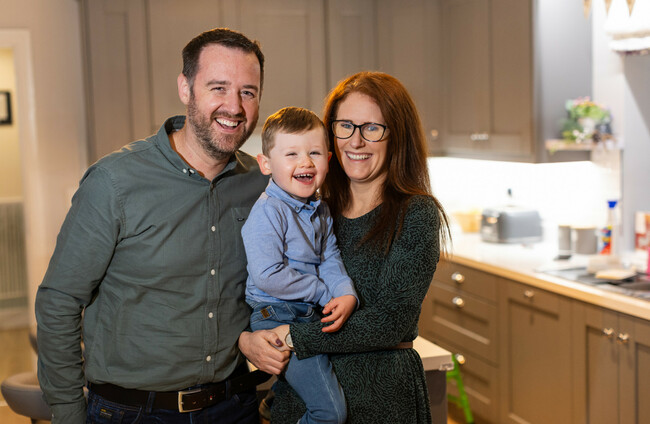
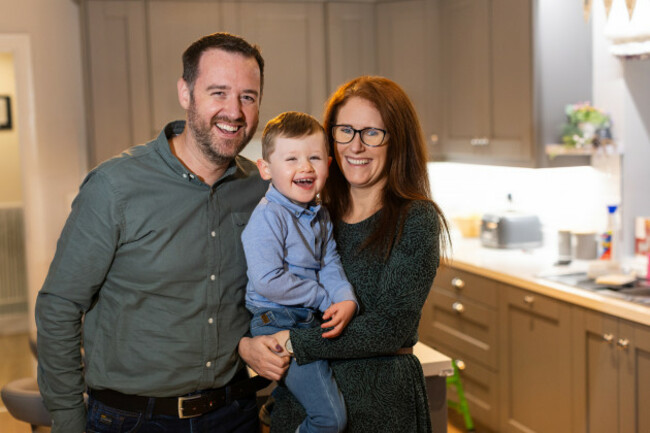
Ross and Caitriona McCarthy are parents to six-year-old Cian who lives with NARS1, an ultra rare neurological condition only discovered in 2021. Julien Behal

'You have to change your life': Irish parents on caring for their children with rare diseases

One in 17 people in Ireland live with rare diseases – and yet there is still a gap in awareness.

RARE DISEASES HAVE been brought to the forefront of Irish life this past week as 17 “changemakers” with different rare diseases – or supporting someone with a rare disease – have come forward to share their stories. 

This day last week Rare Ireland launched its campaign highlighting the lives of Irish people who live with a rare disease. It was launched by Irish rugby star James Lowe, who has Juvenile Idiopathic Arthritis.

He was diagnosed at just 14 years old and has lived with it ever since. 

Lowe’s story is just one of many in Ireland, where one in 17 people live with rare diseases. Among those are Cian McCarthy and Ciara Micks, whose parents spoke to The Journal following the launch of the campaign’s book. 

ROSS CIAN CAITRIONA Ross and Caitriona McCarthy are parents to six-year-old Cian who lives with NARS1, an ultra rare neurological condition only discovered in 2021. Julien Behal Julien Behal

Cian, who is now aged six, was diagnosed with NARS1 Disorder in 2021 after his parents realised he wasn’t hitting his milestones. His father Ross told The Journal about the process receiving Cian’s diagnosis for the disease, which was only identified the year before. Cian was the first person in Ireland to be diagnosed with the disease.

NARS1 Disorder is a gene disorder. The NARS1 gene helps create asparaginyl-tRNA synthetase, an enzyme that assembles building blocks called amino acids into proteins.

Those with NARS1 Disorder have a change or mutation in the gene that means their bodies cannot produce protein as intended. 

He struggles with walking and has a learning disability. He will not be able to live independently as an adult.

Ross said the family decided to become involved with the campaign to raise awareness for Cian’s disorder and to show to other families struggling with coming to terms with a similar diagnosis that there is a community out there for them.

“When we found out we were having Cian, our first child, we didn’t know what he was going to be, and then he turned up, our little boy. Immediately, as a dad for the first time, you jump forward, and you start thinking: when he gets bigger will he be into the sport I’m into, will he be into DIY like I am – all that good stuff,” he said.

“You automatically start mapping the future. And we had absolutely no idea. There was no inkling that anything untoward was going on.”

At six months, they noticed that Cian wasn’t as mobile as they thought he should be at that stage and brought him in for an assessment. After multiple tests, medical professionals confirmed that Cian had a genetic mutation – one that appears organically rather than being inherited.

“There is then this kind of period where that boy I was thinking about when I left Crumlin wasn’t going to be the son that I had, and now I have a different son, and it makes absolutely no difference in terms of how much you love and care for your child, but it is a different child to the one you kind of thought you’d have and you have to go through a process of adjusting,” Ross said.

He said it was a difficult few months for himself and his wife as they tried to uncover more information about the rare disease and how it was going to impact their and Cian’s lives in future.

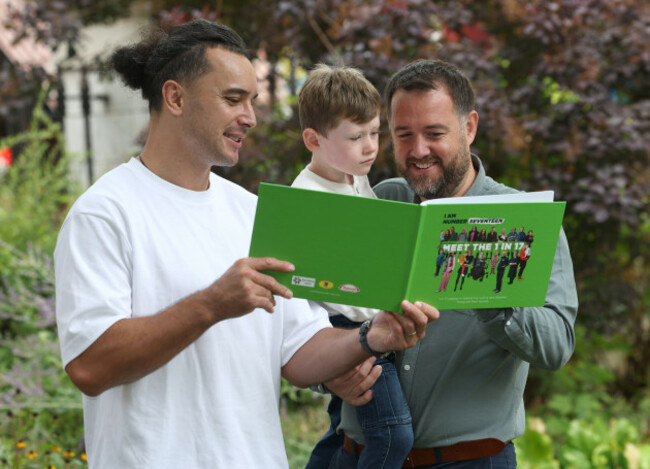
I am Number seventeen Book Launch 02 Irish Rugby International James Lowe, with Changemaker Cian McCarthy and his father Ross. Damien Eagers / Coalesce Damien Eagers / Coalesce / Coalesce

“The whole reason we do this [awareness campaigns] is we hope that when somebody else gets a similar diagnosis, first of all, that they know there’s a community people out there waiting to support them.

“They are absolutely not on their own. The challenge is that you have to change expectations. You have to change your life.

“That’s quite tough. And just knowing that other people have done that successfully before you and come out the other side of this. We went through a very lonely time with Cian, and now we enjoy it, and now we’ve actually come to the realisation that having him has taken absolutely nothing from our lives.

“All he has done is he’s made sure that we focus on what’s important and cut the nonsense, and we operate and we look at it in a completely different way. So when you think about it, having Cian with his rare condition has actually improved our lives, because it’s forced us to slow down, to focus on what’s important, to enjoy the moments.”

Ross describes Cian as being extremely sociable and someone who loves people and having fun.

“We had a great moment after lots and lots of physio and lots and lots of therapies and everything that we had to do. But it was All-Ireland final day last year, and Cian was just turning five at the time. I was lucky enough to have a ticket into the match, and I was doing a bit of physio with him on the morning of the all-Ireland, and he finally walked away from me and walked on his own for the first time.

“When you’re five years waiting for that, you can imagine the excitement. I was probably the only Cork man who came out of Croke Park that day with a smile on his face,” he said.

Ehlers-Danlos Syndromes

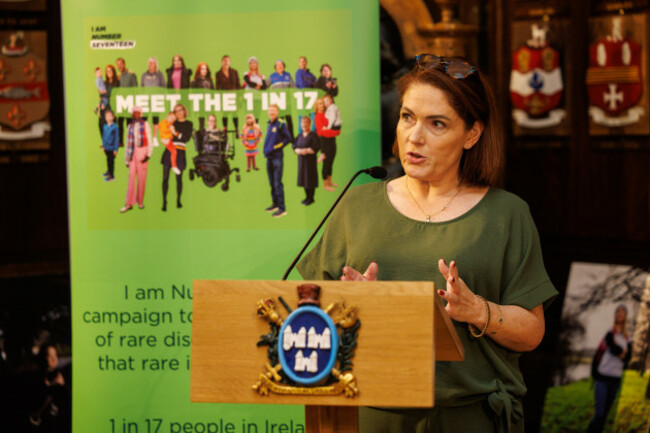
I_am_Number_seventeen_Book_Launch_046 Anne at the launch of the 'I Am Number 17' book, which showcases the stories and portraits of 17 people living with a rare disease across Ireland. Damien Eagers Damien Eagers

Another changemaker whose story has been included in ‘I am Number Seventeen’ campaign is Anne, whose daughter Ciara has severe Ehlers-Danlos Syndrome (EDS).

Anne also has the rare disease, but hers is much more moderate. She and her daughter’s conditions show the spectrum of EDS, she told The Journal.

Growing up, Anne had a number of health issues that were put down to various external factors. Some were blamed on the high pressures of her job in consulting and career management, others were attributed to things like anxiety, chronic fatigue syndrome, among others. She wasn’t diagnosed until she was 51, after her daughter Ciara received her own diagnoses.

EDS is a connective tissue disorder, which primarily is due to the collagen being defective. There are 13 variants and it can affect people in many different ways. 

Ciara lived a “normal” life for much of her early childhood, up until the age of 12. She’s now 23. 

“She was like a Duracell bunny, and she never stopped. She was also an A-student. Ciara wanted to become either a vet or a doctor and she had the brains to do it. Ciara stopped school when she was in first year, because she couldn’t go to school after that.

“I went from having a child that I thought had a very bright future in front of her, to having a child who lost it within the space of a year.”

She requires full-time care, and Anne had to give up her job in consulting in 2014 due to the number of appointments and Ciara’s failing health. In 2018, Ciara received life-changing surgery, which fused her neck and skull, but in 2019 had a heart attack. Now, her health has declined once more.

“It’s basically management now,” Anne said. “And this is one the things we’re fighting for:  we want there to be a centre of excellence in Ireland that can look after rare diseases.

“They may be individually rare, but collectively they’re common. A lot of the rare diseases are syndromes and would be spectrum disorders, so a lot of them would have gastro issues, a lot of them would have heart issues, a lot of them would have lung issues.

“So although their rare condition may be individually rare, a lot of the symptoms and conditions that they may have can be managed and are and need to be managed.”

Despite all that the family has gone through, Anne maintains that she is lucky to still have her daughter and described Rare Ireland as a “lifesaver” for all the support people within the community can offer each other. The Irish EDS group is also a very active support and advocacy group that Anne is chair of.

Rare Ireland will be hosting its annual conference on 14 November in Athlone. Tickets are free and are available here

Readers like you are keeping these stories free for everyone...
A mix of advertising and supporting contributions helps keep paywalls away from valuable information like this article. Over 5,000 readers like you have already stepped up and support us with a monthly payment or a once-off donation.

View 10 comments
Close
10 Comments
This is YOUR comments community. Stay civil, stay constructive, stay on topic. Please familiarise yourself with our comments policy here before taking part.
Leave a Comment
    Submit a report
    Please help us understand how this comment violates our community guidelines.
    Thank you for the feedback
    Your feedback has been sent to our team for review.

    Leave a commentcancel

     
    JournalTv
    News in 60 seconds