We need your help now

Support from readers like you keeps The Journal open.

You are visiting us because we have something you value. Independent, unbiased news that tells the truth. Advertising revenue goes some way to support our mission, but this year it has not been enough.

If you've seen value in our reporting, please contribute what you can, so we can continue to produce accurate and meaningful journalism. For everyone who needs it.

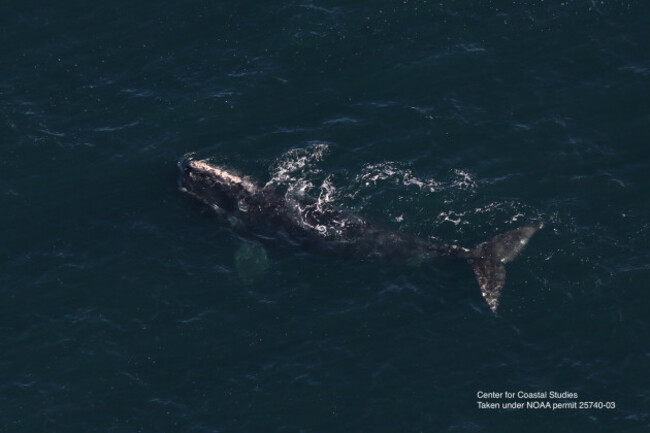
Right whale photographed off Boston on 19 November, 2025, previously located in Donegal Bay, Ireland, in July 2024. Center for Coastal StudiesRight Whale Ecology Program

Rare whale seen at Donegal Bay last year spotted nearly 5,000km away close to Boston

The species of whale is critically endangered, with the population estimated at 384 worldwide.

A RARE WHALE spotted at Donegal Bay last year has been sighted in waters in Massachusetts, almost 5,000km away.

The North Atlantic right whale was seen at Donegal Bay in July 2024. Researchers in the US have identified the whale as the same individual through photographs showcasing its unique features.

The species of whale is critically endangered, with the population estimated at 384 worldwide.

On 19 November, observers from the Centre for Coastal Studies (CCS) Right Whale Ecology Program sighted the whale off the coast of Boston while they conducted an aerial survey.

Researchers Ryan Schosberg and Annie Bartlett were conducting the Centre’s second aerial survey of the 2025-2026 season in Massachusetts Bay at the time.

The flights are designed to monitor the right whale population and determine when regulations designed to safeguard right whales go into effect.

Schosberg said about 4.5 hours into the survey, the two broke from their track lone to document a group of humpback whales.

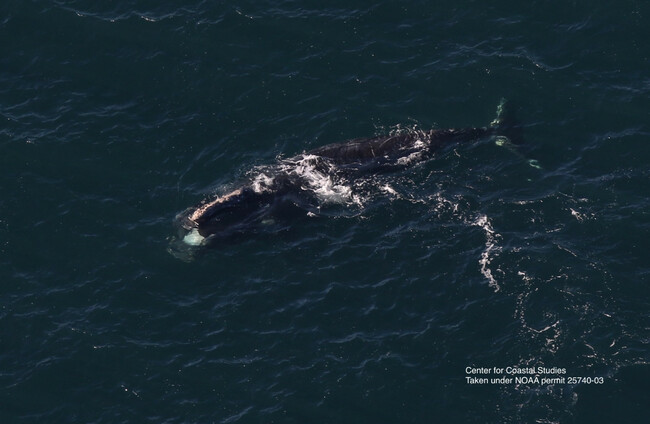
“While photographing the humpbacks, we were surprised to spot a lone right whale feeding at the surface nearby.

“We quickly diverted to photo-document the whale, our first right whale sighting of the season. The first sighting of the year is always exciting, but we didn’t yet realise just how remarkable this one would turn out to be,” he said.

20251119_CCS-A_CT01IRE24_SKM FD_101_7299 Center for Coastal StudiesRight Whale Ecology Program Center for Coastal StudiesRight Whale Ecology Program


CCS documents roughly half the entire species’ population in and around Cape Code Bay, so it’s unusual for the centre to encounter an individual it doesn’t recognise or can’t find in the wider catalogue.

After reaching out to colleagues at the New England Aquarium, it was narrowed down.

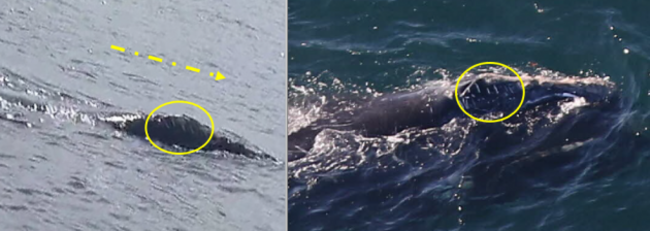
“While the photos from the 2024 Ireland sighting showed some unique features, we were unsure the quality of the photos would be sufficient to identify the whale in the future.

“After a flurry of matching effort and emails, we were excited to discover the first ever photo-ID match between Ireland and the U.S. East Coast,” said Lindsey Jones, a scientist in the Aquarium’s Anderson Cabot Center who manages the North Atlantic Right Whale Catalog.

Composite image - Ireland Boston NARW Unique scarring on the right side of the whale’s head is one of several features that helped researchers in the New England Aquarium’s Anderson Cabot Center for Ocean Life match photos from the Ireland sighting (left) with images captured by the Center for Coastal Studies off Boston (right).

“The next day, when the Aquarium’s catalog team sent over a potential match, I was shocked.

“I remembered the Irish whale sighting from July 2024 and how we’d tried to match that to a known individual in the catalog without success. It was an impressive match by their team, and such an exciting international right whale story,” said Schosberg.

Pádraig Whooley, Sightings Officer at the Irish Whale & Dolphin Group, recognised the unusual whale sighting in 2024 and shared information with the Aquarium for identification.

“But where else would one expect to find a right whale with Irish connections if not off Boston?” Whooley said.

There are rare instances of known North Atlantic right whales from the western Atlantic travelling to the eastern Atlantic and back, but the CCS said this appears to be the first documented case of a whale initially sighted in the eastern North Atlantic and later sighted in the western North Atlantic.

The CCS said the sighting suggests that historical North Atlantic right whale habitats may still hold value and that right whales continue to search widely for suitable habitat.

Readers like you are keeping these stories free for everyone...
A mix of advertising and supporting contributions helps keep paywalls away from valuable information like this article. Over 5,000 readers like you have already stepped up and support us with a monthly payment or a once-off donation.

Close
5 Comments
This is YOUR comments community. Stay civil, stay constructive, stay on topic. Please familiarise yourself with our comments policy here before taking part.
Leave a Comment
    Submit a report
    Please help us understand how this comment violates our community guidelines.
    Thank you for the feedback
    Your feedback has been sent to our team for review.

    Leave a commentcancel

     
    JournalTv
    News in 60 seconds