We need your help now

Support from readers like you keeps The Journal open.

You are visiting us because we have something you value. Independent, unbiased news that tells the truth. Advertising revenue goes some way to support our mission, but this year it has not been enough.

If you've seen value in our reporting, please contribute what you can, so we can continue to produce accurate and meaningful journalism. For everyone who needs it.


Our reading habits have changed since the days of the dominance of daily newspapers but the Irish public still cares about the news. Alamy Stock Photo

Analysis Ireland is still paying attention to news - just not in the same way we used to

Finian Murphy shares insights from his research into how Ireland engages with the news.

AT THIS STAGE of the year, if you feel – as I do – that 2025 has already been a rollercoaster, you’d be right.

The recently published Core Research REVIEW 25 highlights the stories that shaped Irish life and culture over the past twelve months. But beneath the headlines lies a deeper shift in how we, the public, interact with news itself. Across a decade of data, a consistent pattern is emerging: fewer people are aware of the news around them, yet the stories they do follow feel increasingly significant.

That tension sits at the heart of understanding our modern information habits. The stories we rate as important are, unsurprisingly, the ones we actually know about – but the pool of stories people notice is narrowing. Which begs the question: are people turning away from “news,” becoming more selective, or redefining what counts as news?

All three can be true at once, and a ten-year dataset offers a useful lens to see how these forces interact.

A new relationship with information

Across the past decade, Core Research has interviewed more than 120,000 people living in Ireland about the news shaping their lives. Within this dataset, I’ve analysed over 2,000 stories spanning sport, politics, economics, social issues and culture. What consistently emerges is a public recalibrating its relationship with information – switching off from some stories, but investing more meaning in those that break through.

The Reuters Institute Digital News Report captured this contradiction earlier this year: 41% now often or sometimes avoid the news, citing mood impact, volume fatigue, or the dominance of war and politics. Yet at the same time, 1 in 5 people in Ireland pay for online news – aligning with European norms and suggesting that many still value professional journalism even as they limit exposure to it. Trust has also risen to 51%, and remains high by international standards.

So people are not rejecting news – they are curating it.

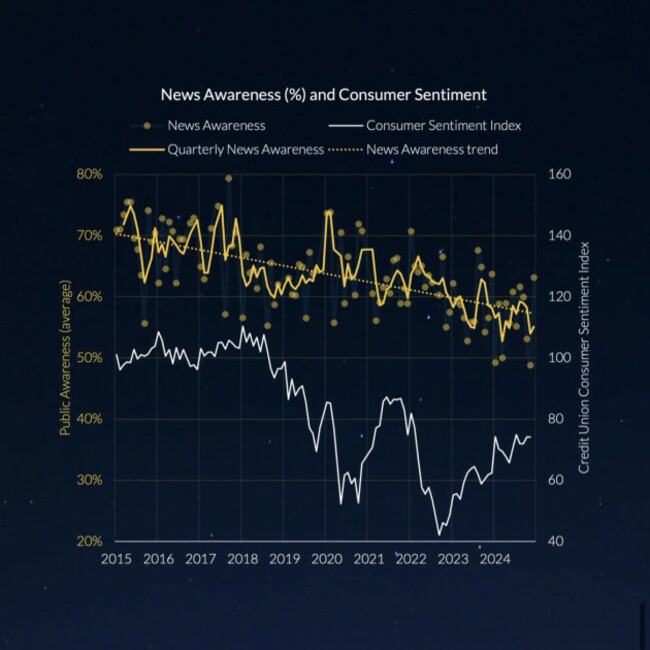
This helps explain one of the defining observations from this year’s Core Research REVIEW 25: fewer people today are aware of the news happening around them than five years ago during Covid, and significantly fewer than in 2015. But among those who stay engaged, there is a strong sense that the stories they do encounter matter more. Awareness is contracting; resonance is intensifying.

IMG_0581

Across ten years of data, only one in 20 stories manage to surpass 90% awareness. They’re the kinds of moments that truly grip the national conversation: Russia’s invasion of Ukraine in 2022; Penneys reopening after the 2020 lockdowns; Donald Trump’s election and re-election; or the movie release of Fifty Shades of Grey in 2015! These are rare periods where the entire country’s attention converges.

Falling awareness – but rising importance

But most stories do not operate at that level. This is where the Cultural Index – a 1 to 100 measure combining awareness with perceived importance – becomes revealing.

Many stories that receive limited media attention, or fall outside recommender algorithms, often score much higher in significance among those aware of them. In other words, relevance is no longer dictated solely by reach.

IMG_0580

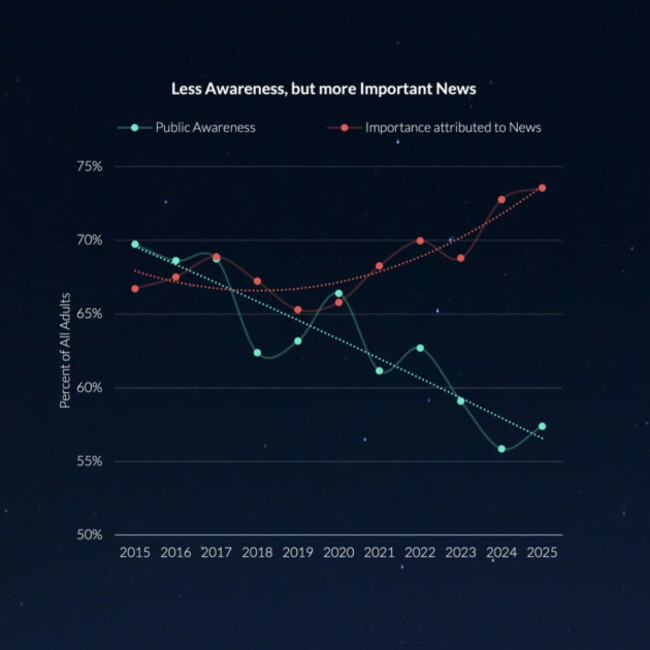
The ten-year dataset makes this clearer. Average story awareness has fallen from nearly 70% in 2015, rose briefly during Covid, and has declined steadily again to below 60% over the past three years. However, for those who remain tuned in, perceived importance has increased from roughly 65% to over 70% today.

Fewer people are following the news, but those who do see it as increasingly consequential amid global and economic uncertainty.

As resonance rises, it becomes even more important to understand where people are now getting the information that shapes their worldview. If awareness is narrowing but meaning is intensifying, the channels through which people access information take on new significance.

What we pay attention to

As part of Core REVIEW 25, we asked the public where they get their news and information daily. What becomes evident is a widening gap between two distinct information ecosystems – one curated and institutional, the other personalised, social and algorithmically driven.

Older adults remain anchored to formats shaped by editorial judgement and curation. Over half (57%) of those aged over 40 years old say they watch live TV news or documentaries every day, compared with 36% of younger adults.

Radio follows a similar pattern for news (55% vs 36%), as does reading online news or newspapers (52% vs 35%). For this group, information flows through institutions that prioritise, contextualise and verify – offering structure amid uncertainty.

The future generation, coming of age, inhabit a far more personalised news and information environment. Nearly half (48%) of under-40s stream online video for news every day, compared with 30% of older adults. Getting news from social influencers is markedly higher (38% vs 23%), and engagement with forums like Reddit leans younger too (26% vs 15%). The WhatsApp group – often the most immediate and intimate form of exchange – is used every day by 65% of younger adults to swap information or news, compared with 53% of those aged 40+.

Their worldview is increasingly shaped not by institutions, but by networks, creators, micro-communities and recommendation engines – a model defined less by shared stories and more by personalised streams of content and social connections.

As overall news awareness declines while resonance rises, these diverging ecosystems may shape how different generations interpret Ireland, its challenges and its future.
The question, perhaps, is no longer whether people are disengaging from news – but whether they are now consuming completely different realities.

Finian Murphy is a researcher and strategist focused on public sentiment, culture and communities.

Readers like you are keeping these stories free for everyone...
A mix of advertising and supporting contributions helps keep paywalls away from valuable information like this article. Over 5,000 readers like you have already stepped up and support us with a monthly payment or a once-off donation.

View 10 comments
Close
10 Comments
This is YOUR comments community. Stay civil, stay constructive, stay on topic. Please familiarise yourself with our comments policy here before taking part.
Leave a Comment
    Submit a report
    Please help us understand how this comment violates our community guidelines.
    Thank you for the feedback
    Your feedback has been sent to our team for review.

    Leave a commentcancel

     
    JournalTv
    News in 60 seconds