Take part in our latest brand partnership survey

We need your help now

Support from readers like you keeps The Journal open.

You are visiting us because we have something you value. Independent, unbiased news that tells the truth. Advertising revenue goes some way to support our mission, but this year it has not been enough.

If you've seen value in our reporting, please contribute what you can, so we can continue to produce accurate and meaningful journalism. For everyone who needs it.

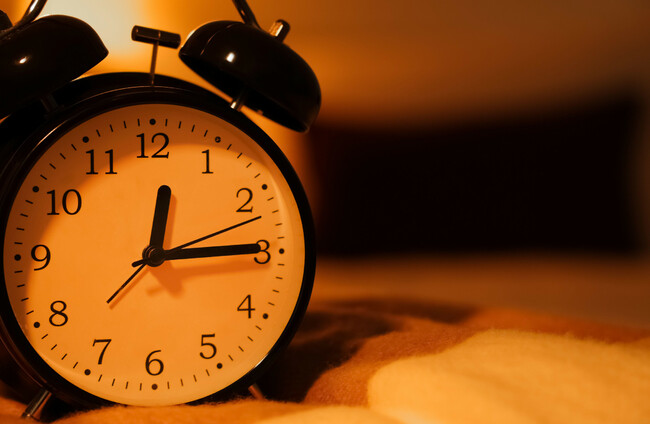
Alamy Stock Photo

Doctor As the time on the clock goes back, make sure you're listening to your body clock too

As the clocks go back this weekend, maybe it isn’t just the hour change we need to rethink, writes Dr Catherine Conlon.

SOME OF US are early birds – tending to go to bed and wake up early, with more energy in the first half of the day – while others are more likely to be full of beans in the evening and night hours.

Whether you are an early bird or a night owl depends to some extent on your genetics, but more evidence is emerging of how this variation is influenced by our individual circadian rhythms.

That explains why at parties or weddings, while some are ready for bed at 10pm, other revellers are getting ready to party late into the night.

Your circadian rhythm is your body’s internal clock. Light, sleep patterns, hormones, meals and temperature can all influence your circadian rhythm, which in turn can influence your overall health.

Athletes understand the impact on their performance. Olympic athlete Usain Bolt and former tennis star Venus Williams insisted on up to 10 hours’ per day, while Roger Federer is reputed to sleep 12 hours a day; and most athletes insist on at least eight, with many sticking to a rigid routine built around nutrition and sleep.

Twice a year, that balance between time clocks and our body clock is upended by a changing the time by an hour to maximise daylight hours.

This weekend sees clocks going back an hour at 2am in the early hours of Sunday.

The question of whether this change is a good idea remains controversial.

The daylight savings debate

Daylight saving time has a long history. In 1916, during the First World War, Germany decided to bring in the time change in March 2016 as an energy saving gesture, followed by the UK two months later. As Ireland was part of the UK at the time, the same rule also applied in Ireland.

In 2019, following a poll in 2018, the European Parliament voted to make the final clock change in the spring of 2021, but it never happened.

Professor David Malone from the Department of Mathematics and Statistics at Maynooth University suggested in 2021 that if we do decide to opt out of daylight savings, we need to decide if we are going on all in on summertime or wintertime.

“If we stay on summertime, which sounds very nice because we think of nice long evenings in the summer, you have to play that off against the very dark winter mornings, which I guess, we’re kind of trying to avoid with going to wintertime. If we stayed in summertime for the whole year, sunrise would actually be after 9.30am in Dublin for basically all of December and all of January.

Malone recounts how we actually tried this from 1969 to 1971.

“There was an experiment when Ireland and the UK were thinking about joining the EU, and for those year we stayed on summertime for the whole time. Initially, everybody thought it would be a great idea, but pretty soon, once you go through a winter with those very late sunrises, everybody started to change their mind.”

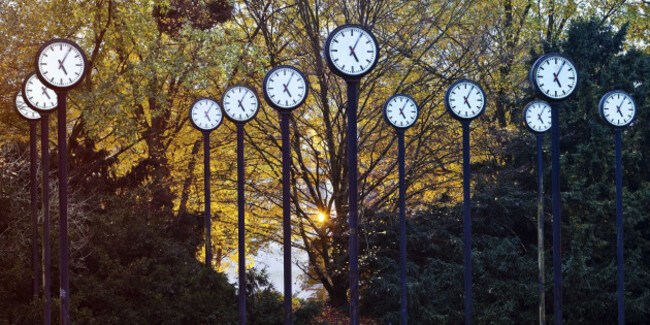
artwork-time-field-24-synchronised-station-clocks-artist-klaus-rinke-time-changeover-volksgarten-duesseldorf-north-rhine-westphalia-germany-eu Synchronised clocks in Dusseldorf, Germany Alamy Stock Photo Alamy Stock Photo

How does the clock change to maximise daylight savings affect us? Last year, a group of scientists at Liverpool John Moores University and the University of Oxford decided to do a nationwide survey in the UK to consider the impact of daylight savings on people’s daily lives.

Over 12,000 people responded to questions about stress, wellbeing, and life satisfaction.

They answered the survey in the week before the clocks went back and re-completed it immediately afterwards.

The survey somewhat surprisingly, found that women’s health and wellbeing suffered in the immediate aftermath of the clocks going back while men experienced greater wellbeing and greater satisfaction with life.

The real question is, what does this tell us about the way men and women experience time?

The survey found that women were more likely to associate the autumn clock changing with worry, confusion, guilt or stress.

The researchers concluded that because these effect occurred within a day or two of the clock change, suggests that it caused the negative effects, rather than the gradual accumulation of dark nights. One female participant was quoted as saying “I am spinning out of control. Mind is overactive. Very behind in tasks. No idea what time it is.”

Women reported difficulty adjusting young children to the new routine with disrupted bedtimes and difficulty getting them ready on time in the morning while men reported significantly more positive experiences than women. One man felt he had “accomplished more already” in the “extra” hour.

Many participants reported a worsening work-life balance following the clock change in October. The researchers suggested that the sudden change to darker evenings reduces how much time we feel have outside the working day for ourselves. While dark nights are inevitable in the winter, the clock changes prevents this adjustment being made over a period of weeks.

One female participant said: “The feeling of the sudden darkness this evening filled me with dread for the dark months… A gradual daily shift would be so much easier to cope with.”

Some of these negative changes can be explained by the impact on our body clock. Circadian rhythms that dictate when we eat and sleep can become disrupted by the changing time.

But it’s not just a singular body clock that is affected. 

Listening to our body clock

The US Institute of General Medical Sciences explains how our body clock is controlled by proteins that are maintained by thousands of genes that switch on and off in a particular order.

The peripheral biological clocks in single cells and tissues are synchronised by a master clock in the brain in a structure called the suprachiasmatic nucleus (SCN).

The SCN controls the production of the hormone melatonin based on the amount of light the eye receives.

In the evening, a person’s master clock tells the brain to make more melatonin, causing sleepiness.

In recent decades, the degree to which our mood, metabolism, and cognitive abilities vary over a 24 hour period is becoming clearer while disruption of the clock is implicated in a range of health conditions, including type 2 diabetes and cancer.

Understanding our circadian rhythms means understanding the natural oscillations in our tissues or the literally trillions of clocks, ticking in every cell of our bodies.

Depending on what time you sleep, eat and exercise – muscle, fat and other cells will be in a different state and will respond to those activities differently.

On today’s world of constant online access, work and sleep and nutrition are no longer aligned with the emergence of light.

Advances in digital technology mean that many of us never really switch off.

As the clocks go back this weekend, maybe it isn’t just the hour change we need to rethink. Perhaps we need to consider how much routine we have around when and how much we sleep, eat and work and how much time we safeguard for rest, replenishment, creativity and play.

Maybe now is the time to ensure that we have a guaranteed block of sleep most evenings as well as a protected tranche of time during the day when we rest, switch off from the demanding world we live in and annex some precious moments for ourselves.

Dr Catherine Conlon is a public health doctor with the HSE in Cork.

Readers like you are keeping these stories free for everyone...
A mix of advertising and supporting contributions helps keep paywalls away from valuable information like this article. Over 5,000 readers like you have already stepped up and support us with a monthly payment or a once-off donation.

Close
7 Comments
This is YOUR comments community. Stay civil, stay constructive, stay on topic. Please familiarise yourself with our comments policy here before taking part.
Leave a Comment
    Submit a report
    Please help us understand how this comment violates our community guidelines.
    Thank you for the feedback
    Your feedback has been sent to our team for review.

    Leave a commentcancel

     
    JournalTv
    News in 60 seconds