We need your help now

Support from readers like you keeps The Journal open.

You are visiting us because we have something you value. Independent, unbiased news that tells the truth. Advertising revenue goes some way to support our mission, but this year it has not been enough.

If you've seen value in our reporting, please contribute what you can, so we can continue to produce accurate and meaningful journalism. For everyone who needs it.

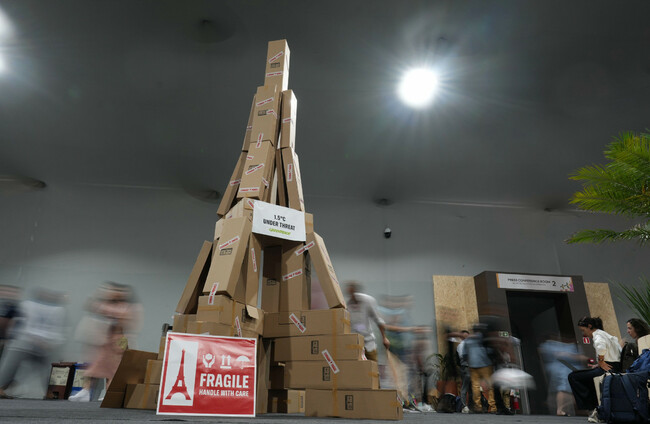
Attendees at COP30 walk past boxes made to look like the Eiffel Tower with a sign that reads "1.5 degrees Celsius under threat", a reference to the 2015 Paris Agreement. Alamy Stock Photo

Analysis We're halfway through COP30. Here's the good, the bad and the ugly so far

Negotiators should put the needs of people who are most affected by the climate crisis at the centre of their decisions, writes Karol Balfe.

WITH ONE WEEK done and the second getting underway, the pressure is on world leaders to deliver on real climate action at this COP30 in Belém, Brazil. Negotiations thus far have included the good, the bad and the ugly.

The good parts have been clear. Despite the notable absence of the US – one of the world’s largest polluters – negotiations continue apace with most countries in the world determined to make this work.

Hugely positive also is progress on finally putting a just transition on the table. In a show of united power, week one brought a pivotal moment when countries of the G77 plus China united to call for a new global mechanism to deliver on just transition, the need to phase out and end investment in fossil fuels and switch to renewable energy, and using agriculture in a way that works with the earth, not against it.

It’s now game on for just transition and week two discussions which will focus on the need for a Belém Action Mechanism to set global standards for how we transition, focusing on ensuring workers, women and communities can shape climate plans to make sure their lives are better and not worse.

It remains to be seen how Global North countries will respond in a meaningful way to this call for overarching climate action and coordination on a just transition, and a renewed focus on ensuring climate action delivers for people and the planet.

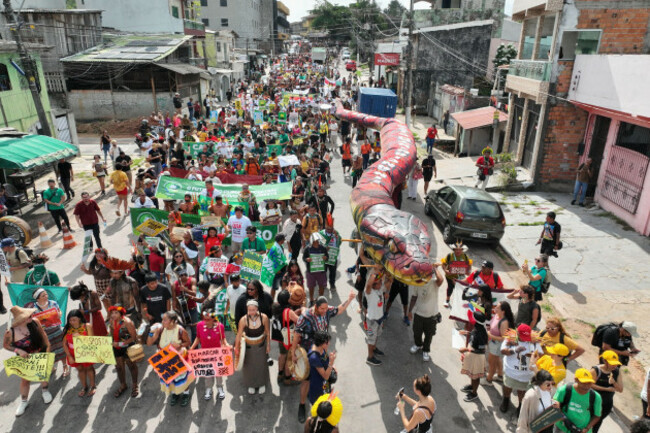
Good too was the solidarity and activism evident all week by many citizens, indigenous people, women’s groups, and civil society organisations who are demanding a better planet for all.

The bad was there in abundance too with rich Global North countries continuing to delay real action.

European states like Ireland call for limiting global warming to the 1.5°C threshold set out in the Paris Agreement but are at the same time allowing for new oil and gas expansion.

The burning of fossil fuels currently accounts for over 75% of global GHGs, making this sector the largest contributor to climate change. Since 2015, the world’s 65 biggest banks have committed $7.9 trillion to the fossil fuel industry. Almost all these banks increased their fossil financing in 2024 in comparison to the previous year, insanity in a climate crisis.

The bad was also reflected in the scale of the gap between what rich counties should pay towards climate finance, in contrast with what they actually do contribute.

The wealthy polluting countries of the Global North who have done the most to cause the climate crisis through a century or more of extraction, industrialisation and pollution, have the legal obligation – under Article 9 of the Paris Agreement – to provide climate finance to Global South countries for mitigation and adaptation. The “climate debt” owed from the richest polluters to those on the front lines in lower income countries has been calculated to be more than $4 trillion per year.

The last COP in Baku in 2024 left big and bitter questions open on the crucial issue of who pays, how much, and what source – gaps that are now haunting COP30.

Pressure is growing for a stronger, grant-based adaptation component and for clarity on developed countries’ public finance obligations. The Baku-to-Belém roadmap lists options but lacks political traction. The Africa Group is keen to ensure that this delivers real money, – a goal on adaption must help them not trap them.

In 2015, under the Paris Agreement, rich countries only agreed to offer US$100 billion per year by 2020. Then at COP29 in Baku during negotiations on a New Collective Quantified Goal (NCQG) on climate finance, rich countries once again failed to respond to the urgent need for trillions in grant-based financing.

Instead, they only agreed to a goal in which all countries (including developing countries in the Global South) are expected to collectively “mobilise” US$ 300 billion per year by 2035. Developing countries found this outcome to be a disappointment and a betrayal.

activists-march-at-a-climate-protest-during-the-cop30-u-n-climate-summit-monday-nov-17-2025-in-belem-brazil-ap-photoandre-penner Activists marching at a climate demonstration in Belém. Alamy Alamy

The EU has a chance to turn this around by committing to at least tripling its grant-based adaptation finance and tripling its contributions to multilateral UN climate funds.

That would send a clear signal that Europe is ready to match words with predictable, fair support for the most vulnerable.

Private finance instruments such as loans, investments or carbon offsets are no substitute for real grant-based public finance and cannot “fill the gap” when it comes to just transitions or urgently-needed climate action. What little climate finance that Global North countries are providing to Global South countries is already mostly (two-thirds) in the form of loans, rather than as grant-based finance.

This is not only inherently unjust and woefully insufficient to address the planetary crisis, but it is exacerbating an acute debt crisis for the country’s most vulnerable to climate change, and who have done the least to cause the problem.

Then there’s the ugly. This COP is in the iconic setting of the Amazon. Described as the lungs of the Earth, the Amazon holds 10% of the world’s known biodiversity. Agriculture is the primary driver of deforestation in Brazil, accounting for over 97% of native vegetation loss between 2019 and 2023. Industrial agriculture is the second largest polluting industries after fossil fuels.

In 2022 (the most recent year in which data is available), the industrial agriculture giant Cargill, one of the world’s largest distributors of soy, was found to have caused 55,131 hectares of deforestation due to soy expansion in Brazil, and GHGs equivalent to more than 10 million tonnes of CO2.29.

Yet, this COP30 is not linking deforestation with large scale industrial agriculture. As deforestation advances, the community faces growing pressure from farmers, business and politicians to leave their forest territory to make way for expanding industrial agriculture.

Brazil, the host, unfortunately has championed false solutions, and sought money for a fund to protect the conservation of tropical forests known as the Tropical Forest Forever Facility. This fund is a gamble in the casino of financial markets. Public finance is scarce and needs to go directly to forest communities rather than to complex financial instruments that aren’t guaranteed to raise money or benefit people on the ground.

There are no shortcuts to tackling the runaway climate crisis. The needs and rights of frontline communities must be centred in all decision-making.

Week two of COP30 must deliver real actions; global commitments to support the just transition, massively increased grants-based climate finance and a move away from false solutions such as carbon offsets.

We must act on the calls for climate justice.

Karol Balfe is the CEO of ActionAid Ireland.

Readers like you are keeping these stories free for everyone...
A mix of advertising and supporting contributions helps keep paywalls away from valuable information like this article. Over 5,000 readers like you have already stepped up and support us with a monthly payment or a once-off donation.

View 13 comments
Close
13 Comments
This is YOUR comments community. Stay civil, stay constructive, stay on topic. Please familiarise yourself with our comments policy here before taking part.
Leave a Comment
    Submit a report
    Please help us understand how this comment violates our community guidelines.
    Thank you for the feedback
    Your feedback has been sent to our team for review.

    Leave a commentcancel

     
    JournalTv
    News in 60 seconds