We need your help now

Support from readers like you keeps The Journal open.

You are visiting us because we have something you value. Independent, unbiased news that tells the truth. Advertising revenue goes some way to support our mission, but this year it has not been enough.

If you've seen value in our reporting, please contribute what you can, so we can continue to produce accurate and meaningful journalism. For everyone who needs it.

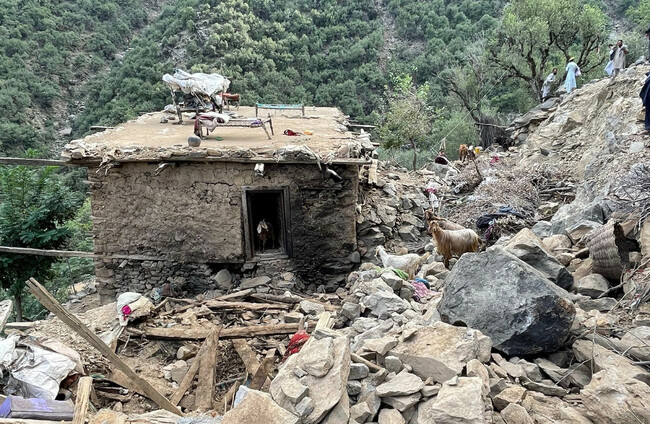
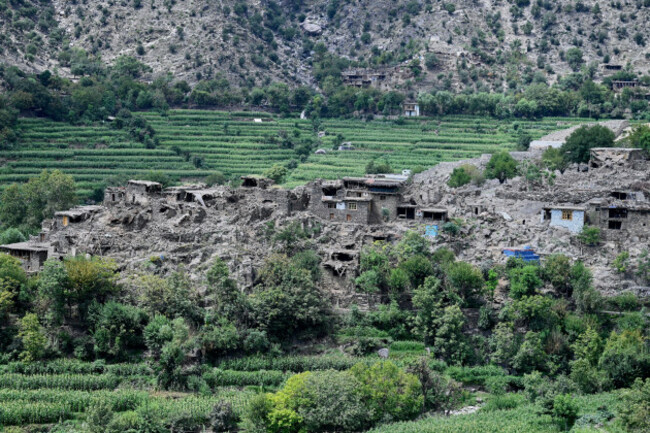
Entire communities have been destroyed in parts of Afghanistan by the earthquakes this week. JEN (Japanese Emergency NGO) via Concern

Earthquake eye-witness in Afghanistan 'It was like something from a nightmare'

It’s a race against the clock to deliver aid to mountainous villages hit by the earthquakes as the impending winter looms, writes humanitarian Shahzad Jamil.

ON TUESDAY AFTERNOON, I was on a windy, mountainside road in the Devagal Valley in Kunar province, Afghanistan when the deafening roar began. It was like something from a nightmare.

Panic erupted as the local team I was travelling with screamed at me to take cover. The ground was shaking and quickly the roaring was joined by rocks and rubble raining down the hillside, tumbling across the road, followed clouds of blinding dust.

This was a 5.2 magnitude earthquake. We sought safety, sheltering behind a nearby boulder. When the roaring eased and the dust began to clear, the road was blocked and everyone with me was shaken, but unharmed.

I was visiting the Devagal Valley at the invitation of Japanese non-governmental organisation JEN to assess the level of damage done by Sunday’s 6.0 magnitude earthquake to the remote communities in the region and their immediate needs. 

Since then, a 6.2 magnitude earthquake struck in Nangarhar, one of the three provinces hit by the earlier earthquakes, which could be felt in the capital city of Kabul. It was followed by a strong aftershock measuring at a 5.4 magnitude only a few hours later.

Devastation

What I witnessed on Tuesday in the wake of Sunday’s major earthquake and the aftermath was total destruction, everywhere I went.

Some people had lost family members, trapped under collapsed homes.

Others had lost livestock – their only source of income.

Some had lost their homes, many of which were inherited from parents and grandparents. They do not have the resources to rebuild them.

The widespread loss was matched only by the trauma of the survivors. One man told me how his three children were trapped in their damaged home for 12 hours before they could be rescued. As he recounted the experience, his children were visibly distressed, crying, non-stop.

Many women and children have moved further down the valley in an attempt to be safe from the recurring aftershocks. But nobody in the valley – whether they are local residents or emergency teams responding – is safe from the threat of major rock falls.

Even before the second earthquake on Tuesday, there were frequent aftershocks, shaking the towering rock-strewn hillsides and badly damaged homes.

a-village-lies-in-rubble-after-sunday-nights-powerful-6-0-magnitude-earthquake-that-struck-several-provinces-in-a-remote-valley-in-kunar-province-afghanistan-tuesday-sept-2-2025-ap-photonava A village left in rubble after the 6.0 magnitude earthquake on Sunday in Kunar province. Nava Jamshidi / AP/Alamy Nava Jamshidi / AP/Alamy / AP/Alamy

Down in the valley, the conditions for those who have relocated are horrible. The 40-square-metre tents are hosting between 50 and 100 women and children. There are no sanitation facilities. People have only the clothes they are standing in. Some of the children have no shoes, which is particularly difficult in such a rocky environment.

Local volunteers are bringing them cooked food. The huge sense of solidarity I witnessed was moving. Throughout the afternoon, there was a steady flow of people arriving in trucks, motor bikes and Tuk Tuks bringing supplies of bread, cooked rice, and fruit. But they are also contributing to the congestion on the narrow roads, hindering access for ambulances and emergency vehicles.

The mountainous, remote environment is the greatest challenge for those responding. The earthquake has made access to some areas impossible by car. Aid workers with our partners ended up walking five to six hours to reach affected villages.

There are some valleys that are still completely cut off, and inaccessible by road, landslides in the aftermath of the earthquake destroying everything in their path. There are areas that can only be reached by helicopter, and it’s not been possible to deliver aid there so far.

Authorities are still struggling to recover dead bodies from the rubble; there’s no machinery to do this work. In some situations, the number of people dead is higher than the number of people who survived.

The latest reports from the authorities put the number of dead at 2,200 with a further 3,600 injured, and 5,400 homeless. But it’s expected that these numbers will rise as rescuers and aid agencies gain access to areas.

Aid funding cuts

People desperately need food, shelter, water, and other items. Concern is responding by releasing stocks of tents and other non-food items which we have in the country, for distribution by our Alliance2015 partners ACTED.

To add to the challenge, the authorities and humanitarian organisations are in a race against the clock, with the impending winter looming. The first snows are expected in November or early December. Temperatures can fall as low as minus 15 degrees Celsius. Providing shelter and warm clothing will be essential and lifesaving.

This disaster also comes against the backdrop of several serious challenges in Afghanistan. A severe drought across the country in recent months has seen water reserves disappear, crop failure and people forced to migrate in search of food and water.

International aid to Afghanistan has been cut drastically. Funding to support people has already been exhausted, and the United Nations and international aid agencies have been struggling to prioritise what we can do with the remaining amount of depleted funding.

Added to this is the forced deportation of Afghan people from neighbouring Pakistan, Tajikistan, and Iran. Some 1.5 million people have arrived back the country in 2025 alone, the majority of whom have absolutely nothing. Many have lived outside Afghanistan for decades and have no support network, no access to land or permanent shelter and no way to earn money. It has put severe pressure on Afghanistan’s already strained services and infrastructure.

The hesitancy of the international donor community to respond promptly and generously to this crisis is a bad omen for those in need.

Shahzad Jamil is Country Director with Concern Worldwide in Afghanistan. Previously he was Country Director in Türkiye with Concern and held similar roles with the Danish Refugee Council in Türkiye/Syria and JEN (Japan Emergency) NGOs. Concern’s Afghanistan appeal is available to support on its website

Readers like you are keeping these stories free for everyone...
A mix of advertising and supporting contributions helps keep paywalls away from valuable information like this article. Over 5,000 readers like you have already stepped up and support us with a monthly payment or a once-off donation.

Close
JournalTv
News in 60 seconds