We need your help now

Support from readers like you keeps The Journal open.

You are visiting us because we have something you value. Independent, unbiased news that tells the truth. Advertising revenue goes some way to support our mission, but this year it has not been enough.

If you've seen value in our reporting, please contribute what you can, so we can continue to produce accurate and meaningful journalism. For everyone who needs it.

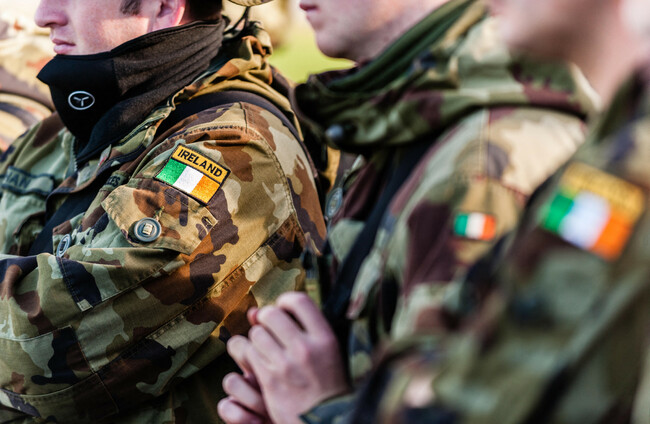
Irish Defence Forces arm patch of a soldier in the Irish Army. Alamy Stock Photo

Retired Irish general Ireland's neutrality, the threat of war and the illusion of security

Trump’s strike on Iran signals the end of the rules-based illusion — and Ireland is unprepared for what follows, writes General Ger Aherne.

IN RECENT TIMES, an article appeared in the UK about the illusion of its “holiday from history”. The notion comes from the belief that Western states, in particular, shielded by alliances and a stable global order after WWII and the Cold War, could avoid the brutal realities of great-power rivalries.

All borders were settled, and war was consigned to the past. Economic interdependence would tame geopolitics.

But now, many believe the holiday is over, and events in the Middle East this week, with Trump’s assault on Iran, have torn away the last pretence that power politics can be civilised by international law.

Ireland’s place in all of this

Compared to the ‘holiday from history’ perspective, Ireland hasn’t had a holiday; it has had a decades-long hiatus from reality and conflict. To be fair, and unlike the UK, Ireland’s hiatus did not begin with the end of the Cold War so much as with the consolidation of the much-revered Peace Process.

As the Troubles receded and the Good Friday Agreement took hold, Ireland quietly fell under a powerful assumption: that the era of hard security dilemmas had passed, and that Ireland’s strategic environment would remain benign, permanently.

This assumption proved as seductive and as misguided as the broader Western belief that history itself had ended, and it is now reflected in our globally unique version of neutrality, i.e. we are not politically neutral but remain militarily neutral. Another way of saying it is we speak loudly, but refuse to act. Our holiday isn’t over just yet.

Our post-conflict comfort

The world accepts that the Peace Process brought real and profound benefits, which the whole island has shared. But it also coincided with a political and cultural downgrading of defence as a serious instrument of state power, of which there are only four: military, economic, diplomatic and information.

With internal security threats diminished and no immediate external adversary in sight, Irish defence policy drifted from basic preparedness to symbolism and ceremony. Short-term cuts had no long-term consequences. Rather than using the strategic breathing space to modernise capabilities, Ireland allowed critical military assets to decay or disappear altogether.

Two decisions stand out.

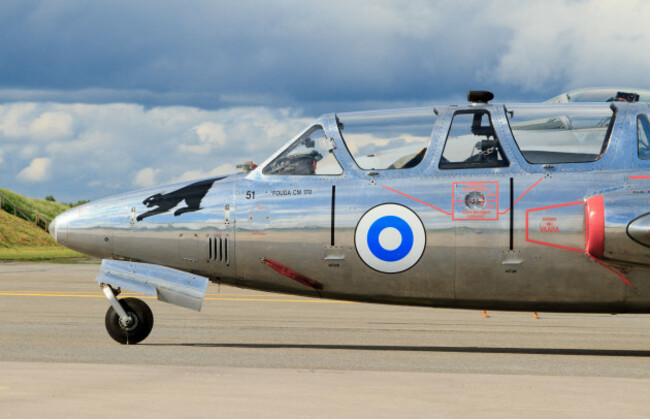
The first was the failure to replace the Fouga Magister jet squadron in 2001, effectively ending any credible fast-jet training or air policing capability. Ireland had operated fast jets continuously from the 1950s until 1999. This was not merely a budgetary choice but a conceptual one, an implicit declaration that Ireland would never again require meaningful control of its airspace beyond surveillance with binoculars and interception with helicopters.

A verbal assurance was all that was required. No other arm of the State has ever been allowed to operate a policy like this; it is akin to the Gardaí taking the word of drivers that they will never use their mobile phones or speed.

veteran-fouga-magister-jet-trainer-of-the-finnish-air-force A Veteran Fouga Magister jet, this one used by the Finnish air force. Alamy Stock Photo Alamy Stock Photo

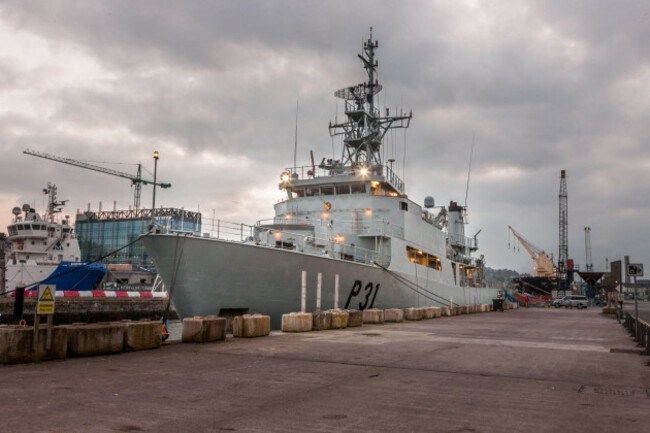
The second was the decision not to replace the Navy flagship, the LÉ Eithne, with a modern, helicopter-capable offshore command vessel. The Eithne was more than a patrol ship, it was a platform for command, humanitarian response, aviation operations, drug detection and Ireland projecting power and sovereignty in our seas.

Its retirement without replacement symbolised a retreat from ambition, particularly at a time when Ireland’s maritime responsibilities, driven by an enormous Exclusive Economic Zone (EEZ) and vulnerable subsea infrastructure, were only growing. Given the value of fisheries alone to the State, this policy failure will go down in history, but not for the right reasons.

cork-city-cork-ireland-22nd-march-2020-irish-naval-vessel-le-eithne-berthed-alongside-the-new-navagation-square-building-where-she-will-be-used-as-a-testing-centre-for-coronavirus-covid-19-at-k Cork City, Cork, Ireland. 22nd March, 2020. Irish naval vessel, LÉ Eithne berthed. Alamy Stock Photo Alamy Stock Photo

Taken together, these decisions left Ireland structurally diminished in two of its three sovereign domains, air and sea, an outcome without precedent in modern European history outside of microstates.

In both cases, capability was not lost because alternatives were impossible, but because the policy makers no longer believed such capabilities were necessary, and if they were, we could pretend that we couldn’t afford them. Like so many aspects of Irish defence policy, that argument is no longer remotely credible.

Peacekeeping without enforcement

Ireland’s overseas military posture followed a similar trajectory. During the 1990s and early 2000s, Irish forces were deployed in environments that required active peace enforcement, not merely observation.

Operations in Liberia and Chad demanded mobility, deterrence and the credible use of force. Irish troops operated in unstable theatres where rules of engagement were robust and where the distinction between peacekeeping and combat was often blurred.

These missions reflected a Defence Forces that understood conflict as dynamic and dangerous, even when conducted under a UN mandate. To many at home, this was neither understood nor appreciated and often downplayed: remember we had a recent Minister for Defence who didn’t like the word ‘battle’ in European Battle Groups.

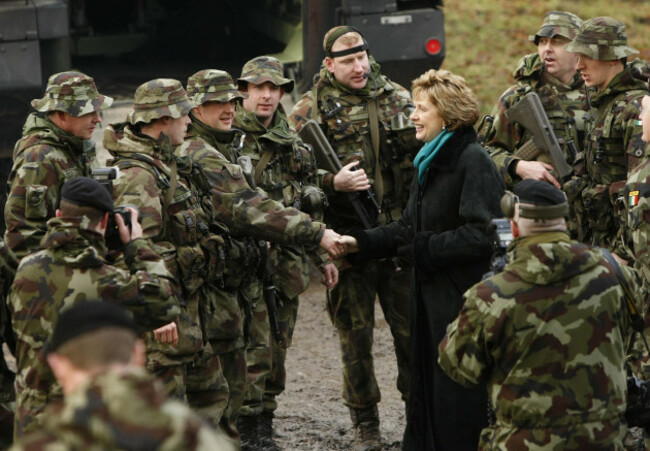
president-mary-mcaleese-supreme-commander-of-the-defence-forces-visits-chad-bound-troops-from-the-102-infantry-battalion-in-the-glen-of-imaal-to-see-how-they-prepare-during-their-mission-readiness-exe Irish peacekeeping troops met with then-President Mary McAleese before departing for Chad in 2009. Alamy Stock Photo Alamy Stock Photo

Over time, however, Ireland’s overseas posture narrowed. The shift towards a long-term, static deployment in southern Lebanon marked a subtle but important change. While UNIFIL remains a valuable contribution, it is structurally constrained, heavily monitored and limited in freedom of manoeuvre. The mission emphasises presence and restraint rather than initiative and enforcement.

The risk is not Lebanon itself, but what it came to represent: a comfort zone in which Irish defence policy could reassure itself that the world remained manageable, rules-based and largely static. Events in the area this week alone have brought such childlike assumptions crashing down, and this noble deployment, with so much sacrificed, now too coming to an end.

Neutrality as an alibi

Underlying Ireland’s decisions was a widening misinterpretation of neutrality. It became not a strategic stance requiring credible defence, but an alibi for underinvestment and obfuscation.

The belief took hold that Ireland could indefinitely outsource deterrence, of airspace, sea lines, cyber infrastructure, energy pipelines to others, while maintaining a moral posture rooted in evaporating peacekeeping rhetoric.

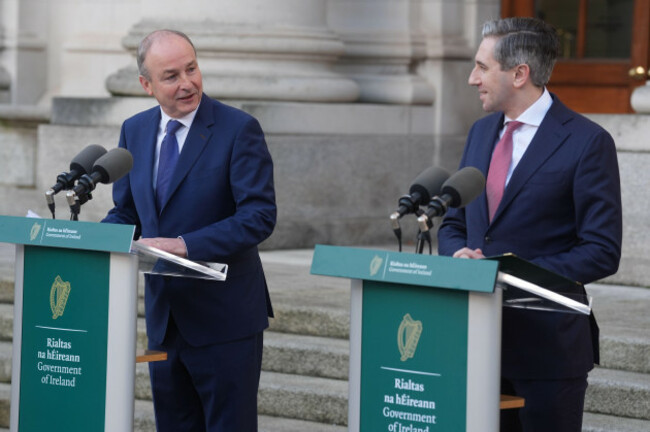
taoiseach-micheal-martin-and-tanaiste-simon-harris-at-the-launch-the-accelerating-infrastructure-report-and-action-plan-at-the-government-buildings-in-dublin-picture-date-wednesday-december-3-20 Taoiseach Micheál Martin and Tánaiste Simon Harris. The government has always maintained that Ireland is 'militarily neutral, but not politically neutral'. Alamy Stock Photo Alamy Stock Photo

This too was a symptom of the “hiatus from history.” Neutrality was treated as a permanent shield against strategic consequence, rather than a policy choice that demands capability and resilience; look to Sweden, Finland, Switzerland and Austria for lessons in defending neutrality in Europe.

History and reality return

The hiatus is now over, yet Ireland continues to behave as if opting out remains cost-free. Nowhere is this clearer than in the refusal to fully engage with EU defence instruments, most glaringly the failure to draw down SAFE funding and VAT-free EU loans.

These mechanisms are explicitly designed to lower borrowing costs for long-term capability investment. Declining them does not protect neutrality; it simply guarantees higher future expenditure for weaker outcomes. As a net EU contributor, not even our EU colleagues can fathom this one.

The timing could scarcely be worse. Ireland approaches its EU Presidency, signalling hesitation and strategic weakness just as defence capability development accelerates across the EU.

At the same time, the external environment is hardening. A more transactional UK will not indefinitely absorb Irish capability gaps, particularly in areas such as airspace control, maritime security and the protection of undersea infrastructure, especially now that the US is no longer filling its capability gaps. Nor is Brussels likely to remain patient with Member States that speak the language of solidarity while rejecting its instruments.

History has returned, not as abstraction but as cost, risk and consequence. The era of pretend and hope is over. The remaining question is whether Ireland intends to meet it as an adult state, willing to invest, signal seriousness and accept responsibility, or continue mistaking inertia for neutrality and delay for a secret wisdom.

Brigadier General Ger Aherne is a retired Irish general.

Readers like you are keeping these stories free for everyone...
A mix of advertising and supporting contributions helps keep paywalls away from valuable information like this article. Over 5,000 readers like you have already stepped up and support us with a monthly payment or a once-off donation.

Close
21 Comments
This is YOUR comments community. Stay civil, stay constructive, stay on topic. Please familiarise yourself with our comments policy here before taking part.
Leave a Comment
    Submit a report
    Please help us understand how this comment violates our community guidelines.
    Thank you for the feedback
    Your feedback has been sent to our team for review.

    Leave a commentcancel

     
    JournalTv
    News in 60 seconds