We need your help now

Support from readers like you keeps The Journal open.

You are visiting us because we have something you value. Independent, unbiased news that tells the truth. Advertising revenue goes some way to support our mission, but this year it has not been enough.

If you've seen value in our reporting, please contribute what you can, so we can continue to produce accurate and meaningful journalism. For everyone who needs it.

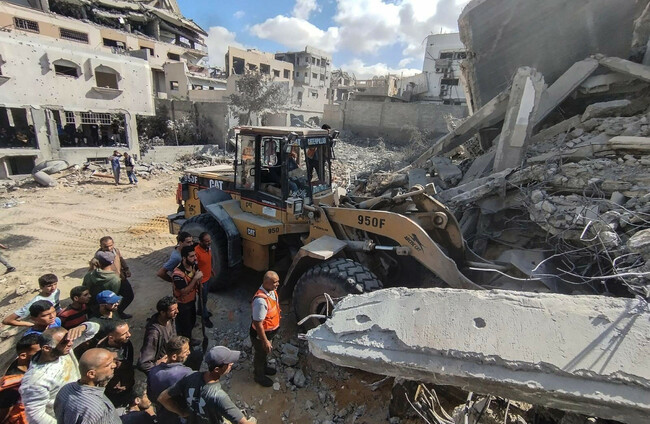
Much of Gaza has been destroyed by Israeli strikes over the last two years. Alamy

Palestinian in Ireland My brother returned to our town in Gaza. He found silence and dust.

Without urgent relief and rebuilding, Gaza’s people face an intergenerational catastrophe, writes Walaa Sabah.

WHEN MY BROTHER Ahmed tried to return to our neighbourhood in Gaza City, he couldn’t last a night. “It’s a ghost city,” he said.

Buildings once twenty meters high are “crushed like biscuits”.

To get a loaf of bread, he walked four kilometers to a bakery that burned wood scraps to fire their ovens.

“There’s no water, no sanitation, no light—only silence and dust,” he described.

$70 billion and decades of time — that’s the estimate of what it will take to rebuild Gaza’s decimated infrastructure.

Roads are reduced to rubble. Hospitals lie hollow. The water system is unreliable, fuel is a luxury, and electricity is an afterthought. For a territory already on its knees, this pause isn’t a peace plan — it’s paralysis. Unless the international community acts decisively, Gaza’s destruction will extend far beyond its physical ruins — exhausting hope, health, and humanity.

The ceasefire deal has brought silence, but not relief

Over one million Gazans have been forcibly displaced from their homes in the north during Israel’s war on the Strip. The most recent exodus just came last month, when Israeli quadcopters dropped leaflets ordering the remaining residents to evacuate Gaza City and move south, once again, completely.

Fathi Kamel, a 61-year-old man who had returned to Gaza City from Al-Mawasi this February after a temporary ceasefire, pitched his tent beside the rubble of his home in the Al-Shuja’iya neighbourhood.

When Israeli forces broke the truce and ordered another evacuation, he fled south along with his family, only to be asked to pay €181.40 “for the very sand where I set up my tent,” he said.

Prior to October 7, that sum would have covered a month’s rent for a two-bedroom apartment in Khan Younis.

In today’s devastated economy, with livelihoods erased and incomes gone, it is an impossible expense for an elderly man whose home, built over a lifetime, was obliterated in a matter of seconds by an Israeli airstrike.

A ceasefire without peace

After two years of bombardment, the guns may have gone quiet. But this quiet is not relief. Before the ceasefire, people were consumed with the sheer effort of staying alive. Now that the sky has stopped falling, the weight of their shock and trauma is beginning to settle in.

A recent World Health Organisation report on cases of trauma among Gaza’s children found that conflict has disrupted every aspect of their world – home, school, community, and family – leaving them with little context for recovery.

The authors note that the trauma is ongoing rather than a single event, and that without “restoring safety, predictability and environments conducive to healing, the psychological burden on children is likely to persist and lead to long-term harm.”

The material devastation is staggering. More than 90% of residential structures have been damaged or destroyed – nearly half beyond repair. Over 70% of Gaza’s 600 water and sanitation facilities lie in ruins. None of Gaza’s 36 hospitals is fully functional. 97% of school buildings have been damaged, many beyond recognition.

3CXDDGX Extensive destruction caused by Israeli strikes seen in the Sheikh Radwan neighborhood in northern Gaza City, with homes reduced to rubble. Alamy Alamy

According to the United Nations Environment Programme, 53.5 million tonnes of debris now blanket Gaza.

That would be enough debris to bury Croke Park beneath a mountain of rubble reaching 2.5 kilometres into the sky.

Even if families dare to return north, there’s nothing to go back to– only rubble, twisted steel, and ghosts.

Even with a ceasefire, the trickle of aid is profoundly insufficient. The deal promised 600 aid trucks per day. In reality, barely 14% of that number is allowed to enter. Gaza needs a flood of relief, not a slow drip-feed. Food insecurity remains catastrophic, and hunger persists.

Trump’s 21-point mirage

Into this humanitarian vacuum, Trump’s 21-Point Plan landed with the weight of an empty promise. Made not in consultation with Palestinians, it offers no timeline, no roadmap, no funding, and no mechanism for reconstruction. It is, at best, a hostage exchange document masquerading as policy, at worst, a cynical distraction.

The Plan says nothing about Gaza’s homeless orphans— many with catastrophic injuries — its destroyed hospitals, or the strangled economy.

It proposes no mechanism for job creation, no safeguards for aid distribution, no fix for the 48% withdrawal fees strangling what little cash remains due to the Israeli restrictions on funds, and no accountability for the ongoing blockade.

It’s a political mirage – designed to appear like a plan, but offering nothing to those who are bleeding.

The rhetoric of “aid getting in” does not mean it’s reaching people. Convoys face impossible bottlenecks, such as security checks, damaged roads, and distribution barriers. The result is a bureaucracy of cruelty: data that looks good on paper but feeds no mouth.

What Gaza really needs

What Gaza needs is urgent measures to get life back on track. A sustained ceasefire must be paired with unhindered humanitarian access, allowing aid and reconstruction materials to flow freely. Aid and reconstruction workers must be safe to do their jobs without being blocked.

Transparent governance is essential. Meaning, only institutions capable of managing massive reconstruction funds without corruption should be contracted.

In parallel, Gaza needs a decade-long commitment to clear debris and unexploded ordnance. This is the backbone to restoring safety before rebuilding can even begin.

Emergency lifelines such as fuel, clean water, sanitation, temporary hospitals, and education must be restarted—immediately! Economic restart programs should tie job creation directly to reconstruction work. Rehabilitation of services from power grids, desalination plants, clinics, and classrooms must be integrated into the Gaza recovery plan.

This ceasefire may have stopped the sounds of war, but it has not ended the suffering.

Without coordinated action, driven by the EU, the UN, and any state willing to put human life above political optics, Gaza’s destruction will deepen suffering that cannot be undone.

Walaa Sabah is a freelance journalist from Gaza.

Readers like you are keeping these stories free for everyone...
A mix of advertising and supporting contributions helps keep paywalls away from valuable information like this article. Over 5,000 readers like you have already stepped up and support us with a monthly payment or a once-off donation.

Close
JournalTv
News in 60 seconds