We need your help now

Support from readers like you keeps The Journal open.

You are visiting us because we have something you value. Independent, unbiased news that tells the truth. Advertising revenue goes some way to support our mission, but this year it has not been enough.

If you've seen value in our reporting, please contribute what you can, so we can continue to produce accurate and meaningful journalism. For everyone who needs it.

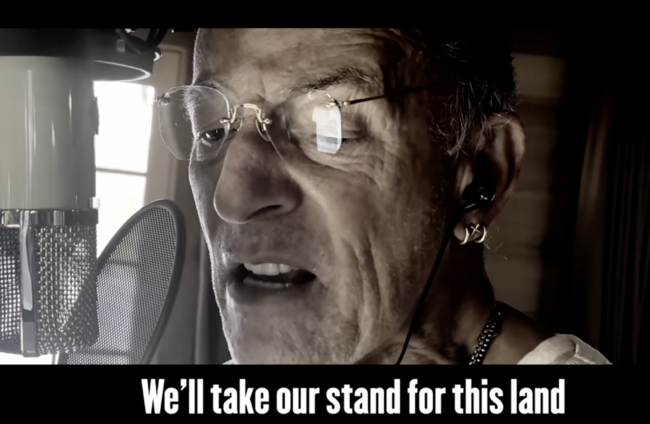
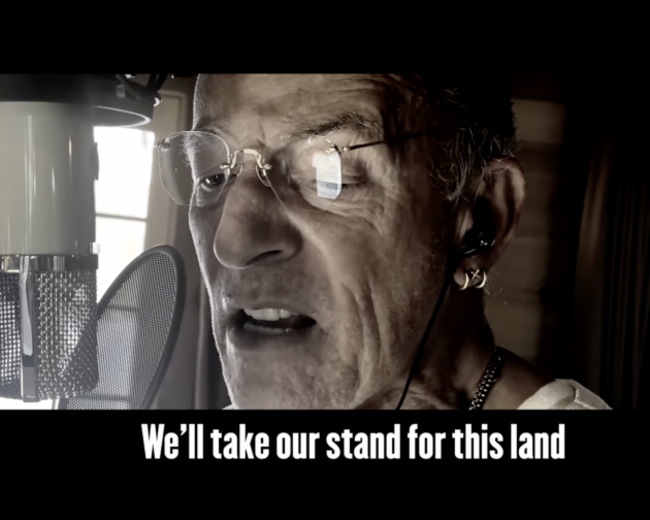
'The Boss' Bruce Springsteen released a protest song against Trump's ICE. instagram/springsteen

Rockin' in the Free World Music fights back against oppression, but is it working?

From Springsteen to Billie Eilish, musicians are raising their voices against injustice — but in an age of cynicism, Jack Campbell wonders if protest music can still provoke action.

THE GRAMMY AWARDS this weekend were not without their fair share of political statements. Artists like Olivia Dean, Billie Eilish and Bad Bunny all had Donald Trump’s ICE in their sights. 

Accepting her award for song of the year, Eilish said, “I feel so honoured every time I get to be in this room, and as grateful as I feel, I honestly don’t feel like I need to say anything.

“But that no one is illegal on stolen land… It’s just really hard to know what to say and what to do right now, and I just, I feel really hopeful in this room, and I feel like we just need to keep fighting and speaking up and protesting, and our voices really do matter, and the people matter.” 

The protest speeches were met with applause, and came on the back of months of tension after the controversial conduct of ICE in Minnesota, in particular. The controversial lifting of hundreds of people of colour under the guise of immigration enforcement by ICE, mixed with the wrongful deaths of two protesters at the hands of ICE officers, has inflamed tensions in the US. 

MixCollage-03-Feb-2026-03-14-PM-2730 Olivia Dean, Bad Bunny and Billie Eilish made statements at the Grammys. Alamy Alamy

Artists’ speeches are one thing, but what about the use of songs as protest? Last week, Bruce Springsteen released a surprise song, hastily recorded to commemorate the Minnesota ICE murders. The Boss has a long history of socially conscious music, but ‘Streets of Minneapolis’ is perhaps the closest he has ever come to a protest record.

This intervention comes off the back of Springsteen’s Land of Hope and Dreams tour last year, where he made unprecedented attacks on the Trump administration from the stage, urging audiences to “raise your voices against authoritarianism and let freedom ring.”

Screenshot 2026-02-03 at 11.45.10 'The Boss' Bruce Springsteen released a protest song against Trump's ICE. instagram / springsteen instagram / springsteen / springsteen

The English singer-songwriter Billy Bragg has similarly released a response to the events of Minneapolis, ‘City of Heroes’, while the American folk singer, Jesse Welles, just a few months prior released ‘Join Ice’, a criticism of the wider actions of the organisation.

Raising voices

None of these songs would win plaudits for their artistry. Yet, as one commentator noted in The Guardian, that isn’t the point. These singers are swapping metaphor for message, such that “it isn’t open to interpretation” what the songs mean. They are so simple and so clear in purpose that, if you bend your ear, you can almost hear echoes of the folk greats, Guthrie, Ochs and Seeger, in the lines. 
 
What is similarly interesting about these recent musical interventions is the speed with which they have been written and recorded. Both Springsteen and Bragg released their songs within days of the killings in Minneapolis. Welles has recorded no less than four studio albums this past year alone, stacked with topical songs from ‘Red’ to ‘No Kings’. This reactivity connects these artists into a long folk lineage of ‘singing the news’. “Every newspaper headline is a potential song”, wrote Phil Ochs in the folk magazine Broadside in 1963.

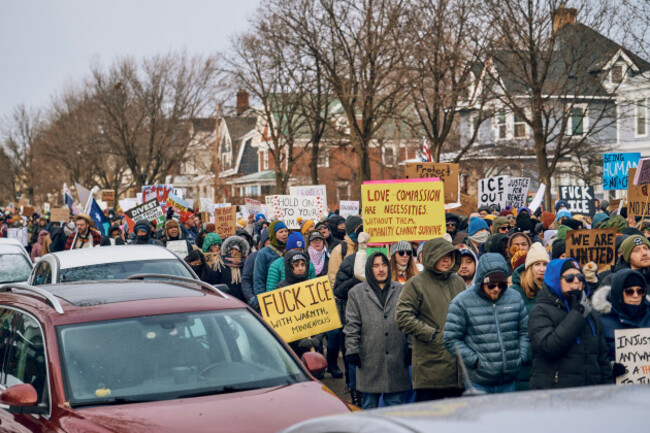
ice-out-protest-january-10-2026-in-minneapolis-mn-united-states-immigration-and-customs-enforcement-ice-agent-shot-and-killed-renee-good-in-min Ice Out protest in Minneapolis, MN. Alamy Stock Photo Alamy Stock Photo

There is a big political difference between Springsteen and co. and the folk singers of old, however. Where they were still part of a society in which access to information was relatively low, and the folk singer sang the news in order to inform the public, we are today only too aware of world events.

We are in a historically unique position of seeing in real-time the injustice, oppression and violence of our societies and to realise our failure at collectively combating these issues. Springsteen sings as much in his song. All we have are “these whistles and phones/ Against Miller and Noem’s dirty lies”, suggesting the vital role social media is playing as a testimony to the atrocities.

How effective is the protest song?

How do we as citizens, especially those in the US, continue to live our lives as normally as one of the world’s greatest democracies slides towards authoritarianism? The Slovenian philosopher Slavoj Žižek suggests that to do so we create a cynical distance from events, through which we are able to disavow our own need to act, allowing us turn a blind eye to what we see. “Just don’t believe your eyes” is the position of the administration, as Springsteen puts it in his song – but it may implicitly be our own response.

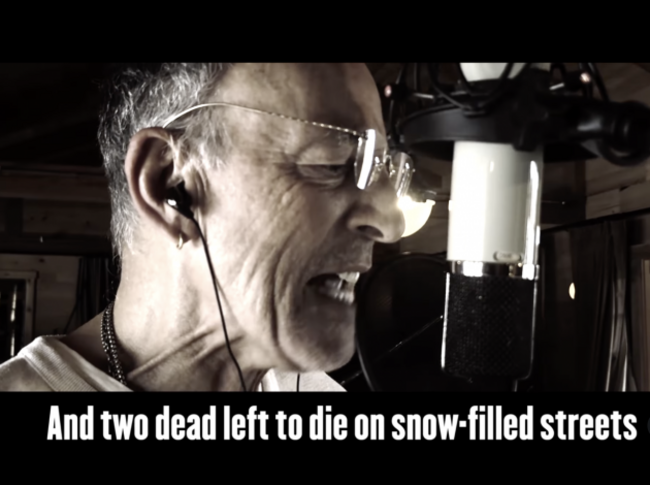
Screenshot 2026-02-03 at 11.44.52 'The Boss' Bruce Springsteen released a protest song against Trump's ICE. instagram / springsteen instagram / springsteen / springsteen

In some way, then, Springsteen, Bragg, Welles and the rest are forcing our eyes back on to the scene before we move on. But this may still be drawn into a Žižekian cyncism. Drawing on Žižek’s work, and others, the social theorist Mark Fisher describes an ‘interpassivity’ that feeds off our awareness of world events in order for us to forget about them. To listen to music, according to Fisher, may be “a walling up against the social”, a way to “retreat into private… consumer bliss”.

By watching others perform our activism for us, we can renounce having to act ourselves. In this way, the protest singer is directly implicated in our own inaction. By listening to songs of protest, we put the burden of testimony onto the performer, allowing us to continue to live our lives as normal. The stadium protest, as on Springsteen’s tour last year, is the epitome of Fisher’s interpassive approach. The Boss tells us of the horrors going on in the US, and dedicates his music to the struggle for a better world. We clap and cheer at Bruce, and boo at the mention of Trump. He sings his setlist, we drink beer and enjoy the evening. Then the lights go up, we shuffle out of the stadium and get on with our lives. 

To use another concept employed by Fisher, our return to protest music may be hauntological, in harking back to a lost past. Yet as the aphorism goes, history repeats itself first as tragedy, then as farce. The tragedy of the 1960s folk movement was its hopefulness that it could really end the war in Vietnam. Phil Ochs went so far as to simply declare that ‘The War is Over’, as if by singing it, then it would become true.

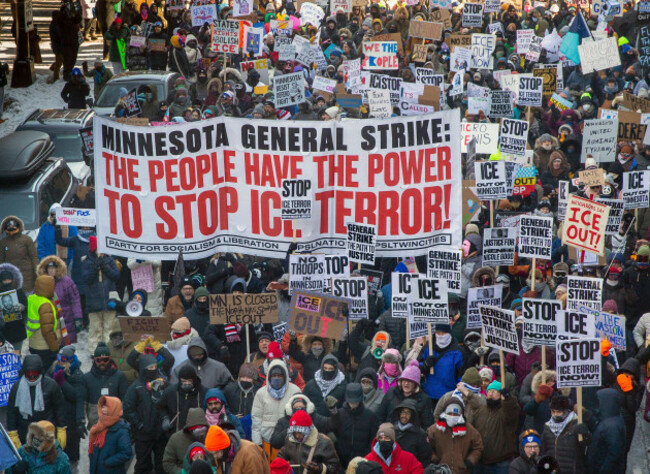
ice-out-mn-protest-rally-and-general-strike-in-minneapolis-protesting-the-immigration-customs-and-enforcement-raids-and-presence-in-minnesota ICE Out MN protest rally and General Strike in Minneapolis protesting the Immigration Customs and Enforcement raids and presence in Minnesota. Alamy Stock Photo Alamy Stock Photo

Our repeat of this moment may be farcical, then, in that we know that our interventions won’t succeed. As Žižek notes, our cynicism has developed over our repeated failure at collective action, beginning perhaps most strongly with the anti-war movement in Vietnam, and later Iraq, through to the post-crash Occupy movement and, most recently, Black Lives Matter.

A song cannot change the world, clearly, if even on-the-ground protest movements cannot. Dorian Lynskey argues, in his book on protest music, that this failure “is entangled with a broader loss of faith in ideology and a fading belief in what we might call heroes”, linked exactly to Žižek’s argument of disavowal.

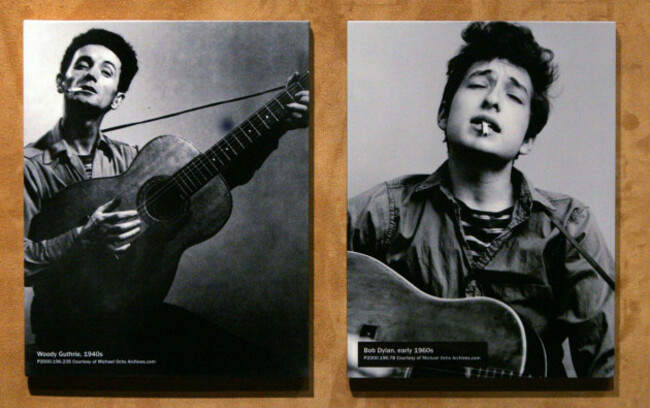
advance-for-weekend-editions-nov-20-21-a-photo-of-woody-guthrie-from-the-1940s-left-is-displayed-next-to-one-of-bob-dylan-from-the-1960s-as-part-of-a-new-display-about-dylan-at-the-exper Woody Guthrie in 1940's, left was the father of the American protest song. He heavily influenced Bob Dylan, right, in the 1960's. Alamy Stock Photo Alamy Stock Photo

What might the role of protest music today then be, in the face of our cynical distance from world events? Perhaps it succeeds in creating those heroes Lynskey talks of, from Guthrie’s ‘Pretty Boy Floyd’ to Dylan’s ‘Hurricane’, whose stories we still sing today.

Bruce Springsteen, in ‘Streets of Minneapolis’, immortalises the slain of recent days: “Two dead, left to die on snow-filled streets, Alex Pretti and Renee Good”. As Phil Ochs wrote in his essay in Broadside, “Topical music is often a method of keeping alive a name or event that is worth remembering”.

Springsteen’s song ends with perhaps his clearest evocation of this role of the song, and of protest music more broadly: a testimony of horror, an account for the historical record, the creation of new heroes. “We’ll remember the names of those who died on the streets of Minneapolis”.

Jack Campbell is a PhD researcher in accounting and everyday life at Dublin City University, funded by Research Ireland. He researches social and political accountability in everyday contexts, particularly social media and social protest music. 

Readers like you are keeping these stories free for everyone...
A mix of advertising and supporting contributions helps keep paywalls away from valuable information like this article. Over 5,000 readers like you have already stepped up and support us with a monthly payment or a once-off donation.

View 27 comments
Close
27 Comments
This is YOUR comments community. Stay civil, stay constructive, stay on topic. Please familiarise yourself with our comments policy here before taking part.
Leave a Comment
    Submit a report
    Please help us understand how this comment violates our community guidelines.
    Thank you for the feedback
    Your feedback has been sent to our team for review.

    Leave a commentcancel

     
    JournalTv
    News in 60 seconds