We need your help now

Support from readers like you keeps The Journal open.

You are visiting us because we have something you value. Independent, unbiased news that tells the truth. Advertising revenue goes some way to support our mission, but this year it has not been enough.

If you've seen value in our reporting, please contribute what you can, so we can continue to produce accurate and meaningful journalism. For everyone who needs it.

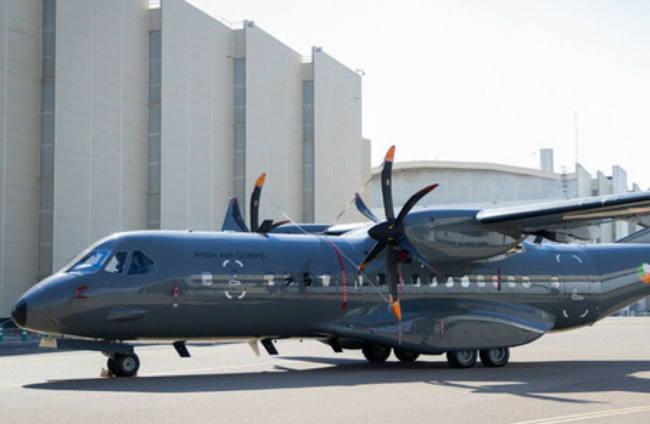
A photo of a new military aircraft recently delivered to Ireland. Department of Defence Department of Defence

Opinion Europe is tired of Ireland's low defence investment - here's a step towards fixing that

Ireland would stand to gain from joining up to a European system of pooling and sharing aircraft resources, writes Kevin Phipps.

IT IS FAIR to say Ireland’s Defence Forces have been starved of resources for many years now.

Spending on military capability is at the bottom of European league tables where we languish perennially welded to the bottom of the relegation zone at 0.2% of GDP.

Commitments by Government to reach for Level of Ambition 2 following the Commission on Defence report of 2021 should see spending increase in the coming years to address specific priority gaps in our ability to deal with an assault on Irish sovereignty and to serve in higher intensity Peace Support Operations. Minister for Defence Helen McEntee recently announced a record (only a record in Ireland) €1.7bn investment out to 2030 encompassing funds from the National Development Plan.

The legacy of years of underspend has seen aging infrastructure and defence systems and major issues with retention of key personnel resulting in some of our Naval Service Ships being tied up and our Army withdrawing from the UN mandated Mission in Syria. The Air Corps has also seen issues with the provision of Air Traffic control services and shortages of technical staff to service aircraft.

Operationally, the impact of underinvestment in defence is evidenced on our television screens and in the newspapers when global events require a military response in support of humanitarian efforts, the rescuing of citizens caught up in global conflict the likes of which we witnessed in Kabul, Afghanistan in 2021.

All too often, Ireland has gone cap in hand to other European partners for aid in providing space on their military aircraft to airlift Irish citizens to safety or to deliver Irish flagged humanitarian aid, or even to fly generators to Ireland to power Irish houses following Storm Éowyn.

Hints of progress

Government investment has taken place in recent years to boost Ireland’s aviation capability with the delivery of two new transport aircraft this year.

Firstly, the Airbus 295 which is a small transport aircraft not dissimilar in size to the propeller driven commuter aircraft that ferry people over and back to the UK from Dublin Airport.


Secondly, this week we saw a Falcon 6X 14 seater Jet aircraft delivered to the Air Corps which provides global reach to the Defence Forces supporting ministerial travel as well as logistical support to overseas DF missions.

These aircraft represent a serious investment but despite the spin they are not the solution to existing problems.

The Airbus 295 takes 12 hours to fly out to our troops in Beirut while only carrying a few tons or cargo and the Falcon while fast and sleek has room for only 14 passengers. We need to somehow grow our investment in order to access different capabilities when we need them.

Pooling resources

The European Air Transport Command (EATC) retraces its origins to the EU Helsinki Summit in 1999 which declared strategic  transport a priority capability gap.

France and Germany were the launch countries for  the initiative and EATC was formally inaugurated in 2010 with 155 personnel and  aircraft drawn from France, Germany, Belgium and the Netherlands with Spain and  Luxembourg and Italy joining later.

Membership requires member states to submit  operational control of their aircraft to a “Pooling and Sharing” mechanism. To date  EATC has operational control over a fleet of 170 aircraft large and small. Headquartered in Eindhoven in the Netherlands, with over 200 support personnel it  handles the full process from planning, tasking and operational support to the pool of  aircraft. EATC chooses the aircraft which best fits to the requirements of the mission  at hand.

That could be flying government ministers to a meeting in a business jet, flying  humanitarian aid to Africa in a large transport aircraft or flying troops to a UN mission area in an military airliner.

So what’s the benefit for Ireland and how much does it cost?

Cash is not king when it comes to paying bills in EATC. It trades in the currency of “Equivalent Flight Hours”, where Ireland would contribute more flying hours on our smaller aircraft to access larger more capable aircraft in the EATC pool.

It is hard to understand why Ireland has taken so long to make the decision to plug itself into the EATC pooling and sharing mechanism. Interestingly, Tánasite Simon Harris in responding to a parliamentary question while he was minister for defence has already show positive inclinations to the scheme.

He said the new Airbus 295  would “allow Ireland to access this ‘pooling and sharing’ option and utilise hours on larger strategic heavy-lift aircraft in exchange for Ireland contributing to the shared pool by offering partner nations hours on the C-295M military transport aircraft”.

“Consideration is being given to Ireland joining this initiative, which would provide the State with access to larger strategic airlift platforms should the need arise, and ameliorate the need for the State to purchase a dedicated heavy-lift aircraft, giving the Defence Forces robust access to strategic airlift capabilities when required, but without the associated costs of ownership and operation,” Harris said.

The strategic benefits for Ireland exist both in the hard power of a variety of transport capabilities on demand but also the soft power of contributing human capital to the EATC HQ in Eindhoven.

Involving itself in the running of the Euro airlift project has great benefits for Irish personnel, not least in standardisation of operational procedures aligning the Irish Air Corps with how other European air forces operate, but also in overseas service opportunities for support staff which has always been seen as a positive retention initiative.

Integration into the EATC would no doubt be a positive for Ireland in providing flexibility to be able to react to the next world crisis and allow it to access air transport capability that we have historically been unwilling to invest in.

Ireland’s commitment to European defence structures exists already with our troops serving in multinational EU battle groups but EATC membership would be an easy win for Ireland at a time when European nations are becoming fed up with Ireland’s lack of focus and investment in its own Defence and security given the European war that rages in Ukraine. We cannot continue to be seen as the weak link in Europe.

Kevin Phipps is an airline captain and retired Irish Air Corps officer.

Readers like you are keeping these stories free for everyone...
A mix of advertising and supporting contributions helps keep paywalls away from valuable information like this article. Over 5,000 readers like you have already stepped up and support us with a monthly payment or a once-off donation.

Close
JournalTv
News in 60 seconds