We need your help now

Support from readers like you keeps The Journal open.

You are visiting us because we have something you value. Independent, unbiased news that tells the truth. Advertising revenue goes some way to support our mission, but this year it has not been enough.

If you've seen value in our reporting, please contribute what you can, so we can continue to produce accurate and meaningful journalism. For everyone who needs it.

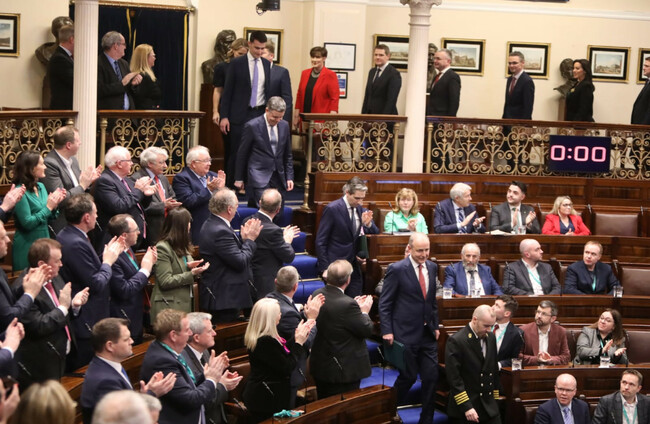
The Taoiseach, Tánaiste and ministers entering the Dáil after formally taking up their positions on 23 January 2025. Oireachtas/Flickr

Opinion We have a go-slow government and a dysfunctional Dáil

Social Democrats TD Pádraig Rice argues that the low number of bills enacted in 2025 is a sign of a poor government.

AS WE LOOK back on the first full year of this Oireachtas, the verdict is clear – this is a go-slow government and a dysfunctional Dáil.

A detailed analysis of the statute book shows that fewer bills have been enacted in 2025 than any year since the foundation of the State. When I challenged the Government Chief Whip on this in the Dáil, she said it wasn’t true. But, unfortunately the facts don’t lie.

By year end, just 21 bills have been enacted. This stands in sharp contrast to 2015 when 66 bills were enacted. A staggering fall in productivity from our government ministers.

In the history of the State, 2025 saw the lowest number of bills enacted of any full calendar year (there were just six bills enacted in 1922, but the Free State was only established in December of that year).

The next lowest were in 1944 and 2016, both with 22 new laws. However, both of these were election years. 2025 wasn’t. In fact, half of the years with the fewest bills enacted relatively were election years. 

A decade ago, 2015 had the highest number of bills ever enacted in Ireland, many of important substance. Both the Marriage Equality Act and the Gender Recognition Act were passed that year. We also had the Assisted Decision Making Act, Children First Act, the Climate Action Act and the establishment of the Low Pay Commission via the National Minimum Wage (Low Pay Commission Act). Each of these acts made a real and lasting difference in people lives.

The 21 bills enacted in 2025 is far lower than the record high of 66 of 2015 and also well below the average rate of 38 bills per year.

I and other opposition TDs repeatedly highlighted throughout the year how much Dáil time was wasted on statements that could have been used to progress vital legislation.

Neither quantity nor quality

This isn’t just about numbers – it’s about substance too. Of the 21 new laws, there is nothing transformative, nothing radical, nothing that will turn the tide on the many crises we face.

Crucially, it is also worth considering what wasn’t passed. No Occupied Territories Act. No bills to cap childcare fees or to provide a right to housing or home care.

The issues that dominated the general election last year remain unresolved.

In fact, things have gotten worse instead of better. Homelessness has increased, hospitals are under increased strain and the climate crisis worsens.

This is a government lacking in energy, enthusiasm and eagerness. A government wounded by the departure of its most senior minister.

It seems to me that both Fianna Fáil and Fine Gael are more concerned with internal divisions, potential leadership challenges and factional rivalry than they are with the concerns of the nation.

How the Dáil works

At the same time, we have a Dáil that is in dire need of reform. We need a more powerful parliament that is better equipped at holding the government to account. We also need a parliament that is more responsive, more open and more family friendly.

Recently, a group of 113 civil society organisations wrote to the clerk of the Dáil to highlight their collective concerns about how the Dáil manages its business. Core to their complaint was that the process of external input is “opaque, inconsistent and difficult to track in a predictable way.” I have to agree.

They also highlighted that Ireland scores fourth lowest of all 38 OECD countries when it comes to external engagement in developing primary laws. This isn’t a position we should be proud of. We need an Oireachtas that is better at engaging with people who are directly affected by the decisions we make.

As an opposition TD, this task is made harder by the stranglehold the government has on the legislative agenda. We are given less than one weeks’ notice of upcoming bills and motions. The Dáil schedule is shared on a Thursday for the following Tuesday.

This gives very little time to prepare for debates, to consult experts or to simply gather information from those most impacted.

It is done like this to limit engagement and to maximise control. There is no reason why a provisional agenda could not be set out weeks in advance.

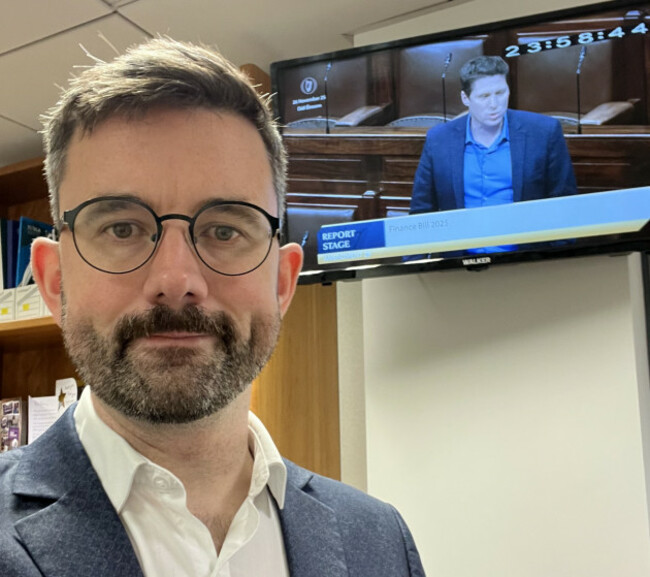
On several occasions recently, the Dáil has sat past midnight. This wasn’t done to deal with an emergency or exceptional circumstance. It was scheduled like this to deal with everyday votes.

IMG_9100 (1) (1) Pádraig Rice in Leinster House while a debate was ongoing in the Dáil. The timestamp shows 11.58pm. Pádraig Rice Pádraig Rice

There is something fundamentally wrong about a parliament voting on bills and motions in the middle of the night while citizens sleep.

There is no logical reason why votes scheduled for midnight could not take place at midday.

It is done like this to evade scrutiny as fewer people are watching. A few dedicated political journalists may remain, but their print deadlines have come and gone and there will be another story in the morning.

Sitting through the night as a matter of course is also at odds with the stated objective of being a family friendly parliament. If we want more young people and more women in the Dáil then we have to make it more compatible with family life.

As we look to the year ahead, I hope the government returns with the promised ‘new energy’ we heard so much about during the last election. I hope the Dáil can become more effective and efficient but fundamentally, I hope the challenges citizens face – from healthcare and childcare to accessing housing and disability services – are addressed and resolved.

To get there we need a more proactive Government and a more dynamic Dáil. This is my wish for 2026.

Pádraig Rice is a Social Democrats TD for Cork South-Central.

Readers like you are keeping these stories free for everyone...
A mix of advertising and supporting contributions helps keep paywalls away from valuable information like this article. Over 5,000 readers like you have already stepped up and support us with a monthly payment or a once-off donation.

View 31 comments
Close
31 Comments
This is YOUR comments community. Stay civil, stay constructive, stay on topic. Please familiarise yourself with our comments policy here before taking part.
Leave a Comment
    Submit a report
    Please help us understand how this comment violates our community guidelines.
    Thank you for the feedback
    Your feedback has been sent to our team for review.

    Leave a commentcancel

     
    JournalTv
    News in 60 seconds