We need your help now

Support from readers like you keeps The Journal open.

You are visiting us because we have something you value. Independent, unbiased news that tells the truth. Advertising revenue goes some way to support our mission, but this year it has not been enough.

If you've seen value in our reporting, please contribute what you can, so we can continue to produce accurate and meaningful journalism. For everyone who needs it.

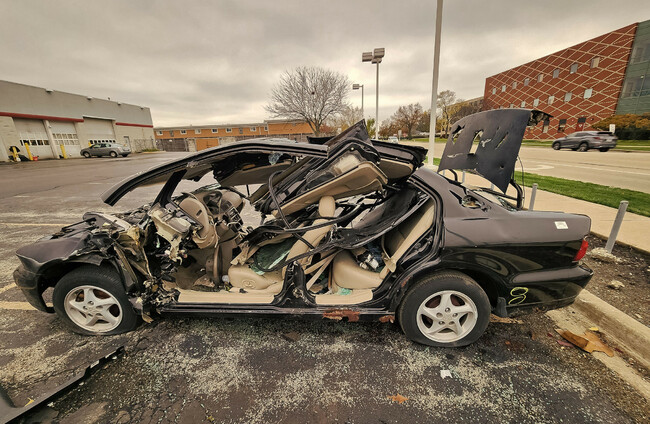
A car after a crash in Chicago last year Alamy Stock Photo

The reality of driving Our brains do not understand the risks we face if we crash

Our motoring expert on our false sense of security: a car coming to a halt from 100 km/h imposes deceleration forces comparable to a major fall from height – no amount of technology can fully cushion that.

SIT INTO A car and something strange happens to many people. For many, their sense of risk drops almost instantly. They close the door, settle into the seat, and the world feels a little further away.

Inside a warm, quiet cabin surrounded by steel, glass, airbags and driver-assist tech, danger feels abstract. It is one of the strongest distortions in road safety. The reason is pretty simple: cars remove the sensory cues our brains rely on.

You can’t feel the wind, hear other people, or judge proximity the way you can on foot or on a bicycle or even on a motorbike. I don’t ride a motorbike, but I have friends that do and they tell me you literally cannot do anything else or think of anything else when you ride a motorbike. It demands your full, undivided attention. And often it is to make sure cars don’t hit you.

Because the car removes many signals, the brain often underestimates the risk. It can explain, in part, why we might tailgate without thinking, some use their phones at traffic lights, and creep above the limit on familiar roads. This cocoon makes danger feel distant.

But the real-world numbers cut through that illusion very quickly.

As of 19 November 2025, 158 people have died on Irish roads — nine more than at the same point last year. Drivers account for the largest share at 60 deaths, followed by 36 pedestrians, 28 motorcyclists, 18 passengers, 13 cyclists, two e-scooter users and one pillion passenger.

Fatal collisions themselves are also up: 149 crashes this year compared with 138 by the same date in 2024. The trend is moving in the wrong direction, and the cocoon effect we feel in newer cars stands in stark contrast with the fragility of the human body when things go wrong.

However, the protection that modern cars genuinely offer has limits – and those limits are set not by technology, but by physics. Seatbelts and airbags have saved countless lives. Although it is still astonishing, five decades (1979) after they became compulsory in Ireland, that a lack of them being used is often cited as a reason for a fatality. In 2025, there are many drivers that still have to be reminded to use them. And there are people who still don’t and won’t.

Strong crash structures, crumple zones and modern restraint systems are remarkable at moderating the forces that reach your body. But they only work within the range of crashes they were designed for, and that range is narrower than most people realise.

Take the Euro NCAP safety tests that we have become so familiar with. Euro NCAP’s main frontal safety test happens at 50 km/h — lower than the speeds involved in many real-world crashes.

Crash energy increases with the square of speed. Doubling your speed doesn’t double the force — it quadruples it. At moderate urban speeds, the car has enough space and structural “give” to lengthen the time it takes for your body to decelerate. That extra fraction of a second is what airbags and seat belts exploit. But at higher speeds, there simply isn’t enough time or distance inside any vehicle to slow the body down gently, no matter how advanced the tech is.

That’s why survival rates fall sharply as impact speeds rise. Research bodies including Euro NCAP and the European Transport Safety Council have repeatedly shown that once impact speeds exceed the typical test range, injury risk rises very quickly — but the exact thresholds vary depending on vehicle type, crash configuration and intrusion levels, so there is no single “survivable” number.

Studies in Australia and the United States also show a similar pattern: when impact speeds rise beyond the range vehicles are designed to manage, the forces involved can exceed what the human body can tolerate. Even vehicles rated five-stars for safety can see severe cabin intrusion or fatal deceleration forces at higher impact speeds, depending on the crash scenario.

You can wear the best seatbelt in the world and sit inside the safest car ever built, but once the energy exceeds what the human body can withstand, the outcome doesn’t change.

This pattern is reflected in the ages of people dying on Irish roads too.

After two years of rising fatalities in 2022 and 2023, there was a decline in 2024 – but the overall trend is still worrying. Young people remain over-represented in fatal crashes. RSA data over recent years shows a consistently higher proportion of deaths among drivers and passengers aged under 25 compared with other age groups.

What the body experiences in a crash

A crash is not a single impact but a chain of them that happen in milliseconds. The car stops first. Your body stops second, when it hits the belt or airbag. Inside your body, your organs stop last. That final internal collision is what causes many fatal injuries. The brain still moves inside the skull. The heart, lungs and liver still shift violently within the torso. Human tissue cannot tolerate that kind of sudden deceleration. RoadSense, an Australian road-safety group, describes these internal forces as key injury mechanisms in serious collisions.

Even with all safety systems functioning perfectly, a car coming to a halt from 100 km/h imposes deceleration forces comparable to a major fall from height. No amount of technology can fully cushion that.

Head-on collisions are particularly devastating. Two cars travelling at 80 km/h each do not behave like a single car hitting a wall at 80; the energy involved is much greater. And when the two vehicles are not equal in size or weight, the smaller one absorbs far more of that energy.

This is one of the most consistent findings in global crash research. The Insurance Institute for Highway Safety in the US has shown repeatedly that occupants of smaller cars face significantly higher fatality risk in head-on collisions with heavier SUVs or pickups, even when both vehicles perform well in crash tests. The mismatch in mass means the heavier vehicle keeps moving forward longer, while the smaller one collapses more abruptly, subjecting its occupants to far greater forces.

This helps explain many outcomes that seem and often are shocking to the public. They are not about driving ability or vehicle brand. They are the direct, unavoidable result of physics.

False sense of security

Modern cars make us feel protected. They are quieter, stronger and more technologically advanced than anything on the road 20 years ago. But that sense of security can lull us into behaviours that undo the very safety the engineering is designed to deliver.

We feel calm because the cabin feels calm. We forget that at 80 or 100 km/h, our body is carrying enormous kinetic energy — energy that must go somewhere if something goes wrong. The safest part of any journey is not the airbags or the crash structure. It is the behaviour of the person behind the wheel, the speed they choose, and the space they leave between themselves and others. Often seemingly innocuous decisions can have devastating results.

Cars remove discomfort. But they do not remove physics.

What Ireland does next

Ireland is preparing the next phase of its road-safety actions for the middle of this decade. After a period of rising deaths – especially among young people – the focus is shifting back to basics: lower speeds, safer roads, and stronger deterrence for high-risk behaviour.

The Department of Transport and its road-safety partners are working on measures that include delivering the national speed-limit review, expanding the use of camera-based enforcement, building more divided roads, and improving safety on walking, cycling and public-transport routes. Proposals for an alcohol-interlock programme are also being advanced for repeat or high-risk drink-driving offenders.

All of these changes have one aim: to narrow the gap between how safe we think modern roads feel, and how dangerous they can be when things go wrong.

Physics ultimately decides the outcome of a crash — but policy, road design and behaviour decide whether the crash happens at all.

Paddy Comyn is the Head of Automotive Content and Communications with DoneDeal Cars. He has been involved in the Irish Motor Industry for more than 25 years. 

Note: Journal Media Ltd has shareholders in common with Done Deal Ltd

Readers like you are keeping these stories free for everyone...
A mix of advertising and supporting contributions helps keep paywalls away from valuable information like this article. Over 5,000 readers like you have already stepped up and support us with a monthly payment or a once-off donation.

View 30 comments
Close
30 Comments
This is YOUR comments community. Stay civil, stay constructive, stay on topic. Please familiarise yourself with our comments policy here before taking part.
Leave a Comment
    Submit a report
    Please help us understand how this comment violates our community guidelines.
    Thank you for the feedback
    Your feedback has been sent to our team for review.

    Leave a commentcancel

     
    JournalTv
    News in 60 seconds