We need your help now

Support from readers like you keeps The Journal open.

You are visiting us because we have something you value. Independent, unbiased news that tells the truth. Advertising revenue goes some way to support our mission, but this year it has not been enough.

If you've seen value in our reporting, please contribute what you can, so we can continue to produce accurate and meaningful journalism. For everyone who needs it.

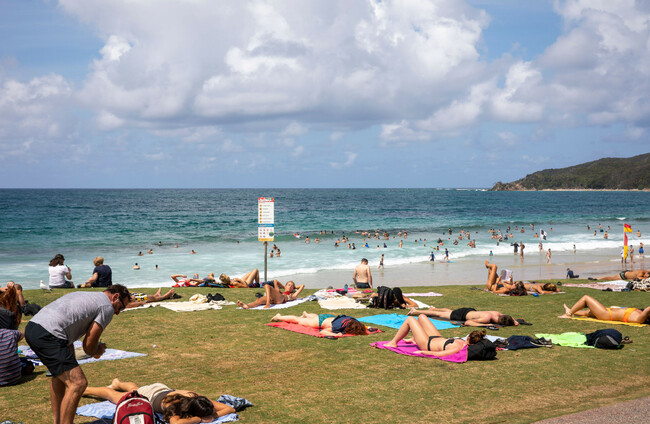
Byron Bay, Australia Alamy Stock Photo

Surrealing in the Years Ireland's latest Australian exodus has no shortage of explanations

In fairness, who doesn’t look at what’s going on in Ireland and occasionally think: ‘Crikey’.

IRELAND’S MASS EXODUS to Australia over the last decade or so makes some measure of sense. 

At one point or another, after all, every one of us has surely taken stock of the social and economic landscape that surrounds us here in Ireland and thought to ourselves what I assume is going through the mind of every Australian person at all times: ‘Crikey’.

It was reported this week that the number of people emigrating from Ireland to Australia is at its highest level since 2013, which will not come as any surprise to the thousands of Irish people in their 20s who have noticed their friends dissolving in real-time, like Marty McFly in Back to the Future when he stops his parents from having sex.

There’s no mystery surrounding this phenomenon. If one of your friends were to tell you that they were moving to Australia tomorrow, you wouldn’t say: ‘Oh my god, what on earth has led you to such a decision?’ You would say: ‘Let me give you the contact details of the other two dozen people I know who have already moved there’.

The appeal of Australia to young Irish people at large is clear. Fosters and wallabies and shrimps on the barbie and salaries that seem to be significantly more commensurate with the cost of living than anything you can find in Ireland. Going to the beach on Christmas? Who the hell do you think you are? Get off Instagram and get back in the gaff. They won’t let you into mass looking like that.

Narratives about emigration from Ireland can often be a bit presumptive. It is not true that everyone who leaves Ireland does so reluctantly. Not everyone is forced out the door by high rents, stagnant wages, and the lack of meaningful job opportunities in key infrastructural areas like healthcare. But many are. 

Another narrative used to justify this state of affairs is that emigration has been part of the Irish way of life for so long that it’s something more like a tradition than it is a reflection of a particular set of social and economic deficiencies. This perspective is especially interesting because there aren’t many other modern behaviours or circumstances that we justify by telling ourselves, ‘Well, we also did this during the famine.’

Others argue that migration away from Ireland is not that big of a deal since so many of those who leave end up coming back. While it’s true that many of those who emigrate do return, there is something strange about a society that appears to be entirely comfortable with conditions that repeatedly decimate the country’s 20-something population — as though once any of us leave college, we’re fed into pneumatic tubes that could drop us anywhere from Sydney to Berlin to London to Glasgow.

It’s a strange feature of Irish society that the fracturing of families and friend groups, as so many young people look abroad for a brighter future, is very much considered to be an inevitable part of life. Perhaps this is written from a place of personal bitterness, since so many of my friends have left me here to stare out across either the Irish Sea or the Atlantic or whatever direction Australia is in and sigh wistfully in the hope they come back to me someday, but does that make it any less valid?

As interesting as it is to pick apart Ireland’s relationship with emigration and the causes thereof, there are other areas of Irish life in which the state’s failure to provide care is much more stark. 

Look, for example, at the mobilisation we’ve seen around the family of Harvey Morrison Sherratt, a young boy who waited for years for spinal surgery, during which time the curve in his spine went from 75 degrees to 130 degrees. In the end, Harvey Morrisson Sherratt was officially on a waiting list before receiving surgery towards the end of last year, by which time his spine could not be properly straightened. Harvey died last month at the age of nine. 

In the aftermath, much of the attention has fallen on Tánaister Simon Harris, who, as Minister for Health in 2017, told Ireland that no child would wait more than four months for scoliosis treatment. 

Speaking to RTÉ this week, Harris said: ‘What I would say is this: successive governments and ministers, including myself, have applied a focus and extra resources to this issue, and despite all of that, we’re nowhere near where we need to be as a country.’ It’s weird to start that sentence with ‘What I would say is this.’ You know, as if you’re about to say something meaningful, rather than a tacit acceptance of a broken promise.

In a similar vein, the latest homelessness figures published by the Department of Housing on Friday finally saw Ireland break the milestone of 5,000 children accessing emergency accommodation services in a month.

Tallying push and pull factors against such a backdrop, you never have to look too hard for a reason why any young Irish person would figure that they have a better chance on the other side of the world. Australia has homelessness, undoubtedly. Australia surely has similar scandals in healthcare. But there is always something especially galling about knowing your own government is letting you down so starkly. 

As the Dáil is in recess, the closest thing we have to any meaningful political movement these days is confined to the pre-presidential campaign we seem to be enduring, whereby it remains unclear whom Fine Gael, Fianna Fáil and Sinn Féin will each nominate. 

This week began with a buzz of rumours that Bertie Ahern might truly be in the mix for Fianna Fáil, threatening to prove once and for all that there are no consequences for anyone as long as they have enough name recognition. Ahern was upstaged as the week wore on, however, as reports emerged that Fianna Fáil were also in conversation with former Dublin senior men’s football manager Jim Gavin. 

Billy Kelleher, an MEP for Fianna Fáil, has officially thrown his name into the hat, which is very funny, because just a few days ago he called on his party to ‘convene urgently’ in the name of picking a presidential nominee, which is sort of the equivalent of convincing your school to put on a talent show because you’ve just learned how to ride the unicycle.

Still, having a party member put their name forward leaves Fianna Fáil a step ahead of Sinn Féin, who can’t decide whether or not to throw their lot in behind Catherine Connolly — perhaps a symptom of the party’s identity crisis over the last few years around how left-wing they really want to be. 

All we know for now about any of the major parties’ candidates is that they will be over 35. That’s partly because it’s a constitutional requirement, but it’s also because anyone under the age of 35 would have to do the job from between seven and nine hours ahead. Depending, of course, on which part of Australia they live in.

Readers like you are keeping these stories free for everyone...
A mix of advertising and supporting contributions helps keep paywalls away from valuable information like this article. Over 5,000 readers like you have already stepped up and support us with a monthly payment or a once-off donation.

Close
JournalTv
News in 60 seconds