We need your help now

Support from readers like you keeps The Journal open.

You are visiting us because we have something you value. Independent, unbiased news that tells the truth. Advertising revenue goes some way to support our mission, but this year it has not been enough.

If you've seen value in our reporting, please contribute what you can, so we can continue to produce accurate and meaningful journalism. For everyone who needs it.

Alamy Stock Photo

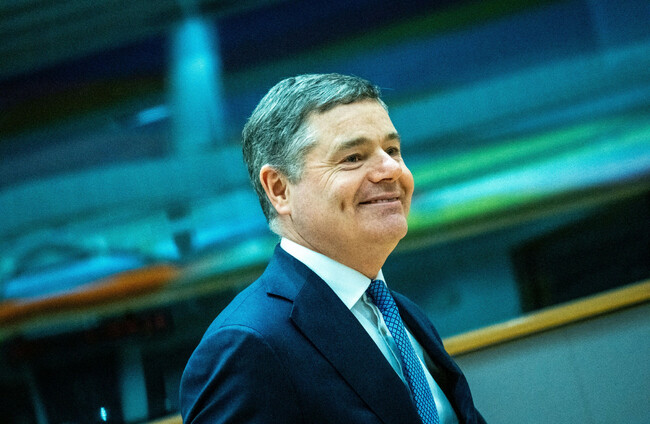
Surrealing in the Years Paschal Donohoe leaves government unscathed, but how?

Donohoe has played a decisive role in every budget since 2016.

IF YOU’RE A politician who wants to get to the very top without anyone ever really even paying that much attention to you, Paschal Donohoe really is the blueprint, isn’t he? 

It was announced this week that Donohoe, who has served as either Minister for Finance or Minister for Public Expenditure and Reform for the better part of the last decade would be moving on to pastures new as Managing Director and Chief Knowledge Officer of the World Bank.

Leaving to one side that ‘Chief Knowledge Officer of the World Bank’ sounds like the kind of title that an eight-year-old would come up with if they were writing a scam email, it does seem pretty cool, doesn’t it? Big salary, off to Washington DC, presumably getting to swim in the vaults like Scrooge McDuck. It’s all really worked out for him. Which is funny, because you don’t often look at the last three or four Taoiseach and think: ‘Wow, it all worked out for them.’ But it’s worked out for Paschal. 

Not only was Donohoe never the leader of Fine Gael, he never even went for it. There were two leadership contests during his time as a cabinet member, either of which would have made him Taoiseach had he won. It seems he was never interested in the top job. In his exit interview this week, he told Morning Ireland: “The pinnacle of my ambition was to be the Minister for Finance.” Which, we all have to admit, is a funny thing to say after you’ve just quit that job to move to what is very objectively a cooler job in every possible way. 

It was as Minister of Finance that Donohoe variably held, tightened, plucked and pulled the purse strings of a state that has failed in so many respects over the course of his tenure, but nobody ever seems particularly bothered by his role in it.

Nobody seems to associate Donohoe with money being held in reserve while the housing and homelessness crises continue unabated, at least not in the same way that they might immediately associate Leo Varadkar, Darragh O’Brien, Micheál Martin or Eoghan Murphy with those same crises. 

Nobody seems to associate the lack of resources and poor pay conditions cited by Gardaí, teachers, nurses, psychologists and whoever else you like with the guy whose role in the finance portfolios has been the only constant since 2016. It’s weird, isn’t it?

Donohoe has emerged from his time in government unscathed, almost undoubtedly the most successful Irish politician of the last ten years, having ruthlessly defended his party’s ideology in government before moving on to one of the most prestigious jobs on earth. Maybe it tells you exactly how far the occasional tax cut, the occasional renter’s credit, the occasional fuel allowance can go. Maybe it’s because he’s smilier than the rest of them. Either way, he’s pulled off something exceedingly rare in any political sphere. 

And in his wake, he leaves us another by-election to look forward to. And not just any old by-election, but a by-election in perhaps the most chaotic constituency of last year’s general election.

Dublin Central was the venue where Labour TD Marie Sherlock narrowly pipped Gerry ‘The Monk’ Hutch to a seat last time around. While it seems unlikely that Hutch has plans to run again, the constituency has proved itself primed for a protest vote, meaning that there is certainly an opportunity for a wild card candidate to cause an upset.

Strangely enough, on-the-ballot-deserver Maria Steen has turned down the opportunity to run. You might be thinking, ‘Well, that’s hardly fair, she doesn’t live in Dublin Central’. True enough, though as President she’d have had to relocate to the neighbouring constituency of Dublin West, so this issue certainly wasn’t a barrier to her ambitions a mere month ago.

Ah Maria, after all those people went to the trouble of writing your name on the ballot last month, you wouldn’t give them the chance to vote for you for real? Why not?

Steen has said she is taking some time to think about ‘what, if anything’ she can ‘add to the political scene in Ireland.’ What, if anything. It’s a rather lukewarm declaration, especially given the amount of time and energy that commentators and columnists have devoted to discussing her and her place in Irish politics over the last month, even as her approach to public service thus far has been Áras or nothing.

Of course, it’s also the constituency of Mary Lou McDonald, which in itself adds a layer of expectation to proceedings. To win a second seat there would be a statement of intent by Sinn Féin, whose decision to back Catherine Connolly in the presidential race ended up paying off. 

Ah, ‘the presidential race’. It is a theory of mine that all political correspondents are secretly sports writers at heart. That’s why we can never seem to make it any more than a few months before the phrase ‘senior hurling’ is getting bandied about. Fortunately for me, this week I get to write about both.

As of Tuesday, Troy Parrott’s last-minute winner against Hungary had been watched on RTÉ’s social media channels over 30,000,000 times. Now, granted, some of that will be an international audience marvelling at how we managed to pull off such a feat after the last nine years of abject misery, but what these numbers also tell you is that we needed this, as a country.

Unfortunately for us though, the draw for the play-offs went about as well as it could be expected on paper. This is always a discomfiting feeling for an Ireland fan, the fear that things seem to be going well. As we’ve just demonstrated for the millionth time, we’re better able for teams with world-class superstars against whom we supposedly have no hope than teams that are still calling up players like Matej Vydra. That’s the kind of thing we would do. 

Our next opponents, Czechia (formerly known to us as the Czech Republic) are no great shakes. They were beaten by the Faroe Islands just over a month ago, undoubtedly thanks to the legacy of Brian Kerr’s time in charge. All this to say that despite our shortcomings, we do have a real chance of beating them. 

If we make it past our Bohemian friends, our final play-off will be a home game against either North Macedonia (the Europeans really do be changing the names of their countries, don’t they?) or, more likely, Denmark. Denmark are not the force they were when they beat us 5-1 in a World Cup play-off seven years ago, though the psychological scars still persist. 

When the games roll around next March, there will rightly be a sense of buzz and optimism around our prospects. This is, of course, the worst thing that could possibly happen to us.

Ideally, we would face the Czechs with a grim resignation that Franz Kafka himself would be proud of and teach them a lesson or two in what it really means to have your soul crushed by bureaucracy. Look at it this way: Our main finance guy for the last ten years was such a finance guy that they put him in charge of the World Bank. Beat that, Kafka. 

Readers like you are keeping these stories free for everyone...
A mix of advertising and supporting contributions helps keep paywalls away from valuable information like this article. Over 5,000 readers like you have already stepped up and support us with a monthly payment or a once-off donation.

Close
JournalTv
News in 60 seconds