We need your help now

Support from readers like you keeps The Journal open.

You are visiting us because we have something you value. Independent, unbiased news that tells the truth. Advertising revenue goes some way to support our mission, but this year it has not been enough.

If you've seen value in our reporting, please contribute what you can, so we can continue to produce accurate and meaningful journalism. For everyone who needs it.

Alamy Stock Photo

Surrealing in the Years Starmer has chosen the wrong opponent in Sally Rooney

The Irish author will make mincemeat of the UK’s prime minister should it come to that.

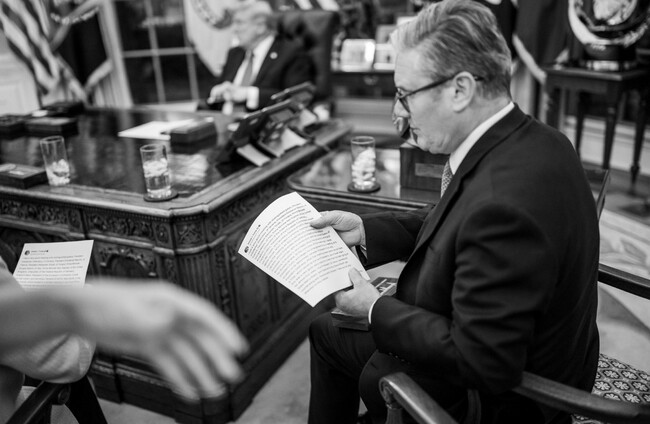
IN FAIRNESS TO Kneecap and Sally Rooney, if I had to embroil myself in a battle of wits with a world leader, I’d probably pick Keir Starmer too.

This week saw Kneecap’s Liam Óg Ó hAnnaidh (aka Mo Chara) back in a British courtroom, where no decision has been made on whether he’ll face trial on terrorism charges. That’s been kicked down the road until late September. Not far away, Downing St issued a warning regarding Rooney’s expression of support for Palestine Action, a group recently proscribed under UK law.

In an Irish Times op-ed, Rooney stated her intention to donate money to Palestine Action, including money generated through BBC adaptations of her novels Normal People and Conversations With Friends. All we need now is for Starmer to take a dislike to The 2 Johnnies, and he’ll have alienated every different genre of Irish person between the ages of 25 and 35. 

Still, making an enemy of Sally Rooney seems a deeply inadvisable course of action for the British government. Though it’s already too late, of course. 

Such is the size of the apparatus that has formed around Rooney’s success, encompassing major publishers, retail chains, streaming services, broadcasters and indeed national broadcasters; her work has become inextricable from the culture it has, in part, defined. You can’t simply proscribe Sally Rooney and be done with it. You can’t reach into the London Underground and pull her books out of the hands of commuters who want to live vicariously and cathartically through her throuples and hunks on the verge of tears. She knows that and she’s using it to her advantage. 

Should it ever come to a moment where Rooney has her day in court — which is precisely what 10 Downing St seemed to be warning of — it will be Mo Chara times a thousand. Before she was one of the world’s most celebrated novelists by the age of about 27, she was a champion orator and debater — a background which shines through whenever she publicly expresses an opinion. 

Given the opportunity for a speech from the dock, Rooney would make such mincemeat of the British government’s position on Gaza that Jim Sheridan would surely be inspired to make a spiritual sequel to In The Name of the Father.

Starmer has seemingly made a game of matching wits with young Irish artists who are smarter, savvier, sounder and much more popular than he is. According to the results of a YouGov poll published this week, less than a quarter of Britons have a favourable view of Starmer, while 68% have a decidedly unfavourable view of the Labour leader.

Of course, it’s tricky to isolate the reasons why each individual might dislike Starmer. For example, despite his government’s aggressively right-wing policies on immigration, welfare, trans rights and the right to protest, there are almost certainly vast swathes of the British public who believe he is not conservative enough. Surely, though, a decent chunk of that 68% comprises people who don’t fancy living in a country where your life can be turned upside down by terrorism charges simply for holding up the wrong kind of sign in the midst of protesting against a genocide. 

Perhaps most disappointing in all of this is the reluctance of the Irish government to speak up on behalf of its own artists as they are targeted by the British state. Similar could be said of Labour Party leader Ivana Bacik, who wrote to Starmer shortly after he became Prime Minister in 2024 a letter which referred to UK and Irish Labour as “sister parties”.

In Irish politics, the race for the Áras remains squarely in the ‘limbering up’ phase, and after Mairead McGuinness’ shock announcement to forego Fine Gael’s nomination due to health reasons, we’re back down to one official candidate for the time being in Catherine Connolly.

Naturally, once McGuinness stepped aside, the Fine Gael elders who had previously insisted they didn’t want the job bravely held out their arms for twisting. 

In an attempt to revise her earlier position, former cabinet minister Heather Humphreys told Northern Sound this week that she’d had a change of heart about her energy levels. In particular, she provided a tepid anecdote which involved someone knowing she works in her garden every day and telling her that, actually, she had loads of energy.

Of course, suggesting that someone run for president because you’re impressed by how hard they were digging makes about as much sense as asking someone to represent you in court because you saw them put together some seven-letter words when they were watching Countdown, but whatever. We’re short on candidates. Humphreys now seems almost certain to get the nod ahead of her Fine Gael rival Seán Kelly MEP.

Without trying to unduly influence the outcome of the election, there is something very boring about the prospect of having someone who is more or less a representative of the government sit in Áras an Uachtarán. More than in the past, questions are being raised over how hard it is to get on the ballot.

There are really only two ways, after all: to be nominated by four local authorities or at least 20 sitting members of the Oireachtas. Former and retiring presidents can also nominate themselves if they’ve only served one term (leaving the door open for a Mary Robinson plot twist). It’s not the most democratic way to choose a head of state. Of course, it’s also not the least democratic way to choose a head of state either, still living as we do in a world of kings, emirs, electoral colleges and whatever other nonsense. 

Unfortunately, now doesn’t really feel like the time to get into this argument, coopted as it has been by the likes of Conor McGregor and others, the kind of people who display proudly their ignorance of the role, what it entails, and its constitutional limitations. 

And besides, even with the system that we have, we’ve still ended up with recent nominees such as Dana, Gavin Duffy, Seán Gallagher and Peter Casey (who this week was quoting Winston Churchill (famously a friend to Ireland) as part of an anti-Muslim diatribe on Twitter). So, if you’re worried about not having the opportunity to vote for someone hopelessly unqualified, don’t be. There’s always a chance.

Indeed, this week Senator Sharon Keogan said she was eager to help five different prospective candidates get on the ballot, including Nick Delehanty, Declan Ganley, Aubrey McCarthy, Gareth Sheridan and Maria Steen. 

As loathe as I am to point out holes in a plan that is doomed for the failure it so deserves, putting five of your preferred candidates on a ballot is pretty much a surefire way to make sure that none of them win. Not only that, but as soon as Keogan’s list was made public, at least one person on it (Steen) was like: ‘Thanks so much, but no thanks‘.

Look, it hasn’t been a race for the ages. As it stands, there is no Fine Gael candidate, no Fianna Fáil candidate and no Sinn Féin candidate. Can we keep it that way, says you! No, but in all seriousness, sooner or later we’re going to find out who’s actually running for president. 

It’s just a shame that Sally Rooney’s only 34. 

Readers like you are keeping these stories free for everyone...
A mix of advertising and supporting contributions helps keep paywalls away from valuable information like this article. Over 5,000 readers like you have already stepped up and support us with a monthly payment or a once-off donation.

Close
JournalTv
News in 60 seconds