We need your help now

Support from readers like you keeps The Journal open.

You are visiting us because we have something you value. Independent, unbiased news that tells the truth. Advertising revenue goes some way to support our mission, but this year it has not been enough.

If you've seen value in our reporting, please contribute what you can, so we can continue to produce accurate and meaningful journalism. For everyone who needs it.


Alamy Stock Photo

Opinion The porn industry is normalising the sex trade for the next generation of teen girls

Teacher and researcher Eoghan Cleary breaks down a recent L’Oreal advertising campaign that partnered with an OnlyFans creator – and explains how girls are being targeted by the porn industry at younger and younger ages.

“OKAY, IT’S CLEAR from what you’re telling me that the porn industry is targeting us boys on every gaming, video-sharing and social media platform we use – YouTube, TikTok, Snapchat, Instagram, X. But what about you girls? Are you being targeted in the same way?”

The second-year class I’m teaching goes unusually quiet; they’re stumped. They can’t think of anything. Then one girl asks: “You mean like the bop house girls?” She’s 13.

A wave of recognition and realisation moves through the girls. They all know who the bop house girls are, but are only now realising the insidious nature of their presence on their social media feeds.

Most of the boys, me included, are clueless. “Who are the bop house girls?” we ask. Immediately, I see from the girls’ faces that this is one of those things that they’ve all seen, but at their age are far too young and embarrassed to be able to explain to the rest of us. One of the braver girls makes eye contact and quietly tells me, “Just look them up.”

So I did.

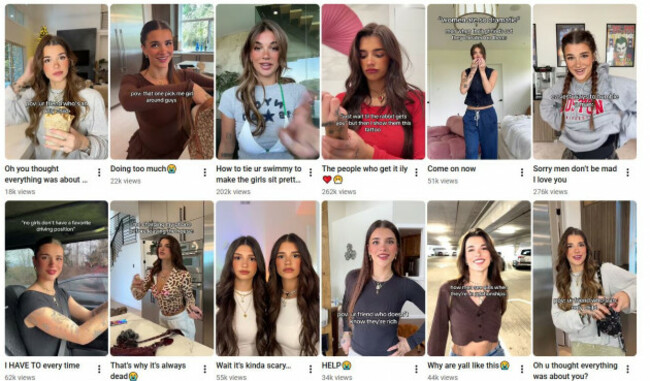
Ask a teen or tween on social media who the “bop house girls” are, and many would be able to tell you: they are a group of young women living together in a porn production mansion in Florida, creating two types of material. One is “get ready with me” videos, dance trend reels and makeup tutorials on TikTok for their teen female followers. The other is sexually explicit content for paying subscribers on OnlyFans.

A few months ago, L’Oreal-owned make-up brand Urban Decay launched its “Battle the Bland” campaign in an apparent effort to engage the next generation of young women and girls. To do so, they hired the hugely successful OnlyFans model and pornographic content creator Ari Kystya as their new brand ambassador. It seems to me that their idea was to hire a “sex worker” (Ari’s words), shake up the industry and make a splash. But it didn’t. It was barely reported on.

Brands with reach

Let’s be really clear, this is not about being anti-sex. This is not about shaming Ari Kystya or anyone else for how they choose to make money with their bodies. This is about L’Oreal, one of the biggest beauty manufacturers in the world, partnering with a creator associated with the adult content industry in a way that I would argue may contribute to the normalisation and glamourisation of that content to young audiences on social media.

So, what’s the problem? With over 4.9 million social media followers, Ari Kytsya, a self-proclaimed ‘sex worker’ who sells virtual sexual interactions for money through the online platform OnlyFans, already has a significant online relationship with millions of young women.

Apart from her explicit content on OnlyFans, the 24-year-old influencer also produces the kind of TikTok videos that end up on the feeds of teenage girls – day-in-the-life vlogs, Q&As, unpacking packages sent to her by brands. TikTok doesn’t technically allow the same kind of outright explicit content as OnlyFans, but Kytsya’s TikTok videos often contain discussions about her creating explicit content for money.

AK youtube Ari Kytsya creates explicit content on OnlyFans but is also present on other social media platforms like YouTube and TikTok Ari Kytsya / YouTube Ari Kytsya / YouTube / YouTube

Ari isn’t one of the bop house girls – but they want her to be. Our teen girls’ social media feeds are flooded with a whole drama-filled universe where these content creators interact with each other, encourage underage girls who want to join the ‘bop house’ as soon as they turn 18, promote each other’s sexually explicit content and ‘collaborations’, and openly discuss their OnlyFans earnings.

They talk about how supportive the community is and how body positive it all feels, glamourising a rapidly expanding aspect of the sex trade. These are the ‘bop house girls’ that the young teenage girls I was teaching were familiar with from seeing them on their social media feeds.

OnlyFans has since made it far more difficult to gather data on its activities, but in 2020, it was reported that the top 1% of content creators on the platform made over one-third of all its revenue but what is not promoted to our teen girls is that, from what we know from the figures available, the same top 1% were making an average of less than €2,200 a month, which works out at €13 per hour (less than the minimum wage in Ireland). The other 99%, today roughly four million humans (mostly female), desperately competing for subscribers (mostly male), were making around €1,600 a year, with many making nothing at all.

Normalisation of pornography

In their desperation to reach that top 1% of earners, many creators feel significant pressure to put in endless hours creating content that is neither glamorous nor empowering, often in response to the demands of their subscribers. Niamh O’Connor, better known as Kneevo, once Ireland’s biggest OnlyFans star, recently explained why it never felt empowering, noting: “The girl who is second or third to you… she’s doing everything, and you realise, well, I’m going to have to do everything.”

Women have reported being pressured into penetrating themselves with objects that cause pain, choking or strangling themselves or otherwise harming themselves on camera, all to stop subscribers from leaving.

In my view, this is sexual exploitation. Porn-prostitution. The online sex trade, rebranded.

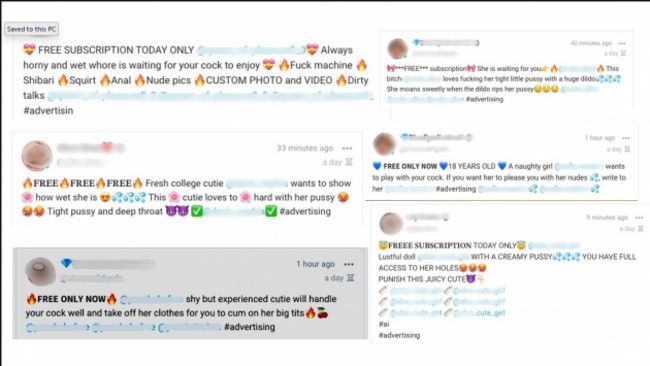
Only Fans Referral System Screenshots that show OnlyFans creators 'promoting' other users they have signed up through the referral programme to their subscribers.

By hiring Ari Kytsya, L’Oreal is trying to make her audience its audience, in order to sell its products and boost its profits.

Where does this audience come from?

OnlyFans actively encourages creators to grow their audience on mainstream social media platforms.

Additionally, as part of their “referral programme”, creators receive 5% of the income generated by every new performer they recruit, while OnlyFans itself takes 20% of all content creators’ earnings.

So, if you can become influential on TikTok and glamorise the life of selling your body for sex online, and even a tiny percentage of your followers decide to follow suit, you take a cut of their earnings.

It’s a pornified prostitution recruitment drive, and it’s working. In a poll earlier this year, 66% of female students in the UK said they would consider joining OnlyFans if they were short on cash. In Ireland, 86% of boys between the ages of 16 and 18 say they’ve used porn, 65% once a week or more. Now, the millionaire “bop girls” and authentic “mattress-actress” influencers are mainstreaming the porn industry to a demographic it was, until now, struggling to engage: our young girls.

By hiring Ari Kystya, L’Oreal’s campaign, in my opinion, risks normalising and glamourising the porn industry in the lives of young girls who otherwise may not have encountered it, or at least not at this age or to this extent.

Exploitation

Behind the glamour and marketing, the business model hasn’t changed. The porn industry still profits from the desperation of vulnerable young women – those trying to pay rent, cover college fees, or support their families – under the effective guise of female empowerment.

In response to a request for comment from The Journal, a spokesperson for OnlyFans said: “OnlyFans has robust age verification processes in place to ensure all of our creator community is over the age of 18. Details can be found here.”

Its age guidelines say that someone must be at least 18 years of age to create an account on OnlyFans, either as a viewer or creator and that it is against OnlyFans’ terms of service for anyone under 18 to view or post content on OnlyFans.

The spokesperson said that “all creators on OnlyFans are adults and go through strict onboarding processes to ensure that is the case”.

In 2024, the Irish Society for the Prevention of Cruelty to Children (ISPCC) told the Sunday Times that its helpline Childline had received ten calls from young people who said they had set up creator accounts on OnlyFans over the previous eight to 12 months. The charity said calls received by Childline about OnlyFans came primarily from girls aged 16 and 17.

In the UK, OnlyFans’ parent company was fined £1.05m in 2025 after providing inaccurate information about the facial age estimation technology used to check the age of users. The company had said the technology would flag anyone attempting to set up an account who appeared to be under the age of 23, but it later disclosed the target age had actually been set to 20. 

L’Oreal did not respond to requests for comment from The Journal.

Previously, in August, a spokesperson told The Guardian that Urban Decay “partners with a diverse range of talent who represent the many facets of creative expression”.

“Urban Decay chose US creator Ari Kytsya for her distinctive makeup artistry and her authenticity,” the spokesperson told the newspaper.

“She is known for her open and transparent dialogue with her community, fostering conversations about her personal experiences, including the joys, challenges, and risks of the industry she works in.”

What we take away

Looking at the porn industry more broadly, recent research that analysed 300 scenes from pornographic videos found almost nine in ten scenes were physically violent, with 94% of aggressive acts in scenes directed towards women. The majority of women acting in these scenes were portrayed with either a neutral or positive response to this aggression.

And our children are being exposed to it earlier than ever. Since 2023, we’ve known that one in ten children in the UK are exposed to online porn by age nine. Almost a third by age eleven. Over half before finishing primary school. And the message our kids are receiving through porn is clear: “Sex equals violence.” “Boys, violence equals pleasure.” “Girls, grin and bear it; this is your worth.”

L’Oreal is known for telling us to use their products “because we’re worth it”.

Our teen girls need to hear that their value in life is more than what the porn industry portrays as women’s worth.

Every other industry is watching – every brand, every influencer – waiting to see what reaction L’Oréal receives to this campaign. So far, there has been little public response.

Maybe it’s time we stand up for our teen girls and respond with a message of our own. Why? Because they’re worth it.

Eoghan Cleary is a secondary school teacher in Co Wicklow. He is currently working as an Educational Expert with the Sexual Exploitation Research and Policy Institute and serves as a director on the board of the Dublin Rape Crisis Centre.

Readers like you are keeping these stories free for everyone...
A mix of advertising and supporting contributions helps keep paywalls away from valuable information like this article. Over 5,000 readers like you have already stepped up and support us with a monthly payment or a once-off donation.

Close
JournalTv
News in 60 seconds