We need your help now

Support from readers like you keeps The Journal open.

You are visiting us because we have something you value. Independent, unbiased news that tells the truth. Advertising revenue goes some way to support our mission, but this year it has not been enough.

If you've seen value in our reporting, please contribute what you can, so we can continue to produce accurate and meaningful journalism. For everyone who needs it.

Alamy Stock Photo

Opinion Trans lives aren’t black and white, our conversations about them shouldn’t be either

Carol Ballantine says she worries about parents like her trying to make sense of gender in an ever-more polarised context.

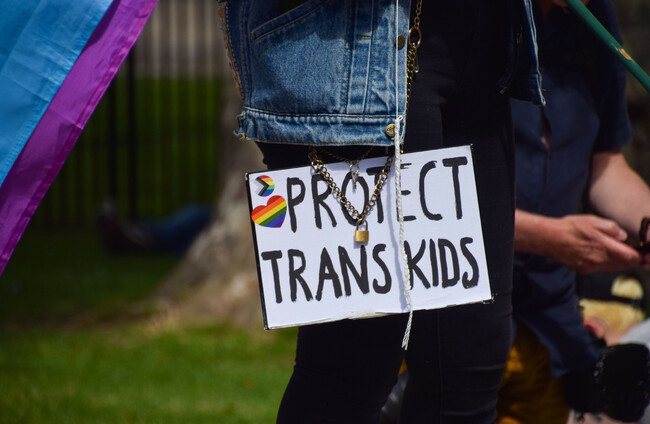
TRANS AND GENDER diverse people keep being put in the firing line, at the hands of governments, coordinated groups and in the media. Survival is everything, as it must be. Tragically, this fact can make it hard to have important conversations about complex issues.

Ten years ago, as a supportive parent of a very young gender diverse child, I was knocked sideways by the divisions and polarisations around transgender rights and inclusions.

Every time the subject of trans rights comes up in the news cycle, it disturbs me. I’m an academic researcher in the field of genders and sexualities; I have a solid understanding of the evidence base and the agreed best practice related to this endlessly topical subject.

I lament the failure of the Irish government to offer trans and gender diverse people, especially children and young people, the healthcare services they need to thrive, and I shudder at the piece-by-piece withdrawal of rights and services underway across the sea in Britain.

Educating ourselves

But there was a time when I avoided the issue of transgender rights and equalities because it looked, to me, like a world of conflict and hostility, and I didn’t want to pick a side. When my twins were four, their gender identities took me by surprise, and I found that I had no choice but to inform myself. Now, I worry about parents like me trying to make sense of gender in an ever-more polarised context.

We know that globally, human rights are under attack, and existing protections are being lost and undermined. We know that trans and gender diverse people are among the most widely targeted and the most vulnerable to this shift. If we consider the current moment as a human rights crisis, then a process of triage, of identifying the highest priority and addressing it most urgently, demands that we join forces to support and defend trans and gender diverse people. But we also need to take a step back and ask, what else is being damaged in this blistering attack on human rights?

As a parent, the divisions that have been stoked up around trans and gender diverse identities made it incredibly difficult for me to ask the questions I needed to ask, or to find the allies I needed to trust.

In 2015, when I was just starting a PhD in women’s studies, my twins Jamie and Zack (these names are pseudonyms) were starting primary school. Although my twins are identical, Jamie expressed a very different gender identity to their brother from as early as they could express themselves, and we embraced this. Still, I was a parent with limited expertise or understanding of these issues, and I had many questions.

What I learned over the following years was that there is no single way of being trans or gender diverse, and therefore, no easy set of answers for a parent to turn to. Every child is different, and everybody’s gender-related needs are different. Good parents will investigate many things that may never come to pass. I researched medication, sports, safeguarding, relationships and sexuality education, and so many other things: I had to.

I was distressed to discover that every question I asked was the subject of intense, heated controversy. At times, it felt like I was doing an archaeological dig in a conflict zone. I worried about bringing the wrong questions to the wrong people and getting shouted down for asking. But still, I urgently needed to ask. 

Divided opinions

I doubted all the professional voices and all the guidance, since everything I read was disputed by somebody who seemed to me equally qualified. With arguments raging between those who fought for trans kids and those who denied the existence of trans kids, I felt at times that there was nobody I could trust to focus on me and my family.

It turned out that I was wrong: the guidance I have received from trans rights organisations and advocates in Ireland was always nuanced and child-centred. It was based on evidence that shows that services are best when they’re supportive, flexible and responsive – and when they don’t shut down possibilities out of hand. Nevertheless, I know I wasn’t alone in my assumption: other people have told me that they’ve felt the same way. It’s the nature of division to simplify and create oppositional camps, when what I needed was openness and complexity.

Even ten years ago, the public discussion about gender identity had the character of a battle. Since then, British politics and media in particular have only become more divisive on this issue. I imagine a parent like me now, looking at supposedly expert information from the UK, and feeling that they have to give it due attention. It comes, after all, from the most trusted places: universities, the Supreme Court, the NHS. Many experts have highlighted the divisive politics that gave rise to these developments, and yet, dismissing them out of hand can feed into the division.

They say that the first casualty of war is truth. In the stoked-up culture wars of the current moment, another important casualty is complexity and nuance. In these dark times, it’s important that parents and others don’t believe that they have to choose between one simplistic narrative and another.

The questions we are asking are good questions, but they are often represented in the news media and elsewhere by bad faith actors, in the service of a simplistic assurance that the whole issue can be resolved with biological definitions and hard boundaries. It is devastating to see these black-and-white arguments coming from the highest levels of government in the UK, but we don’t have to do this in Ireland.

Complexity is there for the taking, if we re-commit to the human rights of everybody, step away from the conflict and noise, and support one another to ask the right questions.

Carol Ballantine teaches and researches gender, sexualities and violence. She is currently a research fellow in UL and UCD. 

Readers like you are keeping these stories free for everyone...
A mix of advertising and supporting contributions helps keep paywalls away from valuable information like this article. Over 5,000 readers like you have already stepped up and support us with a monthly payment or a once-off donation.

Close
JournalTv
News in 60 seconds