We need your help now

Support from readers like you keeps The Journal open.

You are visiting us because we have something you value. Independent, unbiased news that tells the truth. Advertising revenue goes some way to support our mission, but this year it has not been enough.

If you've seen value in our reporting, please contribute what you can, so we can continue to produce accurate and meaningful journalism. For everyone who needs it.

Alamy Stock Photo

Opinion The Government's plans to scrap the Triple Lock should be concerning to all citizens

Stephen Kelly writes that opposition to the Triple Lock is often predicated on assumptions that are misplaced, if not misleading.

THE RENEWAL OF the UN mission in Lebanon, combined with recent remarks by Minister for Health Jennifer Carroll MacNeill, have placed the Triple Lock back on the agenda.

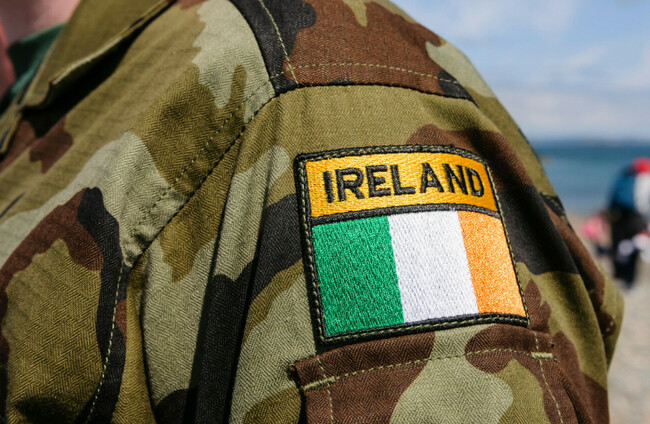
The Triple Lock is the mechanism that requires Irish soldiers to have a UN mandate along with Dáil and Government approval before being sent overseas. The fact that the Government is proceeding with legislation to repeal the Triple Lock should be gravely concerning to all citizens.

Our Constitution prescribes that all power, under God, derives from the people. This is not simply an aspirational statement, but a real statement that goes to the core of the balance of power between the public and politicians. When the governments of the day tried to pass the Nice and Lisbon Treaties (in 2001 and 2008, respectively), Irish voters rejected them. Despite being supportive of the EU, people had grave concerns around neutrality and EU militarisation.

Each time, the referendum was re-run. Voters were clearly told that voting to ratify the treaties would be subject to the Triple Lock remaining in place. This was very important, because it meant that once provisions in the Lisbon Treaty on Permanent Structured Cooperation (“PESCO”) were activated, Irish troops would not serve under EU command unless there was a UN mandate.

Repealing the Triple Lock without a referendum is a betrayal of the commitment given to the Irish people. Our elected leaders need to remember that they are paid by, and derive their authority from, the people.

A blank cheque?

Without the Triple Lock, there is no limit to the number or types of missions Irish troops could be sent on, which is particularly worrying given the state of the world. Taoiseach Micheál Martin has recently stated that Irish troops would be prepared to join a “reassurance force” that would police a ceasefire in Ukraine as part of the so-called “Coalition of the Willing”.

Mr Martin had no authority to make such a commitment while the Triple Lock legislation remains under consideration. Nonetheless, it is a cautionary illustration of the type of danger we would be letting ourselves in for if the Government of the day had a “blank cheque” on where to send troops. As a small nation, our government can all to easily come under pressure from powerful countries and be used as a pawn in big-power politics. We must resist this.

The Russian Federation has made clear that troops from NATO countries being deployed to Ukraine is an absolute red-line, yet that is precisely what this “Coalition of the Willing” envisions. The grouping is led by Britain and France, key NATO members and nuclear powers. It is a response to the frustration of NATO’s European members with American peace overtures to Russia. It is ironic that, despite not being in NATO, we are associating ourselves with a grouping of NATO’s most hardline members.

Micheál Martin is playing with fire, and it is the men and women on the frontline who will be burnt. There is no purpose in having a “reassurance force” policing a ceasefire unless it is prepared to resort to combat operations if there is a breach of the terms of a ceasefire. In other words, it would involve the potential for Western countries to fight Russia directly for the first time since the battle of Berlin in 1945.

Ireland did not participate in war with Russia from 1941-1945, and we should not do so now. We have enough problems as a country without embroiling ourselves in war with Russia’s one million-strong army. Our courageous soldiers enlist in the Defence Forces to defend our own territory from attack, not to drag our country into foreign wars.

Misunderstandings

Opposition to the Triple Lock is often predicated on assumptions that are misplaced if not actively misleading.

For example, we are told that it means our foreign policy is bound by or subjected to the whims of the UN Security Council’s five permanent members. On the contrary, any deployment of Irish troops remains always the decision of the Irish government. The requirement for UN approval is simply a minimum requirement. Whether to participate in a UN-mandated mission, how many troops to contribute and on what terms rightly remain prerogatives of the Irish government.

Far from the clichéd depiction of the UN Security Council as deadlocked, it is the centre of fervent diplomacy and closely-awaited decisions of global importance. From 2020 to 2024, 264 out of 284 resolutions voted on at the Council were passed with no power exercising a veto. This works out as the infamous veto being deployed in only 7% of the cases. Based on public discourse around the Security Council, most people would assume the exact opposite.

The UN is a necessary part in the framework of checks and balances that make up the Triple Lock. It is far from perfect, but the difficulties created by the make-up of the Security Council are nothing new.

While opponents of the Triple Lock seek to suggest that we need to abolish the Triple Lock in light of Russia’s conduct in Ukraine, violations of international law by permanent members are unfortunately not a new problem. The US/British invasion of Iraq in 2003 was described as illegal by the UN Secretary General Kofi Annan and the UN was powerless to stop it. Nonetheless, the fact that the UN refused to approve the invasion meant that Irish troops did not take part.

The United Nations is much more than the Security Council. The UN General Assembly can deal with a situation where a permanent member exercises veto power by what is known as a “Uniting for Peace” resolution, where recommendations can be made on collective action by a two-thirds majority.

Whether we retain or repeal the Triple Lock, it will not make an iota of difference to the UN Security Council’s composition. We should work within the UN, for all its flaws, for a reformed organisation that is true to its founding principles, a role in which we, as a Western, non-colonising state, have the potential to play an important role.

Stephen (Osal) Kelly is Chairperson of the Peace and Neutrality Alliance (PANA), which advocates for the right of the Irish people to their own independent foreign policy with positive neutrality as its key component. 

Readers like you are keeping these stories free for everyone...
A mix of advertising and supporting contributions helps keep paywalls away from valuable information like this article. Over 5,000 readers like you have already stepped up and support us with a monthly payment or a once-off donation.

Close
JournalTv
News in 60 seconds