We need your help now

Support from readers like you keeps The Journal open.

You are visiting us because we have something you value. Independent, unbiased news that tells the truth. Advertising revenue goes some way to support our mission, but this year it has not been enough.

If you've seen value in our reporting, please contribute what you can, so we can continue to produce accurate and meaningful journalism. For everyone who needs it.

Alamy Stock Photo

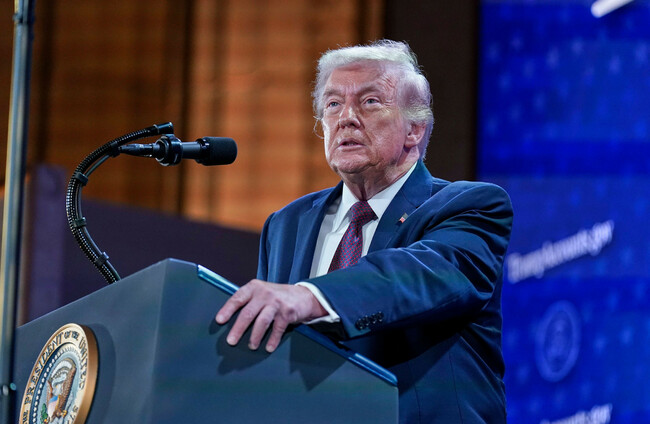
The Donald Show Is Trump pulling back at home and abroad – or no?

Larry Donnelly asks if we can take much more of Trump’s chaotic behaviour.

THE UPPER MIDWESTERN American state of Minnesota, typically a frozen tundra during its harsh winters, has been a powder keg since Renée Nicole Good was shot in the face by an Immigration and Customs Enforcement (ICE) agent on the streets of Minneapolis on 7 January.

Many politicians and pundits aligned with President Donald Trump maintained that the 37-year-old was both impeding federal officials in fulfilling their duties and posing a genuine threat to their lives behind the wheel of her car.

Those who watched the video footage of what happened to the late Ms Good from an objective standpoint, not through an intensely partisan lens, have dismissed such nonsense. But it was impossible for Trump’s adherents to credibly contend that the subsequent killing of Alex Pretti, an intensive care unit nurse, was in any way excusable.

images-of-renee-good-left-and-alex-pretti-who-were-both-shot-and-killed-by-federal-immigration-officers-are-seen-at-a-make-shift-memorial-at-the-site-where-pretti-was-killed-in-minneapolis-wedne Renee Good, left, and Alex Pretti, who were both shot and killed by federal immigration officers in Minneapolis. Alamy Stock Photo Alamy Stock Photo

Mr Pretti may have had a permit to carry a firearm, though the only thing he could be seen brandishing before he was callously leapt upon and brutally slayed by ICE’s masked men was a mobile phone. Even President Trump’s deputy chief of staff and loyal servant Stephen Miller admits that they “may not have been following proper protocol” prior to the fatal shooting.

That the local congresswoman, Ilhan Omar, was just attacked by a disturbed man with an unknown substance at a town hall meeting for her constituents reflects how dire the state of play has been there. And the reaction of the commander-in-chief to this incident – “No, I don’t think about her… I think she’s a fraud… She probably had herself sprayed, knowing her” – is absolutely reprehensible.

CSPAN / X (Formerly Twitter)

While President Trump repeats his vile libels of Ilhan Omar, there seems to have been something of a climb down in Minnesota. The controversial Greg Bovino, who was leading ICE efforts on the ground, has evidently been removed from his post. Trump has said that he wants to de-escalate the situation and had a “very good” call with the state’s governor, Tim Walz, whom he detests. Conversely, he has informed Minneapolis Mayor Jacob Frey that his city cannot decline to apply the immigration laws on the statute books.

What changes his mind?

Roughly 2,000 miles away in Greenland, and across an undeniably frightened European continent, there has been similarly mixed messaging. Yes, at the confab of the great and the good in Davos, President Trump appeared to renege on his pledge to take the huge Arctic island into US possession by force, if necessary, shattering the NATO alliance in the process. Still, his language is menacing with respect to the future of Greenland, and of Europe generally. Declarations of “TACO” (Trump always chickens out) may be premature.

Additionally, a “massive armada” is en route to Iran and “time is running out” to make a deal and avoid American military action. The Iranians have responded defiantly. President Trump purportedly wants to eliminate their nuclear capacity in the wake of an initial strike in 2025 and the executions of thousands of protesters by the government. Yet his critics wonder if this is an attempt to divert attention from internal pressure and falling poll numbers.

Donald Trump’s private and public lives are testimony to the fact that it is a fool’s errand to ascertain what he is thinking or what his next move might be. Indeed, it can be persuasively argued that much of his success in business and in politics – to be sure, his track record is not unblemished – could be attributed to his being unfailingly unpredictable and difficult to gauge.

With that complex caveat accounted for, mindful that we are a little over a year into Trump 2.0 and approximately nine months off the midterms, the following are three thoughts as global stakeholders endeavour to anticipate his bark and his bite in 2026, domestically and internationally. Politically and historically speaking, the 47th president is not in an enviable position. Being in difficulty renders him, according to his foes, quite a dangerous individual.

First, it warrants reiterating that the future of the Trump presidency will depend to a significant degree on the fate of his GOP colleagues who will be on the ballot in November. Notwithstanding his worrying sabre rattling and his forsaking an America First agenda for expansionism, foreign policy, unless it involves “boots on the ground” elsewhere, is near the bottom of the list in the electorate’s pecking order. Members of the US Congress are well-acquainted with this truth.

Second, Trump cannot be entirely oblivious to the consistent negative trend in the opinion surveys or to the trepidation being voiced by prominent Republican officeholders about the growing perception that ICE is wreaking havoc in their constituencies.

On two of the key issues that Trump efficaciously campaigned on in 2024, inflation and immigration, his approval ratings have sunk swiftly. He is now politically under water on each because the sky high prices of goods and services, which ordinary consumers purchase daily, have not reduced and because the grotesque conduct of federal law enforcement, which has been witnessed widely on television and online, has disgusted very many voters who endorse deporting violent criminals and felons, not terrorising families and communities.

The third has been mooted as Trump advocates interventionism and abandons the politically potent America First philosophy, as he dubiously asserts that he has fixed inflation, despite people’s contrary lived experience, and as he mistakes a majority sentiment in favour of ridding the country of illegal undesirables for support of undertrained, roguish, violent thugs. It is that the president simply might not care what transpires in the midterms.

Trump on his own steam

Given how spectacularly unpopular these three initiatives are, there is a cogent case that Trump is operating with scant or no regard for political reality. A cognisance thereof, and the constraint that flows therefrom, has been an important “guard rail” preventing those privileged enough to garner the sacred trust of the American citizenry and to work on their behalf in the White House from transgressing their authority.

But Trump looks at most Republicans in Congress with thinly veiled contempt, as sycophantic, pathetic cowards. Privately, he would likely venture that there is not a chance of their retaining control of the US House of Representatives. He may think he can govern by sheer strength of personality, through executive order and via the courts until January 2029. In that event, who knows what he might try to do?

I am doggedly hopeful and cautiously optimistic that, contrary to less malevolent considerations, will prevail in President Trump’s calculus, perhaps with an eye on the history books. I pray this will lead to pulling back at home and abroad. Yet this doomsday scenario, and the other, even worse ones that are continually floated, can no longer be dismissed as altogether far-fetched – much as this writer and millions of my fellow Americans wish we could do so.

“Appalling vista” is a phrase used too frequently. When it comes to all matters stateside and their prospective emanations, however, I struggle at the moment to find words that are more apt.

Larry Donnelly is a Boston lawyer, a Law Lecturer at the University of Galway and a political columnist with TheJournal.ie.

Readers like you are keeping these stories free for everyone...
A mix of advertising and supporting contributions helps keep paywalls away from valuable information like this article. Over 5,000 readers like you have already stepped up and support us with a monthly payment or a once-off donation.

Close
18 Comments
This is YOUR comments community. Stay civil, stay constructive, stay on topic. Please familiarise yourself with our comments policy here before taking part.
Leave a Comment
    Submit a report
    Please help us understand how this comment violates our community guidelines.
    Thank you for the feedback
    Your feedback has been sent to our team for review.

    Leave a commentcancel

     
    JournalTv
    News in 60 seconds