We need your help now

Support from readers like you keeps The Journal open.

You are visiting us because we have something you value. Independent, unbiased news that tells the truth. Advertising revenue goes some way to support our mission, but this year it has not been enough.

If you've seen value in our reporting, please contribute what you can, so we can continue to produce accurate and meaningful journalism. For everyone who needs it.

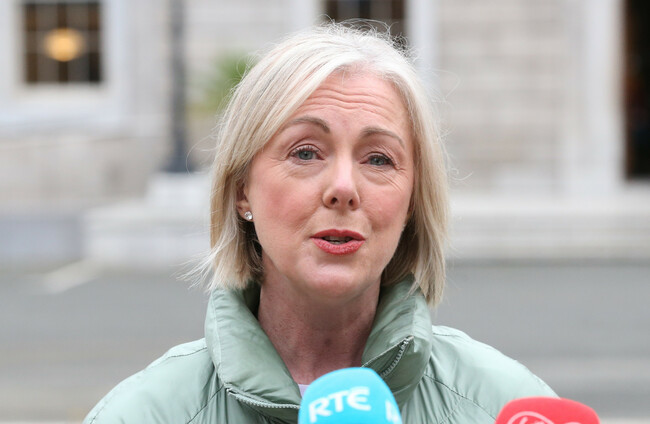
Regina Doherty

Ireland needs more landlords 'that have five or more houses who treat it like a business'

The government is trying to ‘change the housing culture in Ireland’, according to Fine Gael MEP Regina Doherty.

IRELAND NEEDS MORE landlords with five or more properties who treat renting as a business, rather than one-off landlords who see it as their pension. 

That’s according to Fine Gael MEP Regina Doherty, who is also vice-chair of the EU’s Special Committee on the Housing Crisis, who spoke to The Journal in Brussels this week about the EU’s first-ever report dedicated entirely to housing. 

Doherty said that the Irish government is trying to ‘change the housing culture’ in Ireland with the new set of rental rules that came into effect at the start of this month. 

According to Doherty, the new rental rules in Ireland were “the right thing to do” but she acknowledges the impact on people who were evicted before the rules were introduced. 

“For the people who’ve been put out of their homes in the last number of weeks, it has had devastating consequences. I’m not diminishing them. But we’re changing a culture,” she said.

We do need to protect renters if societal changes are having people renting for longer, which they currently are at the moment.

“When I was growing up, you tried to have your three-bed semi by the time you were in your late 20s and then most people got married in their late 20s.

“That’s now not happening until people are in their mid-30s and they need to have that security.” 

The Journal / YouTube

Doherty said Ireland’s rental market is not used to giving renters more protections and security, and the changes had the “unintended and very unpleasant consequence” of a number of landlords leaving the market because they decided that they did not like the new rules.

She said Ireland needs to emulate European rental contracts where tenants are given longer tenancies, and where there are fewer one-off landlords who see housing as a pension investment. 

“We need to get, not institutional landlords – because they have a particularly bad name at the moment, particularly for the price of rents that they’re charging – but landlords that have five or ten or more houses, who are in it for a financial investment,” she said.

“Landlords who view housing as their business and not just a pot of money that’s going to be realised when they get to 65 or 66. 

“Those long term protections for renters, when the culture does shift, will obviously absolutely benefit renters. But we’re experiencing that squeeze, that pinch point at the moment.”

Doherty says that the Irish government needs to provide more rental accommodation as well as lower levels of rent increases each year. 

We need levels of what you can charge similar to what we have in Brussels, where you can only put up the rent by 1.6 to 1.8% every year, less than inflation.

“If we had those rules at home with the state being the landlord, I think we would have a proper functioning rental sector that’s governed, that has proper rental rules and requirements for the renter, but which also has proper requirements as to how the rent can increase every single year.”

EU-level housing plan

The European Parliament formally set up a special committee on the housing crisis within the EU in January 2025, with the aim of drafting a report with ideas, backed by research, on how to solve the housing crisis across member states.

A special committee in the European Parliament is a temporary body established to examine specific, urgent, or complex issues that fall outside the scope of standing committees.

Its mandate is usually a year -which has scope to be extended – and the housing committee is due to wind down in July 2026. 

The report passed a vote by 367 votes to 166 on 10 March, with 84 abstentions among the European Parliament in Strasbourg.

The proposals will now be sent to the European Commission and join a separate housing plan launched by the EU’s first Housing Commissioner late last year.

Doherty believes that the political will is there to push for housing reform across the EU and that this is just a starting point.

“Housing isn’t something that the EU ever had an interest in before and particularly even when this new parliament was formed in July 2024, there was pushback from certain quarters in the parliament that it was none of the EU’s business,” she said. 

“But a very large number of us fought to make sure that it was on the European agenda, and now it’s very firmly on the European agenda, and it’s going to stay on it.”

Doherty also says that it’s important that the report by the special committee has been issued because many countries across the EU have the same problems as Ireland, including not enough houses being built, overly-complex planning issues and the fact that short-term rental options skew the market. 

Criticism of the report

The Left group in the European Parliament criticised the report, stating that it did not do enough to tackle the issues of Airbnb and short-term lets.

This followed accusations that the report was watered down after Doherty’s EPP colleague, Borja Giménez Larraz, met with tech lobbyists such as Airbnb over 25 times during the drafting stage of the report. 

In contrast, he only had one meeting with housing activists during the drafting stage. 

“The report’s chapters around Airbnb and the recommendations are only recommendations, because they really are governed by municipalities,” Doherty said.

“And I think that was the chilling impact in so far as some of the cities that we went to, we were literally told by local authority and municipalities, ‘do not tell us how to do our job’. 

“I won’t say we were warned, but we were told very, very seriously to not overstep the mark, or we could have scuttled everything else that we were doing.”

She says that Airbnbs are big businesses in some countries and are causing frustrations for young people especially in countries such as Portugal and Spain.

“That lobby is very strong, but it’s also very, very wide,” she said. “It’s not like they’re institutional landlords, they’re all singular, independent people who are making money and, in some cases, making a living off the back of these short-term rentals.

“They do need to be governed well, and I suppose what we needed to do was to empower the municipalities to say ‘you’re responsible to your young people’.

‘We’re only here trying to help solve the problems that we see from kind of a helicopter view. It’s now down to you. We can try to the recommendations of what we’ll fix, and it’s down to you.” 

Readers like you are keeping these stories free for everyone...
A mix of advertising and supporting contributions helps keep paywalls away from valuable information like this article. Over 5,000 readers like you have already stepped up and support us with a monthly payment or a once-off donation.

Close
22 Comments
This is YOUR comments community. Stay civil, stay constructive, stay on topic. Please familiarise yourself with our comments policy here before taking part.
Leave a Comment
    Submit a report
    Please help us understand how this comment violates our community guidelines.
    Thank you for the feedback
    Your feedback has been sent to our team for review.

    Leave a commentcancel

     
    JournalTv
    News in 60 seconds