We need your help now

Support from readers like you keeps The Journal open.

You are visiting us because we have something you value. Independent, unbiased news that tells the truth. Advertising revenue goes some way to support our mission, but this year it has not been enough.

If you've seen value in our reporting, please contribute what you can, so we can continue to produce accurate and meaningful journalism. For everyone who needs it.

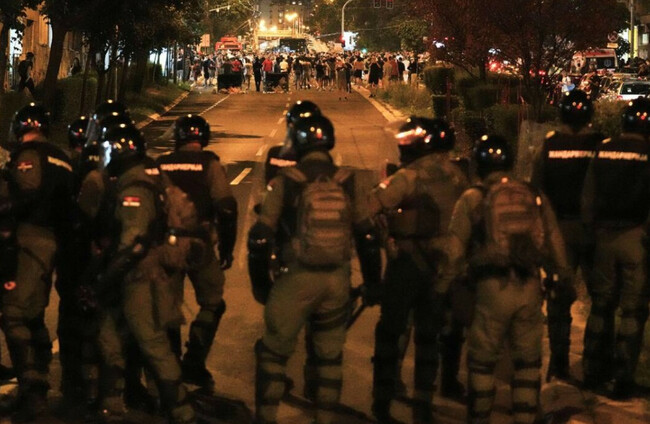
Serbian police officers face off against protesters during an anti-government rally in Belgrade Alamy Stock Photo

After a week of street violence, what is happening with the major protests in Serbia?

The president’s party’s offices were set on fire this week.

RECENT DAYS IN Serbia have seen violence across the streets of its capital city Belgrade, with the the destruction of president Aleksandar Vucic’s party offices and attacks by his supporters on protesters.

Riot police responded forcefully to the smashing of window at Vucic’s party offices, inflaming tensions in the Balkan nation.

Serbian anti-government protesters have accused police of beating and threatening detained activists. The allegations have been strongly denied by the government but the unfolding crisis is fuelling fears of a spiralling crackdown after a week of violent clashes.

More than 100 protesters have been detained, with one telling AFP they were beaten and threatened with rape while in custody.

How did the standoff in Serbia get to this point?

Serbia has witnessed mass demonstrations over the past year as tens of thousands of people rally in favour of an anti-corruption movement.

Almost daily protests have gripped the country since November, sparked by the collapse of a railway station roof that killed 16 people.

The tragedy became a symbol of deep-rooted institutional corruption in the Balkan nation, with demands for a transparent investigation morphing into calls for early elections.

Corruption has long been considered an impediment to the country’s candidacy for EU membership, with Transparency International placing the country at 105th on its Corruption Perceptions Index.

The young anti-corruption movement has seen solidarity demonstrations span cities across the world. In March, rallies took place simultaneously in Dublin and Cork, alongside cities across Europe, North America and Australia.

What has the president said?

While the protests have so far led to the resignation of the prime minister and the collapse of the government, Vucic – in power for 13 years – has remained defiant.

He has repeatedly rejected calls for early elections and recently threatened a “strong response” to the demonstrations.

“This is an attempt at a foreign-funded colour revolution, in which no means are spared, and violence is used in a bid to seize power,” he said on Monday night.

He has frequently decried the movement as a “colour revolution” — a term favoured by the Kremlin and its allies to smear protest movements as illegitimate.

Russia remains a close Serbian ally despite Belgrade’s declared path to the European Union.

What have protesters alleged?

Across several nights, loyalists of Vucic attacked protesters and riot police responding forcefully to the destruction of his party offices.

Hundreds gathered in front of the accused commander’s police building in Belgrade on Tuesday to support  Sindjelic and decry widespread reports of police brutality.

Protesters carried banners reading, “Rapists with badges” and “The system beats us, we defend ourselves”.

“Unfortunately, we are now entering a spiral of violence, and I do not see how it can end well if things continue in this way,” 31-year-old protester Andrej Sevo said.

“They must decide how to act and calm the situation, rather than simply pouring fuel on the fire by sending in the police, with ever more brutal behaviour.”

Aleksandra Krstic, 45, also at the rally, said women were especially vulnerable to police abuse.

“We have no one to protect us. If I go to a protest, I should be able to turn to the police… not be beaten, dragged into some basement of a government building, threatened with rape, and forced to beg them to stop,” the political science professor said.

Government denies claims of brutality

The Ministry of Internal Affairs “strongly denied” the allegations made by protesters. It said Sindjelic was arrested for being part of a group that had attacked government buildings and police.

“Throughout the entire procedure, no means of coercion, handcuffing, insults, or any form of mistreatment were applied,” it said.

The EU ambassador to Serbia, Andreas von Beckerath, said he and other diplomats had met with the government to “discuss the current political situation” in Serbia.

“The EU Ambassador underlined the need by all parties to uphold the respect for fundamental rights, including the right for peaceful assembly,” Beckerath said on Monday.

“Any suspicion of excessive use of force needs to be duly investigated, including worrying reports about threats and violence against journalists,” he said.

With reporting by © Agence France-Presse

Readers like you are keeping these stories free for everyone...
Our Explainer articles bring context and explanations in plain language to help make sense of complex issues. We're asking readers like you to support us so we can continue to provide helpful context to everyone, regardless of their ability to pay.

Close
JournalTv
News in 60 seconds