Sign in. It’s quick, free and it’s up to you.
An account is an optional way to support the work we do. Find out more.
Sign in. It’s quick, free and it’s up to you.
An account is an optional way to support the work we do. Find out more.
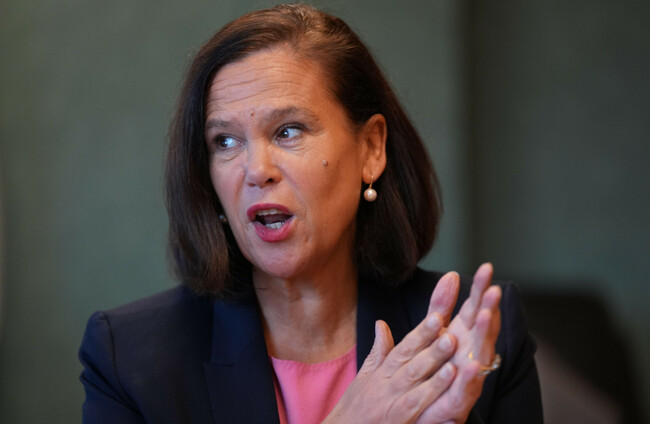
SINN FÉIN LEADER Mary Lou McDonald has said that while she is “mindful” of the Irish-US relationship, her party may boycott next year’s St Patrick’s Day visit again if the situation in Gaza does not improve.
Since the 1950s, Irish taoisigh have travelled to the White House to present the US president of the day with a bowl of shamrock on St Patrick’s Day in a ceremony that is attended by a wide variety of politicians, dignitaries and other Irish people of note.
This year, Sinn Féin President Mary Lou McDonald and Vice-President Michelle O’Neill boycotted the annual trip over the United States’ involvement in the genocide in Gaza.
The party’s decision came shortly after US President Donald Trump proposed an American takeover of Gaza and suggested a permanent displacement of Palestinians from the enclave.
Explaining the reason for the boycott, McDonald said at the time that it was “a principled stance against the threat of mass expulsion of the Palestinian people from Gaza”.
Asked by The Journal if her party will continue the boycott this year, McDonald said she remains very concerned about what is still happening in Gaza and the West Bank and that no decision has been made yet in relation to the trip.
“I think we have a ceasefire in name, but we don’t have the reality of peace on the ground. We need to get to that place very quickly,” she said.
McDonald said she continues to hope and pray for the appropriate international response and for Israel to be held to account so that a real process of dialogue and peacemaking can be built.
“That’s what we need, and I can only pray that long before St Patrick’s Day is on the horizon, that we’re in that space. We’re not there yet, and it is not quite as dire as it has been for the last number of years, where we saw just unprecedented horror, but there is still some way to go, and Ireland needs to continue to be to the forefront,” she said.
McDonald encouraged activists in Ireland, including those in sports and culture, to continue to speak out.
She also urged the Government to pass the now long-stalled Occupied Territories Bill.
“The world needs Ireland to be on the right side of this in the way that, in fairness, Spain and Slovenia and some others are also,” McDonald said.
Asked if the trip is being kept under review, McDonald said: “Well, let’s see where we are.”
“I hope we’re not faced again with that scenario. I mean, in a scenario like that, a trip is the least of your worries, the least of your concerns. I really hope that we’re not in that space again.”
She added however, that she is “very mindful of our relationship with the United States”.
She noted the flocks of people that returned from the US to Ireland over the Christmas period and said the relationship isn’t just political, it’s “a family relationship between our two countries”.
“So let’s hope that we are not faced with the type of horror that we saw last year. Let’s hope that 2026, at last, will bring good news for the Middle East and for Palestinians in particular.”
Last week, the World Health Organisation (WHO) warned that 1.6 million people (77% of the population of Gaza) are still facing high levels of acute food insecurity since the ceasefire in October.
This includes over 100,000 children and 37,000 pregnant and breastfeeding women projected to suffer acute malnutrition through to April next year.
WHO said that without sustained, large-scale expansion of food, livelihood, agriculture and health assistance, along with increased commercial inflows, hundreds of thousands of people in Gaza could rapidly slip back into famine.
It noted that while the ceasefire has improved some deliveries of food, animal feed, basic supplies and essential commercial imports into Gaza, most families are still grappling with severe shortages.

To embed this post, copy the code below on your site













have your say