We need your help now

Support from readers like you keeps The Journal open.

You are visiting us because we have something you value. Independent, unbiased news that tells the truth. Advertising revenue goes some way to support our mission, but this year it has not been enough.

If you've seen value in our reporting, please contribute what you can, so we can continue to produce accurate and meaningful journalism. For everyone who needs it.

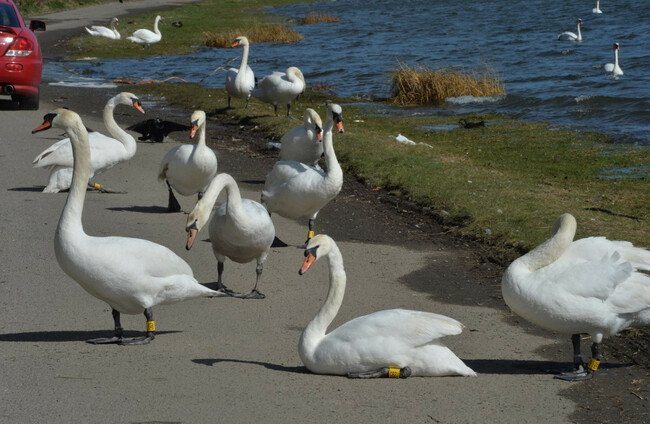
Swans at Broadmeadow Estuary in Swords, Dublin. Irish Midland Ringing Group

Dublin swans carry drug-resistant bacteria that makes infections harder to treat

A University of Galway-led study said it is likely that the high rate of AMR detection in swans is “linked to human-associated pollution” of their water habitat.

SWANS IN THE Greater Dublin and Co Kildare areas have been found to frequently carry antimicrobial resistant (AMR) bacteria in their guts that are very similar to those that cause infections in humans which are difficult to treat.

As part of a new study, researchers from the University of Galway, working with the Irish Midland Ringing Group, collected faecal samples from 17 swans living in several locations around the Greater Dublin Area, including Broadmeadow Estuary in Swords, Bray harbour, Newbridge, Co Kildare, and along the Grand Canal in Dublin city.

An analysis of the 17 samples taken found that 11 were positive for one or more AMR bacteria, with 35 AMR bacteria detected overall. The most common type of AMR bacteria detected were multidrug-resistant E coli.

The study states that it is likely that the high rate of detection of these AMR bacteria in swans is linked to human-associated pollution of their shared water habitat with treated and untreated wastewaters and through storm water overflows, but it did not rule out direct spread from swan to swan. 

AMR occurs when bacteria and viruses change over time and no longer respond to medicines, making infections harder to treat and increasing the risk of disease spread and severe illness. 

Dr Liam Burke, lecturer in bacteriology in the School of Medicine at University of Galway and the study’s principal investigator, said the university had previously conducted studies looking at the presence of AMR bacteria in water. 

Speaking on RTÉ’s Morning Ireland, he said: “We found some of those that are causing infections in humans in canals, in rivers and in coastal areas in a few different places around Ireland, including Dublin, and we always noticed that wherever we found these bacteria, there was always swans present in the canals.

“So we decided that it would be worth looking to see whether swans were picking up bacteria that are resistant to these antibiotics.”

Spread to humans

Burke said that if animals are carrying these drug-resistant bacteria, they can pass them on to humans.

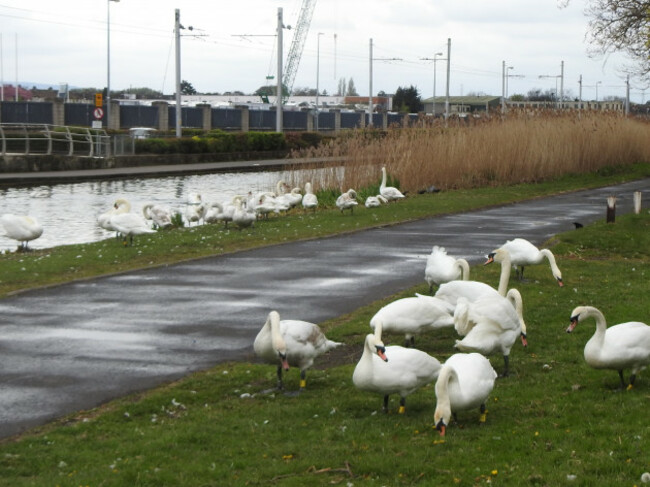
2522428a-8e1c-4f82-b776-ef8be5c8d1ee Swans at Davitt Road alongside the Grand Canal at Goldenbridge, Dublin. Irish Midland Ringing Group Irish Midland Ringing Group

“If swans are in parks and other areas where humans might go for recreation, they can spread the bacteria in the water there, and if we are exposed to that water and swallow that water, then there’s potential for us to become colonised with these AMR bacteria.”

He said that if this bacteria gets into our gut or bloodstream, it can cause an infection that is difficult to treat, adding that first-line antibiotics might not be effective and “last resort antibiotics” might be needed to kill these bacteria.

According to Burke, while a lot is known about the spread of the spread of AMR in humans and in livestock, the extent to which wild animals can transmit AMR is a “big knowledge gap”.

“It’s important for us to know what are the potential risks of dissemination in wild animals and in the environment,” he said. 

The World Health Organisation states that AMR is one of the top global public health and development threats. A study published in the Lancet estimated that bacterial AMR was directly responsible for 1.27 million global deaths in 2019 and contributed to 4.95 million deaths.

“We really need to try and control the spread of these antimicrobial resistant bacteria,” Burke said.

He said that some of the ways to do this is by limiting their dissemination in the environment, through wastewater treatment discharges, and limiting their environmental pollution.

The University of Galway-led study was funded by the EU’s Erasmus+ Programme, the Environmental Protection Agency (EPA) and the HSE.

It was published in the Science of the Total Environment and can be read here.

Readers like you are keeping these stories free for everyone...
A mix of advertising and supporting contributions helps keep paywalls away from valuable information like this article. Over 5,000 readers like you have already stepped up and support us with a monthly payment or a once-off donation.

Close
25 Comments
This is YOUR comments community. Stay civil, stay constructive, stay on topic. Please familiarise yourself with our comments policy here before taking part.
Leave a Comment
    Submit a report
    Please help us understand how this comment violates our community guidelines.
    Thank you for the feedback
    Your feedback has been sent to our team for review.

    Leave a commentcancel

     
    JournalTv
    News in 60 seconds