Sign in. It’s quick, free and it’s up to you.
An account is an optional way to support the work we do. Find out more.
Sign in. It’s quick, free and it’s up to you.
An account is an optional way to support the work we do. Find out more.
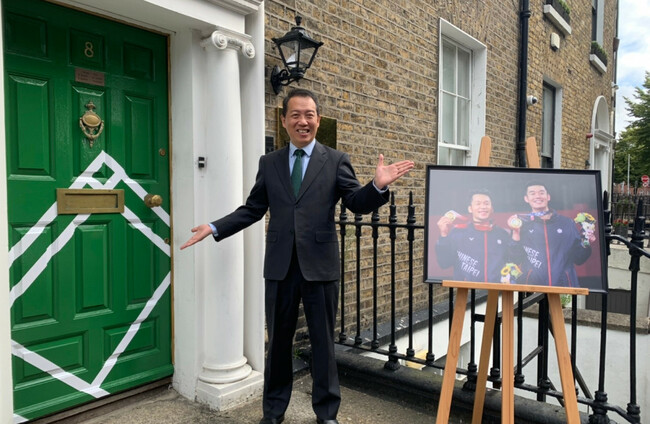
A TAIWAN OFFICIAL has urged the Irish Government to reopen its representative office in Taipei in an effort to strengthen relations amid growing tensions in the South China Sea.
Ireland’s representative office in Taipei closed in 2012, cited at the time as being due to austerity measures. The Institute for Trade and Investment opened in 1989 and undertook a range of activities from consular assistance to trade promotion.
Currently, some 15 EU member states maintain trade offices in Taipei alongside the European Economic and Trade Office.
Speaking to TheJournal, Representative Tzu-Pao Yang said EU relations with Taiwan have “rapidly improved” over the past few years and he hopes Ireland can “catch up” given the “new relationship” between the EU and Taiwan.
Representative Yang claims the closure of the consulate “coincidentally” coincided with the rise of Xi Jinping within the Chinese Communist Party and China’s place on the world stage.
He said Ireland currently has “all its eggs in one basket” when it comes to China: “If you have a good relationship with China and the trade is good, good for you, but at the same time why can’t Ireland have a better relationship with Taiwan under the One China Policy. Taiwan is a different country.”
The island nation has been ruled separately from China since the end of a civil war in 1949, but under the One-China policy, Beijing considers it a part of its territory, with reunification by force an option. It refuses to recognise the island’s government and has increasingly sought to isolate the independence-leaning administration of President Tsai Ing-wen.
Taiwan says it is an independent country of 23 million people with a right to be treated as such internationally, and that it will defend itself from China if attacked.
The One China policy is the diplomatic acknowledgement of China’s position that there is only one Chinese government – the People’s Republic of China (PRC), and not the Republic of China (ROC) which is also known as Taiwan.
Ireland, like all EU Member States adhering to the One China policy, does not maintain diplomatic relations with Taiwan but engages in economic and cultural matters through the Taipei Representative Office in Dublin - established in 1988.
The Department of Foreign Affairs said that given Ireland only engages with Taiwan on an economic and cultural basis, Enterprise Ireland and IDA Ireland manage the Taiwanese market and marketplace services for Irish companies from their offices in the region.
The Department spokesperson added that the One China policy does not preclude the development of economic and cultural relations with Taiwan at an official level.
‘Not a provocation’
Representative Yang’s comments follow a call from a recent European Parliament delegation to Taipei which urged the international community to interact more with Taiwan to help defuse tensions with China.
Thirteen members of the European Parliament’s committee on foreign interference in democratic processes travelled to Taipei this week – the first-ever official delegation dispatched to Taiwan from the EU legislature.
Beijing expressed “strong dissatisfaction and firm opposition” to the trip, however, the head of the delegation dismissed claims that visiting the island was a provocation.
“It’s not a provocation to come to Taiwan. It should be normal,” French MEP Raphael Glucksmann told a press conference in Taipei yesterday.
He cautioned that isolation of the island would fuel tensions while “integration of Taiwan into our debate is actually defusing the deep concerns about security”.
The contentious trip follows the European Parliament passing a report last month urging closer ties between the bloc and Taiwan “guided by the EU’s One China Policy”.
The text adopted by MEPs expressed grave concern over China’s continued military “belligerence, pressure, assault exercises, airspace violations and disinformation campaigns” against Taiwan.
The vote urged the EU to do more to address these tensions, to protect Taiwan’s democracy, and the island’s status as an important EU partner.
Ireland South MEP Mick Wallace voted against the report and posted a video statement on Twitter stating that Taiwan is part of China “and recognised as such by the UN”.
Fine Gael senator Barry Ward was one of many politicians to criticise Wallace’s comments, tweeting: “Democratic self-determination is important too, irrespective of what China’s view on Taiwan is.”
Taiwan is part of #China + recognised as such by #UN but now #US is stoking tensions- US military have even been in Taiwan training local forces. US + #EU are interfering in China’s domestic affairs- a violation of Art 2 of UN Charter- EU must stop working for US state dept… pic.twitter.com/C4VWV6wgzn
— Mick Wallace (@wallacemick) October 26, 2021
In 1971, Beijing took over China’s seat at the United Nations, previously held by Taipei, following the passing of UN General Assembly Resolution 2758.
Representative Yang said Wallace’s claims were “fake news” and spread a false narrative about Taiwan’s history. He stressed that Beijing’s communist leadership has never controlled Taiwan and that the 1971 resolution which expelled the ROC from the assembly “does not claim Taiwan” to be part of the PRC.
The nationalist Kuomintang party fled to Taiwan in 1949 after losing the Chinese civil war, while Mao’s winning communist forces founded the People’s Republic of China on the mainland.
The United States initially recognised officials in Taiwan as China’s legitimate representatives, however, it switched allegiances in 1979 from the ROC to the PRC and established full diplomatic ties with the CCP in Beijing.
Washington continued to have a relationship with Taipei, enacting the Taiwan Relations Act that same year – setting up non-diplomatic relations and promising to help the island defend itself.
The island of 24 million people has since transformed into a democracy and major tech hub, leading many – including President Tsai Ing-wen – to assert Taiwan’s distinct identity, which Beijing attacks as separatism.
China has ramped up its military and diplomatic pressure against Taiwan to force it to accept Chinese sovereignty, and tensions are at an all-time high in the Taiwan Strait.
- Additional reporting from AFP

To embed this post, copy the code below on your site











have your say