We need your help now

Support from readers like you keeps The Journal open.

You are visiting us because we have something you value. Independent, unbiased news that tells the truth. Advertising revenue goes some way to support our mission, but this year it has not been enough.

If you've seen value in our reporting, please contribute what you can, so we can continue to produce accurate and meaningful journalism. For everyone who needs it.

What's the secret of success for TG4's long-running soap Ros na Rún?

Ros na Rún does not feature elections, global diseases or language struggle but there is plenty of drama on the TG4 soap, which its in its 30th season.

IF YOU’RE ALREADY fed up with the presidential election campaign, head about 10 kilometres west of Galway city to the small Gaeltacht town of Ros na Rún, home to the Irish-speaking community we know from the hit TG4 drama soap opera which is now in its 30th season.

Every Tuesday and Thursday at 8.30pm, it’s where all sorts of drama happens – young couples falling in love, old people dealing with their daily struggles, gangsters and death threats and all sorts of other dramatic conflicts.

In fact, during this season, fans of the soap opera will be able to join their community every Monday and Wednesday as episodes will be released on the TG4 player the day before the edition airs on television.

This is a reflection of the many changes that have occurred in life since the series began back in 1996, when there was no talk of television programmes being available on the internet on computers and mobile phones.

In the same period there has been a noticeable change in Ros na Rún – back in 1996 Tigh Thaidhg, the local pub, was the place where the community would meet. Now there is a café – Cúlchaint – and a restaurant, Gaudi, not to mention a retail shop of the kind you would find in any village in the country.

It is more like a suburb of a city on the edge of the Gaeltacht now, which is a reflection of how inhabitants of the real-life Gaeltacht view their communities rather than a less contemporary view some still hold, closer to their fossilised memories of Peig’s harsh life on the Blasket Islands than the reality of suburban life in Ireland today.

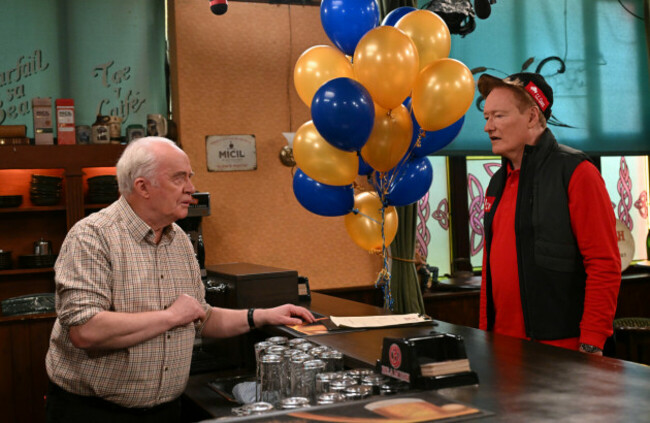
Such is the rapid pace of forward change in the Gaeltacht that celebrities such as US chat show host, Conan O’Brien, and British actor Stephen Fry, have featured in walk-on parts on Ros na Rún.

river-1

Ros na Rún is a special place, however. It is a Gaeltacht community without a doubt and there is no question that it is a community where Irish is prevalent, at a time when Gaeltacht communities across the country are struggling to keep Irish as the language of the community and language planning officers are swimming against the tide to turn the tide.

And there will be no hint in the editions between now and the end of next month that an election for President of Ireland is taking place in the country.

This is a common practice on soap operas around the world – whether it’s Coronation Street or Summer Bay – to base the drama on the back-and-forth between the characters and their own strengths and weaknesses rather than on circumstances in the world the audience lives in. They are from the same world in many ways – but the life of the soap opera is a surreal one, and the Ros na Rún community is no exception.

As Máire Éilís Ní Fhlatharta explains, we know her as Caitríona Ní Loideán, a character who has been around since the first edition, it is to escape from the real grey and gloomy world that we all live that we visit Ros na Rún every Tuesday and Thursday. She acknowledges, however, that life in Ros na Rún can be quite bleak from time to time too – there is certainly plenty of drama.

People see us a refuge from the humdrum and hardship of their own lives – yet we refer to things that could be happening in people’s normal lives, normal things that happen in everyone’s lives.

When the pandemic was raging in Ireland and globally, there was no sign or report of the disease in Ros na Rún. Noreen d’Arcy, who is in charge of public relations for Ros na Rún, called this a ‘brave decision’.

“Ros na Rún made a very strong and good decision and the audience was very happy that they were not looking at face masks and listening to talk about Covid because they were trying to escape it,” said Noreen.

However, due to the care taken by the programme’s producers, no one on set had any cases of the disease. Máire Éilís remembers that they had a two-metre long rod to ensure a safe distance between the characters.

There are plenty of other things to attract the crowd – and by all accounts, Ros na Rún is doing the business for TG4 with over 150,000 viewers watching the Irish language drama series set in the Gaeltacht.

It’s strong characters that bring people back to Ros na Rún time and time again as Máire Éilís/Caitríona explains:

As they say, every good person can be nasty and every nasty person can be nice – so that applies to all the characters.

“Storytelling, drama, and things that happen, usually get close to the bone for people and the lives they themselves are living.

“But the stories are published a year in advance, it’s difficult to be up to date all the time, but we manage to do a great job, I think, with all the characters we have in the soap.”

Of the cast we met when the drama first aired, shortly after TG4 – then Teilifís na Gaeilge – was founded on Halloween 1996, only five people remain in the drama and one of them is Caitríona Ní Loideáin – a role played by local Spidéal actress Máire Éilís Ní Fhlatharta. The other four are Macdara Ó Fátharta (Tadhg Ó Direáin the pubkeeper), Josie Ó Cualáin (Mícheál Seoighe), Berni Ní Neachtain.

At that time Caitríona was the young reporter for Raidió Pobail, eager for the story, listening to the neighbours and hoping to escape to achieve fame and fortune in the wider world.

“She was working as a young journalist, with a lot of energy and she wanted to investigate every story, she was like eyes and ears everywhere, she was immersed in every story, that’s the kind of person she was.

“She was everywhere, listening in the background often, in the shop, in the pub, on the street, everywhere and she was stuck in every story, that’s what she had been doing as a journalist for many years and after a while she left the radio but went back again.

“She tried to leave a few times – she wanted to be a famous journalist but she quickly discovered that she was a ‘big fish in a small pond’ and she was really small out in the big world.”

If Ros na Rún started out in 1996 as a small fish in the world of Irish television at a time when Glenroe and Fair City were the big fish in the country and EastEnders, Emmerdale and Coronation Street were the bigger fish, not to mention Australia’s Neighbours and Home & Away, that is no longer the case.

Ros na Rún’s audience is loyal and growing, reaping the benefits of the renewed interest in the Irish language and the Gaeltacht. A new season is looming and the series’ script team is already working on series 31.

The Journal’s Gaeltacht initiative is supported by the Local Democracy Reporting Scheme

Readers like you are keeping these stories free for everyone...
A mix of advertising and supporting contributions helps keep paywalls away from valuable information like this article. Over 5,000 readers like you have already stepped up and support us with a monthly payment or a once-off donation.

Close
Comments
This is YOUR comments community. Stay civil, stay constructive, stay on topic. Please familiarise yourself with our comments policy here before taking part.
Leave a Comment
    Submit a report
    Please help us understand how this comment violates our community guidelines.
    Thank you for the feedback
    Your feedback has been sent to our team for review.

    Leave a commentcancel

     
    JournalTv
    News in 60 seconds