We need your help now

Support from readers like you keeps The Journal open.

You are visiting us because we have something you value. Independent, unbiased news that tells the truth. Advertising revenue goes some way to support our mission, but this year it has not been enough.

If you've seen value in our reporting, please contribute what you can, so we can continue to produce accurate and meaningful journalism. For everyone who needs it.

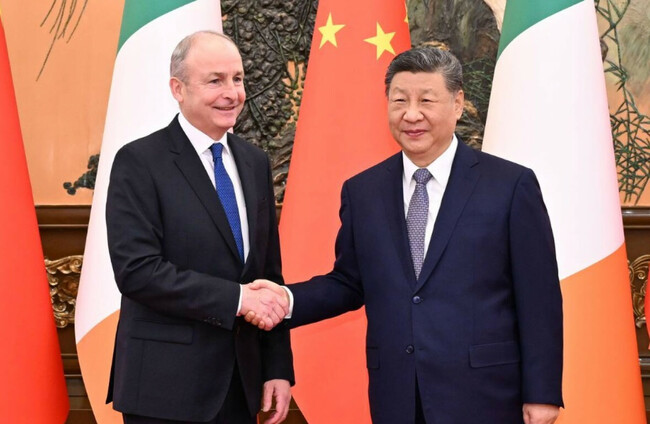
Taoiseach Micheál Martin with China President Xi Jinping at the Great Hall of the People in Beijing yesterday. Alamy Live News

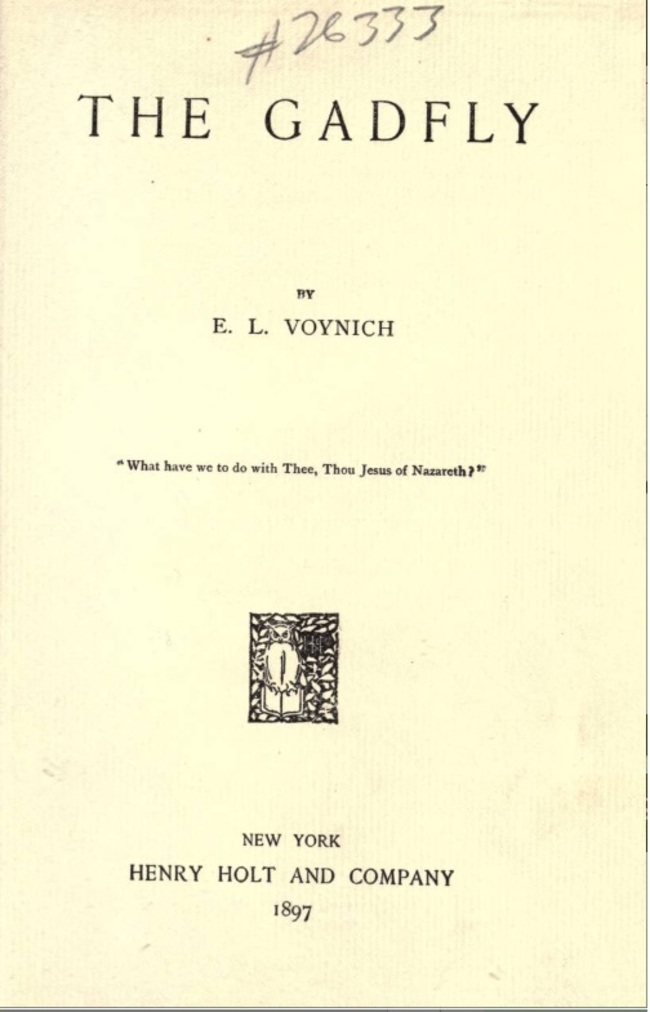
Martin and Xi say they read it as teens - but what is The Gadfly and who is its Cork-born author?

One historian says the novel’s author was a ‘one-woman node in a global network’, with her work speaking to Ireland’s global cultural influence.

THE TAOISEACH’S MEETING with China President Xi Jinping yesterday threw up a surprise: it turns out the Chinese leader says he is a fan of an Irish novel.

Xi credited the 1897 book The Gadfly – by Cork-born author Ethel Voynich – as sustaining him during his traumatic teenage years when his family suffered under a purge by the Communist Party leadership.

Micheál Martin told Irish media yesterday that he and Xi found the book was common ground during his visit to Beijing, as the Fianna Fáil leader had also read it when he was a teenager.

“It was unusual that we ended up discussing The Gadfly and its impact on both of us, but there you are,” Martin said.

As a boy, Xi found himself cast out of any comforts enjoyed by his family after his father fell foul during a purge of supposed internal rivals by party leader Mao Zedong, with the future president reportedly having to sleep in a cave at points during his exile.

However, what’s arguably more surprising about Xi’s recall of the book is that it didn’t come as all that much of a surprise to some observers.

This is because The Gadfly carries a different weight depending on where you are in the world – having sold over 5 million copies in the Soviet Union alone.

According to historian Donal Fallon, its author Voynich is one of a number of Irish writers who enjoyed broader readerships in the likes of China and the Soviet Union than you might first expect.

“The Gadfly found its audience in different continents, not least China, and even finding an English language copy was sometimes tricky in the past,” Fallon told The Journal.

While it has remained little known to a general Irish audience, it did find itself cited by leftists at home as well as abroad – partly because of their educational value to socialists as much as their literary merit was.

“The Gadfly also gets mention in the memoir of Peadar O’Donnell, Anti-Treaty Republican, who recalled ‘the Gadfly was being widely read in C Wing: It is a tale of Italian revolution with a ghastly execution scene’,” Fallon added, referring to O’Donnell’s time in prison in Ireland.

Screenshot (408) A copy of the book. File photo Alamy Alamy

The book follows a young Englishman who goes to 1840s Italy to study to become a priest but finds himself caught up in the radical politics of the era, while also navigating a relationship with another revolutionary.

Born in 1864 in Blackrock in Cork as Ethel Lilian Boole, her family moved to Lancashire, England after her mathematician father George Boole died when she was an infant. (Boole’s name adorns a well-known building used to this day by students on the campus of University College Cork)

Voynich was in her early 30s when The Gadfly was published, with speculation that it may have been partly inspired by her own involvement with similar revolutionaries.

Historian Maurice Casey described Voynich to The Journal as a “one-woman node in a global network” in her own era, with her book’s citing by China’s leader speaking to Ireland’s global cultural influence.

“Her comrades included Ukrainian and Russian socialists – and she married a Polish political exile,” said Casey, whose 2024 book Hotel Lux looked at the forgotten Irish radicals and their lives and loves in Russia during the rise of socialism.

Like its author, The Gadfly has long been a connecting point between geographically disparate movements, easily finding an audience among Chinese revolutionaries after their Soviet counterparts thumbed through thousands of Russian-language editions.

Casey added that for the book to arise in the exchange between Martin and Xi – both whom recalling reading it as teenagers – is a way of reminding us that The Gadfly’s success “lay in Voynich’s ability to portray common experiences of a revolutionary life”.

This ranged from commitment to a cause, to sacrifice and even romance, Casey said, all features that may well have bolstered the nineteenth century novel’s appeal to any young person with an interest in politics, “whether surviving the Cultural Revolution in China or a teenager in Cork city during the 1970s”.

Readers like you are keeping these stories free for everyone...
A mix of advertising and supporting contributions helps keep paywalls away from valuable information like this article. Over 5,000 readers like you have already stepped up and support us with a monthly payment or a once-off donation.

Close
11 Comments
This is YOUR comments community. Stay civil, stay constructive, stay on topic. Please familiarise yourself with our comments policy here before taking part.
Leave a Comment
    Submit a report
    Please help us understand how this comment violates our community guidelines.
    Thank you for the feedback
    Your feedback has been sent to our team for review.

    Leave a commentcancel

     
    JournalTv
    News in 60 seconds