We need your help now

Support from readers like you keeps The Journal open.

You are visiting us because we have something you value. Independent, unbiased news that tells the truth. Advertising revenue goes some way to support our mission, but this year it has not been enough.

If you've seen value in our reporting, please contribute what you can, so we can continue to produce accurate and meaningful journalism. For everyone who needs it.

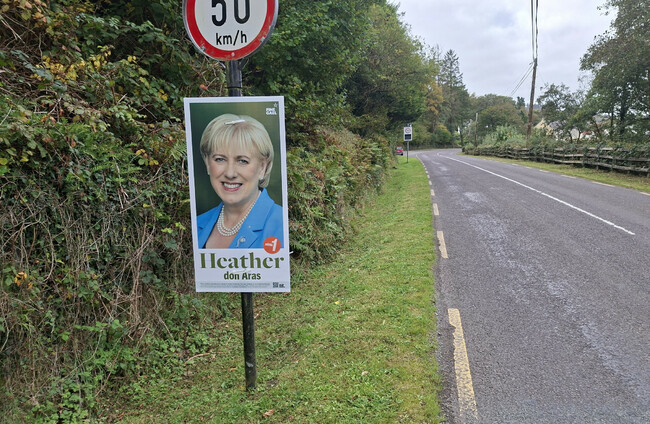
With less than a week to go to Polling Day, both election candidates have been making pledges about what they will do for Irish if elected. Concubhar Ó Liatháin

Presidential candidates commit to Irish language projects if elected to the Áras

A year of debate and discussion about the way forward for the Irish language and Gaeltacht has been promised by Catherine Connolly while Heather Humphreys wants to encourage people to rediscover the Irish language we learned in school.

Foireann nua Gaeltachta The Journal a chuir an scéal seo ar fáil. Tá leagan as Gaeilge anseo.

BOTH PRESIDENTIAL CANDIDATES have committed to implementing Irish language initiatives during their terms if elected

The promises comes as 3% of respondents in the latest presidential election poll named ‘speaking Irish’ as an important competency of the President.

This is the first time that a question about the candidates’ Irish language ability has been included in a poll. The results of the Ipsos Behaviour & Attitudes survey were published in the Irish Times last week and the issue has since gained more prominence.

Speaking to The Journal on her way to the Corca Dhuibhne Gaeltacht on Friday, independent candidate Catherine Connolly said she was planning a year-long initiative to mark the 100th anniversary of the publication of the first report of the Gaeltacht Commission in 1926.

In this project, entitled Teanga na hÉireann – A Nation’s Living Voice, Connolly promised that it would be “a bottom-up conversation, listening to Gaeltacht and overseas communities, north and south, and to the global Irish community”.

In response to our query, Heather Humphreys’ campaign said she would lead a “national effort to rediscover, improve and use the Irish language we learned in school more in our everyday lives”.

Her spokesperson said that celebrating Irish-speaking and Gaeltacht communities would be a significant part of her term “should she be so fortunate as to be elected President”.

CatherineTralee Catherine Connolly spent Friday campaigning in Kerry, beginning in Tralee and finishing in the Corca Dhuibhne Gaeltacht.

Catherine Connolly spent most of Friday in Kerry, starting her time in the Kingdom with a visit to Tralee, where she met with the townspeople before speaking to the media and concluding with the launch of her initiative at a community event in Halla na Feothanaí in west Dungannon.

By the end of the night she was dancing a set with the locals to music played by Cormac Ó Beaglaoich and his friends.

Speaking in Tralee, Connolly said the centenary of the report published by the Gaeltacht Commission in 1926 should be “celebrated and used”.

“What were the findings of that Commission – they were absolutely damning in terms of how vulnerable the Irish language was at the time and the specific recommendations.

“During that year I intend to read that report again, to have a debate about what has changed.

I think the Irish language is as vulnerable now despite all the efforts that have been made in terms of laws and rights – the Irish language and the Gaeltachts are vulnerable, especially in terms of housing and planning.

“There will be a wide range of events during that year, attracting young people, academics, representatives from all the Gaeltachts and we will have various forums openly and there will be plenty of discussion and debate.”

The report of the Gaeltacht Commission in 1926 made many recommendations regarding the areas that should be recognised as Gaeltachts and, as well as namely, recommendations on ways to encourage the use of Irish in the public service. It included an introduction by William T Cosgrave, President of the Executive Council of the Government (Taoiseach in today’s terms) in which he acknowledged that efforts had been made to “kill” the Irish language and “shut it out of most public life”.

The report of that Commission made many recommendations regarding the areas that should be recognised as Gaeltachts and, as well as namely, recommendations on ways to encourage the use of Irish in the public service., The membership of the Commission included leading Irish scholars of the time, such as Pádraig Ó Siochradha (An Seabhac) and representatives from various Gaeltacht areas, Irish language organisations and State departments.

According to contemporary scholars looking back on the implementation of the recommendations made, the report was far-sighted but many of the recommendations were not implemented and the decline that was prevailing at the time continued as a result.

A spokesperson for Heather Humphreys defended the lack of Irish in pre-election documents distributed in the various Gaeltacht areas. The Fine Gael candidate’s leaflet contained only one sentence in Irish, while Connolly’s leaflet was entirely bilingual, prompting many complaints from Irish speakers and Gaeltacht representatives.

“Under the Electoral Acts, candidates in European and general elections are entitled to one free mailing to every household or voter in the country, the Election Letter.”

The spokesperson said this was managed by An Post and that the company used data from local councils, with no connection to any candidate’s election teams.

“We have no direct access to this information, so we cannot target specific Gaeltacht areas, or any other area within any constituency, for specific communications.  The Heather Humphreys campaign spokesperson had this much to say: 

There is significant Irish language content on their website, their election booklet and so on.

Julian de Spáinn, general secretary of Conradh na Gaeilge, has said that documents that the State is paying for to be sent through An Post should be entirely in Irish.

The spokesperson recalled that the Department of Arts, Heritage and the Gaeltacht had a budget of €246m when she was appointed Minister in 2014 and that the Department had a budget of €303m when she moved on, an increase of almost 25%.

However, when looking at the amount made available to the Gaeltacht, including Údarás na Gaeltachta and Foras na Gaeilge, the increase is smaller. In 2014 there was €41.4m provided. It was increased to €43.06m in 2015, €51.2m in 2016 and there was a decrease to €46.6m in 2017. This represents an increase of approximately 11-12% during Heather Humphreys’ tenure as Minister for the Gaeltacht.

The allocation received by the Department of the Gaeltacht in Budget 2026 is €159m.

 The Journal’s Gaeltacht initiative is supported by the Local Democracy Reporting Scheme.

The Journal / YouTube

Readers like you are keeping these stories free for everyone...
A mix of advertising and supporting contributions helps keep paywalls away from valuable information like this article. Over 5,000 readers like you have already stepped up and support us with a monthly payment or a once-off donation.

Close
Comments
This is YOUR comments community. Stay civil, stay constructive, stay on topic. Please familiarise yourself with our comments policy here before taking part.
Leave a Comment
    Submit a report
    Please help us understand how this comment violates our community guidelines.
    Thank you for the feedback
    Your feedback has been sent to our team for review.

    Leave a commentcancel

     
    JournalTv
    News in 60 seconds