We need your help now

Support from readers like you keeps The Journal open.

You are visiting us because we have something you value. Independent, unbiased news that tells the truth. Advertising revenue goes some way to support our mission, but this year it has not been enough.

If you've seen value in our reporting, please contribute what you can, so we can continue to produce accurate and meaningful journalism. For everyone who needs it.

Belfast United Nations humanitarian worker Angus Lambkin has travelled to disaster zones all over the world. Angus Lambkin

Irish speaker on the frontline of the world's disaster sites and conflict zones tells his story

Angus Lambkin works with the United Nations Office for Co-ordination of Humanitarian Affairs at disaster sites all over the world.

(Seo alt ónár bhfoireann Gaeltachta. Is féidir an bunleagan as Gaeilge a léamh anseo)

ANGUS LAMBKIN, AN Irish speaker from Belfast, is laden with stories from his travels all around the world and, in particular, the locations of all manners of natural disasters, wars, earthquakes and epidemics.

Angus, who was raised in the Ormeau area of ​​Belfast and attended Bunscoil Phobal Feirste, works with the Office for the Co-ordination of Humanitarian Affairs and was speaking to The Journal while he was on holiday in New Zealand after spending most of 2025 working from Fiji in the Pacific.

“I was in Fiji for most of last year – I went to Vananatu first because there was an earthquake which hit just before Christmas 2024,” he said, speaking of the South Pacific island, west of Fiji and 1750 km east of northern Australia.

Although there was a lot of work to do to support the Vananatu authorities as they dealt with the damage from the 7.3 magnitude earthquake, Angus was not under as much pressure as in other places he had worked before.

“It was strange for me but it was nice because we prepared and we did a lot of training courses and things like that but, certainly, we didn’t have an emergency context to deal with,” he said.

The type of work Angus does is that he deals with the local government at the scene of the emergency and deals on behalf of that government with the various organisations that are working on the ground dealing with different aspects of the emergency.

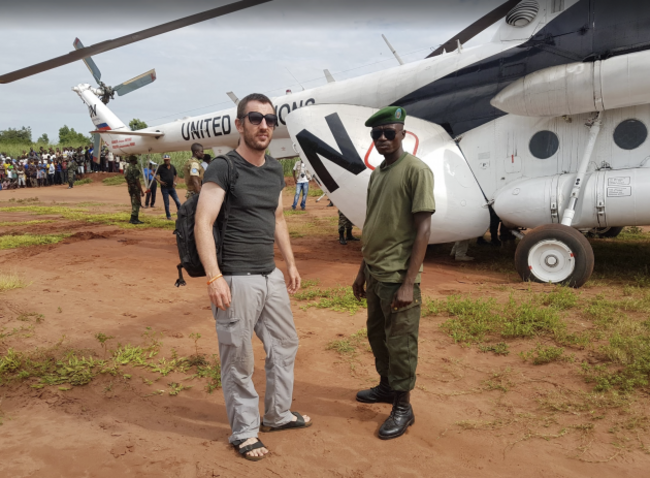
Screenshot 2026-02-10 at 10.49.04 Angus Lambkin worked in the Democratic Republic of Congo, Cameroon and the Republic of Central Africa during times of conflict there. Angus Lambkin Angus Lambkin

“We want the work to be meaningful and to complement the work that the government is doing and we want the government to accept our work but my role is dealing with security forces and, at times, armed groups.

“We want to inform them about the work that is going on so that we can operate in less secure contexts and that they will allow us to continue our work especially when there are checkpoints and the like.”

When he was in Vananatu after the earthquake, measuring 7.3 on the Richter scale, many buildings had been destroyed and many teams had to fly in to help the people, about 80,000 in the capital, Port Vila, and the surrounding area, whose lives were turned upside down.

Angus had to talk to the Vananatu government about the capabilities of the teams coming in, the equipment needed and so on. There was a lot of work to do – searching for people in the rubble and organising medical assistance and all the while there was danger as buildings were in danger of collapsing on the relief workers.

“There were flights landing from forces from Australia, New Zealand and France which is next door in New Caledonia.”

Angus and his colleagues worked at the heart of the efforts to help the people in Vananatu and spoke to the leaders of the various teams working on the ground so that they understood what was needed.

It is quite dangerous – with the danger of collapsing buildings – to work in an earthquake zone like Vananatu but, at least, everyone is working on the same side. The story was not the same everywhere Angus worked.

“In places where there is war, there are other risks involved,” he said.

Angus’s priority in places where there is war is to make sure that all sides understand that they are neutral.

“We want this work to be accepted, we have to explain to the Government some of the work that we do, but quite often we see armed groups taking control of different regions and we have to explain to them as well.

“The message we have to share is that this is based on international law, that the concept is historical and that people should have access to help even though they are at war and that the groups that are doing this work should be neutral and impartial.”

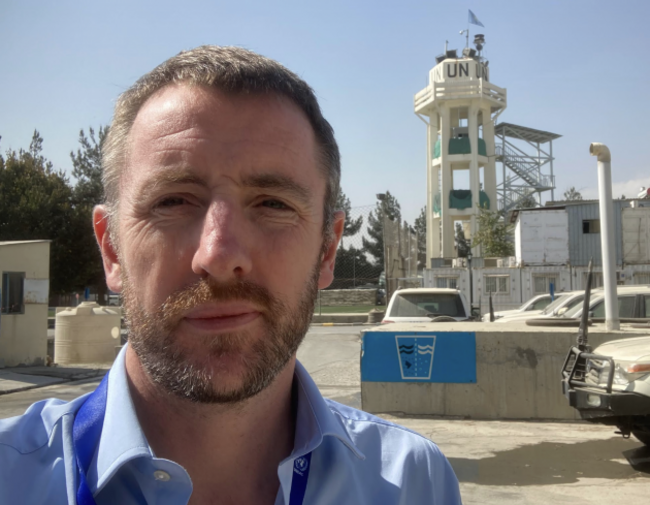
Screenshot 2026-02-10 at 10.49.20 Angus Lambkin at a UN post Angus Lamkin Angus Lamkin

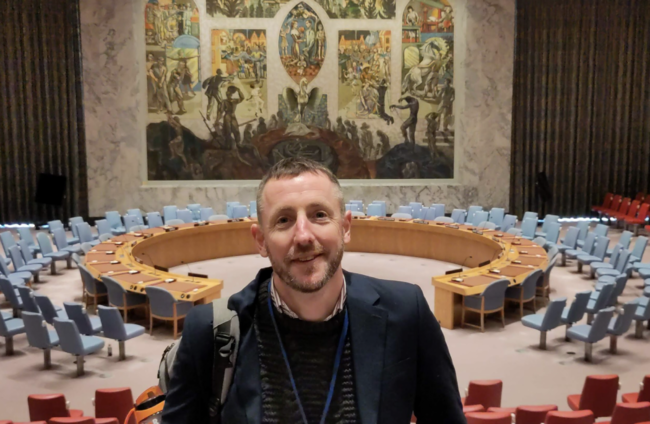
Thar nais sa cheannaras, Angus Lambkin i seomra chomhthionóil na Náisiúin Aontaithe i Nua EabhracSource: Angus Lambkin

Angus has worked in many conflict zones over his years with the United Nations.

“I’ve been to the Democratic Republic of Congo, the Central African Republic, Cameroon, southern Sudan, Iraq, Afghanistan, Turkey, after the earthquake there a few years ago,” he said.

He said he had been in Afghanistan after US military forces left that country in August 2021.

“The United Nations and charities stayed there, they discussed this with the Taliban beforehand in Qatar, there was a Taliban representative in talks there.

“They decided to stay because the Taliban allowed them to continue their work.”

Before the US forces left, they and the Afghan Army were in control of some regions and the Taliban were in control of others. After the Americans left, the Taliban were in control everywhere.

“The big thing to discuss was what role women should play in working as humanitarian workers, as volunteers, as local women and as international women and how we should deal with Afghan women.

“The Taliban believed that we should only deal with men, the men of the family.”

Angus said that the charities and the UN wanted to talk to the women directly about health issues. In the end, they managed to work out a deal that included some flexibility.

Angus doesn’t know where he’ll be going after this. But you can be sure that if there’s an earthquake or war or other disaster near you, he or his colleagues will be there to help!

The Journal’s Gaeltacht initiative is supported by the Local Democracy Reporting Scheme

Readers like you are keeping these stories free for everyone...
A mix of advertising and supporting contributions helps keep paywalls away from valuable information like this article. Over 5,000 readers like you have already stepped up and support us with a monthly payment or a once-off donation.

Close
Comments
This is YOUR comments community. Stay civil, stay constructive, stay on topic. Please familiarise yourself with our comments policy here before taking part.
Leave a Comment
    Submit a report
    Please help us understand how this comment violates our community guidelines.
    Thank you for the feedback
    Your feedback has been sent to our team for review.

    Leave a commentcancel

     
    JournalTv
    News in 60 seconds