We need your help now

Support from readers like you keeps The Journal open.

You are visiting us because we have something you value. Independent, unbiased news that tells the truth. Advertising revenue goes some way to support our mission, but this year it has not been enough.

If you've seen value in our reporting, please contribute what you can, so we can continue to produce accurate and meaningful journalism. For everyone who needs it.

Alamy Stock Photo

Is Ukraine a financial burden for the EU? How different countries are contributing

Germany and France give the most support in absolute terms – but the Baltic and Nordic countries give the most as a share of GDP.

February will mark the fourth anniversary of the start of the war in Ukraine. European media outlets – including The Journal – will mark the anniversary through a series of articles on Ukraine and the EU, covering areas such as agriculture, security, and disinformation, and beginning with this, on what Europe is contributing.

NEW FIGURES SHOW that Europe has moved towards being the main financier for Ukraine in its war with Russia, as the US has begun to dramatically decrease its decades-long support for Europe.

This comes amid debates in Brussels and across EU states, where some politicians and groups have repeatedly claimed that supporting Ukraine costs the EU too much money. 

The figures, however, tell a different story: the EU is currently paying roughly the same amount as it would cost if Russia actually won the war and took the fight to NATO, according to projections – a scenario where there would be far greater risks.

It is a debate that is also being played out in how differently the media present the financial burden of supporting Ukraine.

The Journal is part of a major cross-border European journalism initiative called PULSE and recently carried a story to debunk the myth that “financing Ukraine has cost Ireland billions of euros” with detailed figures. By contrast, the line from Hungarian news website Origo that “spending money on Ukraine is like pouring it into a leaky sack” is a typical contemporary snapshot of how government-aligned media target Hungarians’ humanitarian and realpolitik sensitivities.

More generally, a Europe-wide trend is emerging: politicians are increasingly campaigning on the claim that the financial burden of the war in Ukraine is unsustainable.

Who lends Ukraine support?

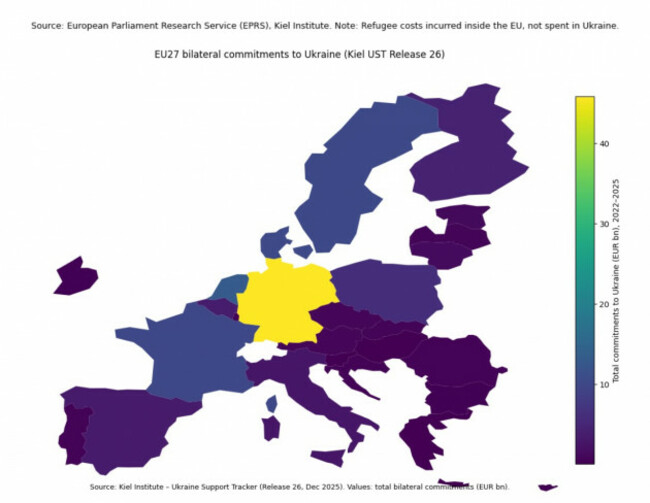
Up-to-date data from the German-based Kiel Institute’s Ukraine Support Tracker, which shows that Hungary spends relatively little on supporting Ukraine, despite – or perhaps because of – the proximity of the war in the neighbouring country.

This contrasts sharply with the comparatively less affluent Baltic states – such as Estonia and Latvia – and the Nordic countries, including Denmark and Finland, which shoulder the greatest burden relative to their GDP.

Poland, the Czech Republic and Slovakia are also exceptionally generous in the “middle band,” while in absolute terms Germany and France provide the most support (see map).

Among international lenders and donors, however, there is little debate about the urgency of guaranteeing continued support for Ukraine. In its statement of 26 November 2025, the International Monetary Fund (IMF) said: “Prompt action by donors is indispensable to avoid liquidity strains.”

The World Bank has estimated Ukraine’s external financing needs for 2025 at €37 billion – in other words, securing financing from early 2026 onward is urgent.

/Datawrapper

Fresh figures from the Kiel Institute also highlight the drastic decline in military and defence support for Ukraine. Europe has allocated only about €4.2 billion in new military aid to Ukraine – far too little to offset the halt in US support under the Trump administration. 

At the same time, disparities within Europe have widened. France, Germany and the United Kingdom have significantly increased their allocations, but in relative terms they still lag behind the Nordic countries. By contrast, Italy and Spain have contributed only minimally.

As for Ireland, earlier this month Taoiseach Micheál Martin announced an additional €125 million in financial support for Ukraine as part of a new roadmap for partnership with Ireland to cover the next five years.

That roadmap includes the allocation of an additional €100 million in non-lethal military support, with another €100 million having previously been announced, and €25m to support the restoration and protection of Ukrainian energy infrastructure.

Some €35.4 million in humanitarian and stabilisation supports had already been announced by the Irish government this year.

Elsewhere, refugee costs in Europe weigh particularly heavily on Germany, Poland, Romania and the Czech Republic. 

How much does Ukraine cost the EU?

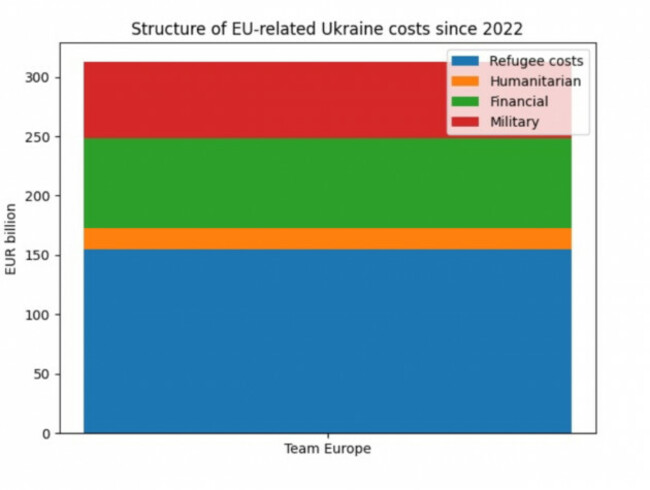
According to an October 2025 overview by the European Parliamentary Research Service (EPRS), EU institutions and the 27 member states together, as “Team Europe,” have mobilised around €177.5 billion in financial, military and humanitarian support for Ukraine since February 2022.

IMG_9781

This includes macro-financial assistance and the €50 billion Ukraine Facility for 2024–2027, of which €38.27 billion is direct budget support, mainly through concessional loans. Added to this is military assistance, which the EPRS estimates at around €63–65 billion when including member-state deliveries and payments from the European Peace Facility (EPF).

Based on data from the Kiel Institute’s Ukraine Support Tracker, the EPRS estimates EU member states’ refugee-related expenditures at around €155 billion between early 2022 and August 2025.

IMG_9782

If everything is added together – EU budget programmes, military aid and refugee costs – Ukraine’s “price tag” for the EU so far is in the order of €330 billion over 3.5 years. On an annual basis this is around €90–100 billion, while the EU-27’s GDP in 2024 was well above €15,000 billion – meaning the bill amounts to roughly 0.6–0.7 percentage points of economic output per year.

The EU’s “development wartime economy”

EU financial institutions are also key players in financing Ukraine. According to a July 2025 statement by the European Investment Bank (EIB) Group, since the start of the Russian invasion it has mobilised €3.6 billion in support and loans for Ukraine – mainly for energy infrastructure, transport and SME financing.

The European Bank for Reconstruction and Development (EBRD) is Ukraine’s largest institutional investor during the war: at the 2025 Ukraine Recovery Conference in Rome, it reported wartime financing reaching €7.6 billion and aims to maintain an annual level of €1.5–2 billion.

These figures do not represent “extra luxury investments” but primarily power plants, bridges, urban district-heating systems, border crossings, and the survival of small and medium-sized enterprises – in other words, everything without which a frontline country would quickly become a permanently unstable, collapsing neighbour.

Europe vs the US: who really pays?

Amid the transatlantic “who pays more?” debate, latest data shows that earlier this year Europe moved from being a passenger to becoming the main financier. According to the Kiel Institute, since 2022 EU institutions and member states together have committed around €165.7 billion in support to Ukraine, while the United States has provided about €130.6 billion.

The EPRS also highlights that by 2025 Team Europe had overtaken the United States in total allocated financial, humanitarian and military support.

In military equipment, EU member states have also allocated slightly more to Ukraine this year than Washington: €65.1 billion compared with €64.6 billion from the US, alongside a further €32.8 billion in European pledges.

The picture is more nuanced, however, as a larger share of US support consists of grants, while around 75% of EU financing takes the form of concessional loans with long grace periods and interest subsidies. Admittedly, this means lower immediate costs, but the EU assumes greater long-term financial risk – partly based on the expectation that the loans will ultimately be repaid from Russian assets or “war reparations loans.”

Which would cost more: Ukrainian victory or Russian breakthrough?

Paradoxically, the strongest argument against the claim that “financing Ukraine is too expensive” is to outline how costly it might be not to pay.

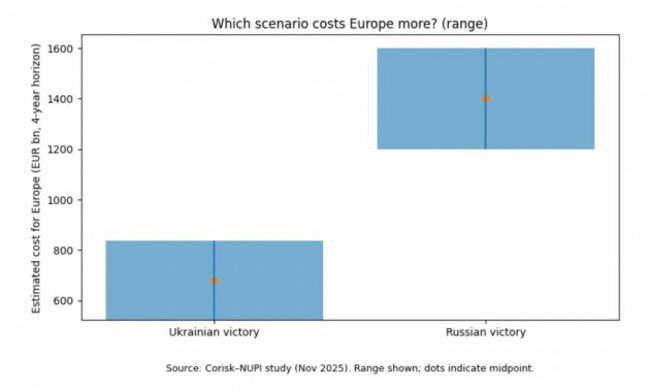
A recent study by the Norwegian, civil-funded analytical firm Corisk and the Norwegian Institute of International Affairs (NUPI) provides a clear framework by comparing two scenarios:

  • Scenario 1: Russian (partial) victory: Moscow pushes the front westward, Ukraine is forced to accept a “bad peace” and loses up to half of its territory. According to the study, this would impose €524–€952 billion in refugee and social costs on Europe over four years, plus additional defence spending, bringing the total bill to €1.2–€1.6 trillion.
  • Scenario 2: Ukrainian victory: Europe arms Ukraine (1,500–2,500 tanks, 2,000–3,000 artillery systems, up to 8 million drones, modern air defence), enabling it to push back Russian forces and force the Kremlin into a favourable peace. Researchers estimate the cost at €522–€838 billion over four years – roughly half of what Europe would pay in the event of a Russian victory.

The study also assumes a reduced role for the United States, meaning that the bulk of the burden – as today – would fall on Europe.

What if Russia attacked a NATO member?

There is no direct, official EU calculation of the cost of an actual NATO war, but there are approximate estimates of what European defence would require even in the event of a US withdrawal.

According to a 2025 analysis by the Brussels-based think tank Bruegel, if Europe had to deter Russia without the United States, it would need at least 300,000 additional troops and around €250 billion in extra defence spending annually in the coming years.

IMG_9783

According to the Norwegian study cited above, additional defence spending to reinforce NATO’s eastern flank in the event of a Russian war against NATO would raise Europe’s total costs under Scenario 1 to €1.2–1.6 trillion.

This alone already exceeds what the EU currently spends in total on supporting Ukraine – and this calculation does not even include potential infrastructure destruction in the Baltic or Scandinavian theatres, nor new waves of refugees.

Decision time for the EU

Those at an EU Summit in Brussels this week will look at whether they can use seized Russian assets to help finance Ukraine’s ongoing military defence.

At the start of this month the European Commission published its proposals to allow the lawful use of interest on seized Russian assets to finance Ukraine.

In parallel, there was also a change to EU Treaties. Until now, member states had to unanimously renew the asset freeze every six months – but now, a qualified majority of member states can do so, circumventing a possible veto by a single member state.

It is yet another new dimension for Europe as the fourth anniversary of the start of the conflict hoves into view.

This article was written as part of a cross-border European journalistic collaboration within the framework of the EU NEIGHBOURS east project.

Journalist: György Folk (EUrologus / HVG, Brussels)

Readers like you are keeping these stories free for everyone...
A mix of advertising and supporting contributions helps keep paywalls away from valuable information like this article. Over 5,000 readers like you have already stepped up and support us with a monthly payment or a once-off donation.

Close
JournalTv
News in 60 seconds