We need your help now

Support from readers like you keeps The Journal open.

You are visiting us because we have something you value. Independent, unbiased news that tells the truth. Advertising revenue goes some way to support our mission, but this year it has not been enough.

If you've seen value in our reporting, please contribute what you can, so we can continue to produce accurate and meaningful journalism. For everyone who needs it.

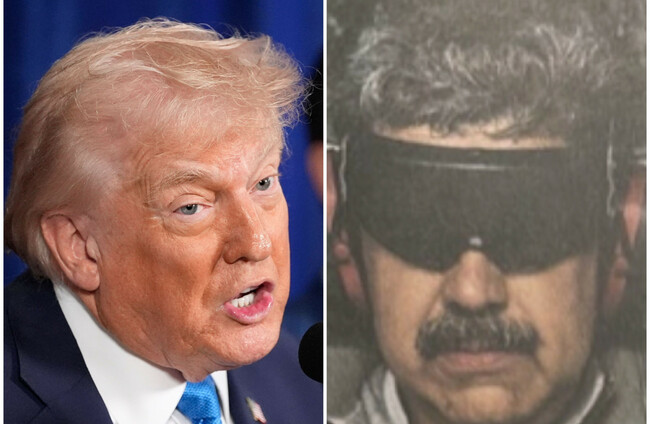
Trump shared an image of Maduro (right) blindfolded and handcuffed on social media on Saturday. Alamy/Truth Social

Venezuela Q&A: What next - and is this Trump's new era of US dominance?

US forces seized President Nicolás Maduro over the weekend, Trump says Washington will oversee the running of Venezuela, and global leaders are reacting with concern.

OUSTED VENEZUELAN PRESIDENT Nicolás Maduro has appeared in a New York court today after being seized by US forces in a dramatic weekend operation that has drawn global condemnation and prompted an emergency UN Security Council meeting.

With Washington claiming it will oversee Venezuela’s transition and warning of further action, here’s everything you need to know.

What happened on Saturday?

In the early hours of Saturday morning, the US launched a surprise military operation in Venezuela, carrying out airstrikes around Caracas before capturing President Nicolás Maduro and his wife, Cilia Flores.

US special forces stormed Maduro’s residence shortly after 2am local time, cutting power in parts of the capital as aircraft struck military bases, an airport, a major port and communications infrastructure.

Maduro and his wife were flown out of the country via a US warship and later transferred to New York, where they are now in federal custody.

The US says the operation involved more than 150 aircraft and resulted in no American fatalities.

Guardian News / YouTube

Venezuelan officials claim soldiers and civilians were killed, but have not released confirmed figures.

Why did the US do this?

The Trump administration says Maduro is a criminal leader who has long evaded justice.

US prosecutors have charged him with narco-terrorism, drug trafficking and weapons offences, accusing him of running state-backed criminal networks that funnel cocaine into the United States.

Donald Trump has also repeatedly accused Maduro of destabilising the region, driving migration to the US and allowing gangs to operate freely.

Maduro denies all allegations and says the US is using the “war on drugs” as cover for regime change and control of Venezuela’s oil.

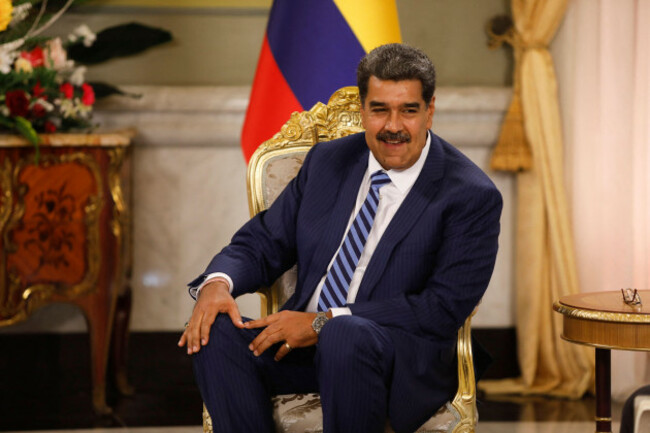
caracas-venezuela-16th-aug-2023-nicolas-maduro-president-of-venezuela-waits-to-receive-the-new-colombian-ambassador-to-venezuela-at-the-miraflores-presidential-palace-in-caracas-venezuela-cred Maduro pictured in 2023. Alamy Stock Photo Alamy Stock Photo

Venezuela holds the world’s largest proven oil reserves (about 303 billion barrels, roughly 17% of global reserves) making its energy resources one of the biggest in the world.

Maduro was widely considered to have been a dictator leading an authoritarian government characterised by electoral fraud, human rights abuses, corruption, and severe economic hardship.

Maduro inherited the presidency from his predecessor Hugo Chavez in 2013. In 2018, Maduro was reelected president and sworn in in a process dismissed as illegitimate by the United States and the EU.

Between 2013 and 2023, Venezuela dropped 42 places in the Press Freedom Index.

According to estimates by UN and Human Rights Watch, under Maduro’s administration thousands of people have died in extrajudicial killings and seven million Venezuelans were forced to flee the country.

What has Maduro been charged with?

Maduro and his wife have been indicted in New York on charges including conspiracy to import cocaine, narco-terrorism and possession of heavy weapons.

Maduro appeared in front of a court in New York earlier today along with his wife ahead of his upcoming trial.

The defence is expected to tackle his charges head-on, arguing that as a foreign head of state, Maduro should have diplomatic immunity.

Who is running Venezuela now?

The answer to this is not exactly clear-cut.

Venezuela’s vice-president, Delcy Rodríguez, has been sworn in as interim president by the country’s Supreme Court.

While Trump has claimed the US will “run” Venezuela during a transition period, the Venezuelan state, military and courts remain under the control of Maduro’s allies.

Rodríguez has publicly rejected US interference and demanded Maduro’s release, even as Trump claims she has privately signalled a willingness to cooperate.

What’s expected to happen next?

That also remains unclear.

Trump has not ruled out further military action and has openly discussed US involvement in rebuilding Venezuela’s oil industry, saying American companies will “move in” and extract resources.

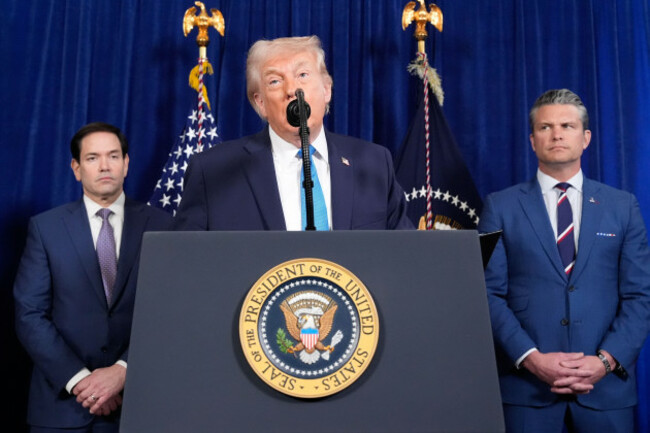
president-donald-trump-speaks-at-his-mar-a-lago-club-saturday-jan-3-2026-in-palm-beach-fla-as-secretary-of-state-marco-rubio-and-defense-secretary-pete-hegseth-listen-ap-photoalex-brandon Trump pictured during a press conference with US Secretary of State Marco Rubio and Secretary of War Pete Hegseth. Alamy Stock Photo Alamy Stock Photo

Venezuela’s constitution says elections should be held within 30 days if the presidency becomes vacant, but it is not clear whether that process will happen.

Opposition figures are divided, and Trump has dismissed key Venezuelan opposition leader María Corina Machado, claiming that she does not have popular support in the country.

Is what the US did legal?

That’s heavily disputed.

The Trump administration argues the operation was a “law enforcement action” to arrest an indicted criminal, not an invasion, and therefore did not require approval from US Congress.

Legal experts and US lawmakers strongly disagree, pointing out that US forces carried out airstrikes and ground operations inside another sovereign country without congressional authorisation.

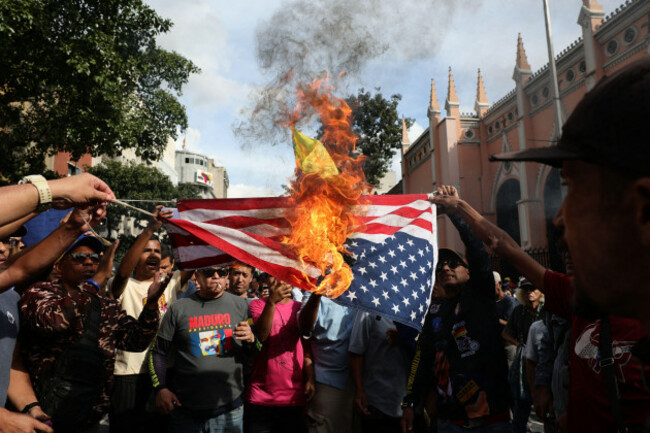
caracas-venezuela-03rd-jan-2026-venezuelans-burn-a-us-flag-after-the-announcement-of-the-us-attacks-and-the-capture-of-venezuelan-leader-maduro-credit-stringerdpaalamy-live-news Venezuelans in Caracas burn a US flag after the capture of Maduro. Alamy Stock Photo Alamy Stock Photo

“It’s an old and obvious pattern,” former Transportation Secretary and Democrat Pete Buttigieg wrote on X Saturday.

“An unpopular president — failing on the economy and losing his grip on power at home — decides to launch a war for regime change abroad. The American people don’t want to ‘run’ a foreign country while our leaders fail to improve life in this one.”

Democratic Representative Alexandria Occasio-Cortez also pushed back on Trump’s assertion that the Maduro operation was about drug trafficking.

“If it was, Trump wouldn’t have pardoned one of the largest narco traffickers in the world last month,” Ocasio-Cortez wrote on X, referencing Trump’s pardon of former Honduran President Juan Orlando Hernández, who was sentenced to decades in an American prison on drug trafficking charges.

“It’s about oil and regime change.”

Internationally, the operation is widely seen as a breach of international law.

What is the Monroe Doctrine, and why is Trump talking about it?

The Monroe Doctrine is a 19th-century US policy that claimed the western hemisphere as America’s sphere of influence, and warned European powers against interference in Latin America.

The doctrine has been repeatedly invoked by US presidents and policymakers to justify military and political interventions, including invasions and covert operations, in Latin American countries. 

Trump invoked it – renaming it as the “Don-roe Doctrine” – to justify US dominance in the region.

Critics say reviving it signals a return to gunboat diplomacy and regime change in Latin America.

How has the international community reacted?

The reaction has been swift and divided.

Russia, China and Iran condemned the US attack as illegal and a violation of sovereignty.

Many South American countries, including Colombia and Brazil, also criticised the operation.

Argentina’s president, a Trump ally, welcomed Maduro’s removal, while Cuba described the attack as “criminal”.

How has Europe (and Ireland) responded?

European leaders have been notably cautious.

The EU has repeated its position that Maduro lacks democratic legitimacy but stressed that any transition must respect international law.

There has been no endorsement of the US operation.

Ireland has aligned with the EU stance, calling for restraint and a peaceful, lawful transition.

The government, in a statement issued by Minister for Foreign Affairs Helen McEntee, echoed the EU line.

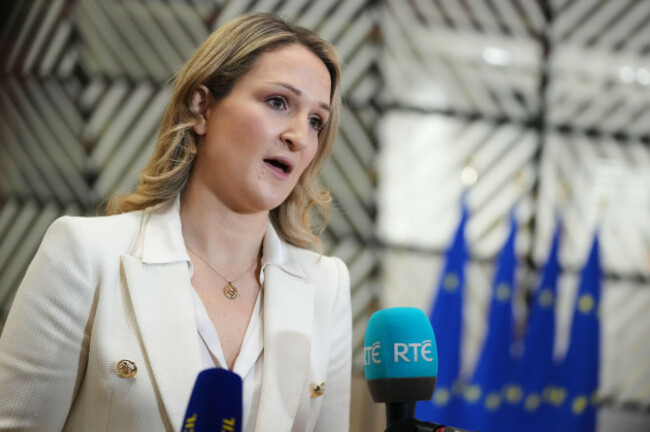
irelands-foreign-minister-helen-mcentee-speaks-with-the-media-as-she-arrives-for-a-meeting-of-eu-foreign-ministers-at-the-european-council-building-in-brussels-monday-dec-15-2025-ap-photovirgi Minister for Foreign Affairs Helen McEntee. Alamy Stock Photo Alamy Stock Photo

“Ireland, together with our EU partners, underlines the absolute necessity of full respect for international law and the principles of the UN Charter,” McEntee said.

“While we have been clear that president Maduro does not have any democratic legitimacy, we have consistently called for a peaceful and negotiated transition in Venezuela, and have supported all international efforts to that end.”

Taoiseach Micheál Martin declined to criticise the US for its abduction of Maduro this morning, but said he would have preferred a peaceful transition to democracy in the country.

Opposition parties criticised the government for stopping short of condemning the US action.

Sinn Féin foreign affairs spokesperson Donnchadh Ó Laoghaire said the operation amounted to “a naked power grab to gain control of Venezuelan oil”, adding that world leaders must push for “immediate de-escalation to prevent a full-blown regional conflict”.

Why is the EU being so restrained?

While the EU does not recognise Nicolás Maduro as Venezuela’s legitimate president, it is deeply wary of endorsing a US military intervention that appears to sidestep international law.

EU leaders are keen to avoid setting a precedent that would legitimise the forcible removal of governments without UN backing, something many fear could be used elsewhere in the world.

There are also practical concerns.

The EU is being careful not to alienate the US as negotiations continue between Russia and Ukraine.

Openly condemning Washington’s actions could prompt Trump to sideline European input on the conflict, and could play into the hands of Russian officials.

The EU also has limited leverage on the ground in Venezuela, little appetite for escalation in Latin America, and a strong interest in preventing a wider conflict that could trigger refugee flows or draw in powers such as Russia and China.

Publicly backing the US would risk tying the bloc to an open-ended operation with unclear legal footing and no defined exit plan.

In short, the EU wants Maduro gone, but not like this, and not at the cost of undermining the international rules it relies on to protect its own interests.

Readers like you are keeping these stories free for everyone...
Our Explainer articles bring context and explanations in plain language to help make sense of complex issues. We're asking readers like you to support us so we can continue to provide helpful context to everyone, regardless of their ability to pay.

Close
41 Comments
This is YOUR comments community. Stay civil, stay constructive, stay on topic. Please familiarise yourself with our comments policy here before taking part.
Leave a Comment
    Submit a report
    Please help us understand how this comment violates our community guidelines.
    Thank you for the feedback
    Your feedback has been sent to our team for review.

    Leave a commentcancel

     
    JournalTv
    News in 60 seconds