We need your help now

Support from readers like you keeps The Journal open.

You are visiting us because we have something you value. Independent, unbiased news that tells the truth. Advertising revenue goes some way to support our mission, but this year it has not been enough.

If you've seen value in our reporting, please contribute what you can, so we can continue to produce accurate and meaningful journalism. For everyone who needs it.

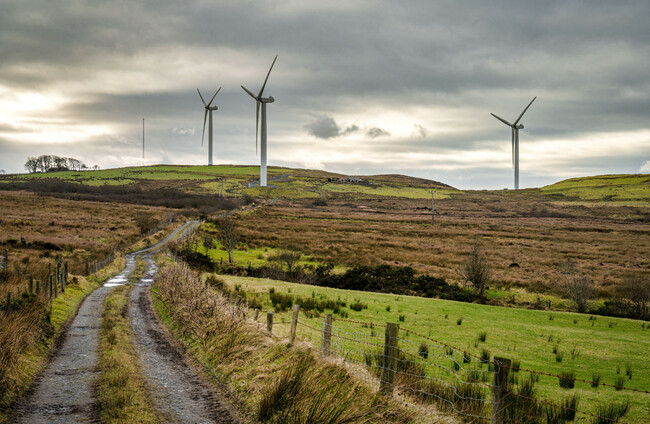
File photo of a wind farm. Alamy Stock Photo

Supreme Court issues significant ruling in favour of climate action in wind farm case

The ruling could have implications for projects with a climate impact such as data centres.

THE SUPREME COURT has partially upheld a significant High Court decision in favour of climate action in the case of a proposed wind farm in Co Laois.

The case, which hinged on the interpretation of the 2021 Climate Action and Low Carbon (Amendment) Act, could inform future decision-making on projects with climate implications, including energy projects, data centres and the government’s proposed liquefied natural gas (LNG) terminal.

However, the Supreme Court emphasised today that it was upholding the High Court’s decision to quash An Coimisiún Pleanála’s refusal of planning permission for the wind farm on “different and narrower grounds”.

These different grounds set out by the Supreme Court are likely to soften the potential ongoing implications of the case.

Background to the case

The case originated in 2023, when Norwegian renewables giant Statkraft applied to An Coimisiún Pleanála, the planning board, for permission to develop a 13-turbine wind farm in Timahoe, Co Laois called Coolglass.

An Coimisiún Pleanála refused permission in 2024, on the basis that the Laois County Development Plan did not allow wind farms in that area. The planning board’s inspector concluded that the development plan must take precedence over national climate policy.

Statkraft challenged this decision in the High Court, citing the state’s climate obligations – and won decisively in 2025.

High Court judge Richard Humphreys noted that 2021 amendments to the Climate Act required state bodies to perform their functions “so far as practicable…in a manner consistent with” the most recently approved Climate Action Plans and long-term climate action strategy.

The 2024 Climate Action Plan sets ambitious targets for wind energy, and Statkraft argued it would contribute to this objective.

The 2021 Climate Act also states that State bodies should perform their functions in a manner consistent with “the objective of mitigating [reducing] greenhouse gas emissions and adapting to the effects of climate change in the State”. In the course of its ruling, the High Court concluded that the 2021 Climate Act “imposes sweeping obligations across the public sector from the government down”.

The unsuccessful appeal to the Supreme Court against the 2025 High Court decision was taken by An Coimsiún Pleanála, the planning board, with the State backing the planning board’s case as a notice party.

The state argued that if the High Court’s approach were followed, there would be a “strong, almost overriding, presumption that permissions for developments causing emissions should be refused and that this would have grave and far-reaching implications for many important public interest projects”, according to a summary provided in today’s ruling.

Today’s ruling

Today, the Supreme Court ruled that An Coimisiún Pleanála had failed in its obligations to consider whether planning permission should be granted for the wind farm even though this contravened the County Development Plan, particularly having regards to its duty under section 15 of the Climate Act.

In a judgment handed down by Donal O’Donnell, the chief justice, the seven-judge court concluded: “The section creates a legal obligation binding upon [An Coimisiún Pleanála] and enforceable, if necessary, by action, to ensure that any decision it makes to grant or refuse permission is consistent with the climate objectives set out in section 15.”

It said it was not apparent that An Coimisiún Pleanála had ever engaged in a real and substantive way with the question of the climate benefit of the proposed development as an argument in its favour. Failing to do so was “an error of law”, the Supreme Court said.

However, departing from the original High Court decision, the court found that the wording of the Climate Act “implies that there is a range of possible outcomes” open to public bodies in acting consistently with climate objectives “and a degree of tolerance” in how this is achieved.

It noted that the “essence” of the High Court decision and its decision lay in its conclusion that An Coimisiún Pleanála was “obliged” by section 15 of the Climate Act to “depart from the terms of a development plan in order to favour development which is more likely to enable Ireland to meet its climate change objectives unless it was impracticable to do so”.

The Supreme Court rejected Coolglass’s interpretation of the law, which was also along these lines, and which the court said would result in a strong presumption in favour of any renewable energy project.

“The question of consistency of an individual planning decision with the section 15 objectives is much more complex than a traffic light system of climate-friendly ‘go’ (unless impracticable) and climate-unfriendly ‘stop’,” the court said.

Implications of the case

Statkraft, the wind farm developer, said this afternoon that the Supreme Court’s decision was a “positive and important outcome for the renewable energy sector in Ireland”.

“The decision provides much‑needed clarity on the role of climate law in our planning process,” Statkraft said.

Deirdre Duffy, chief executive of Friends of the Earth, said that while the Supreme Court had somewhat “reigned in” the original High Court judgment, the higher court had still provided a “strong interpretation” of what section 15 of the Climate Act means.

“This judgment clearly reinforces the importance of the national climate objective, and that section 15 has to be applied by public bodies in a real way,” Duffy said.

Environmentalist Oisín Coghlan, who campaigned for the 2021 Climate Act, said the judgment made it clear that there was a “real and substantive duty on public bodies” to carry out their functions in a manner that is consistent with the climate law and contributes to reducing emissions.

“It should have direct effect when An Coimisiún Pleanála is considering whether to grant planning permission to any commercial LNG import terminal,” Coghlan said.

He added that the judgment may contradict the position of the Commission for Regulation of Utilities, the energy regulator, that it does not have the authority to regulate emissions from large energy users such as data centres, and could leave the regulator open to legal challenges.

Planning and environmental lawyer Fred Logue said the Supreme Court ruling shows that section 15 of the Climate Act “has teeth” and its correct application “is a matter of law”.

“It clarifies that if something is manifestly inconsistent with carbon budgets or sectoral ceilings it will have to be refused,” Logue said.

He added that upcoming environmental cases are likely to “flesh out” the issues raised by the Supreme Court decision. He said one future battleground could be whether the provisions of section 15 of the Climate Act apply to state bodies that do not have direct environment obligations, such as Bord na Móna, Coillte and the Dublin Airport Authority.

Friends of the Irish Environment, an NGO which has taken many legal challenges on environmental grounds, said it strongly welcomed the ruling, which it said confirmed the requirements placed on public bodies by the Climate Act. It said the court has made it clear that compliance with these duties is for the courts to decide – not a subjective test for public bodies to determine for themselves.

An Coimisiún Pleanála said it welcomed the Supreme Court clarifications on how climate obligations and section 15 of the Climate Act apply to planning and environmental decision-making and will examine the judgment closely to incorporate this into its ongoing decision-making.

“According to the Supreme Court judgment, the matter will be remitted to the [An Coimisiún Pleanála for a new decision to be made,” it said.

Parties will have the opportunity to make further submissions on the wind farm proposal, it added.

Readers like you are keeping these stories free for everyone...
A mix of advertising and supporting contributions helps keep paywalls away from valuable information like this article. Over 5,000 readers like you have already stepped up and support us with a monthly payment or a once-off donation.

Close
9 Comments
This is YOUR comments community. Stay civil, stay constructive, stay on topic. Please familiarise yourself with our comments policy here before taking part.
Leave a Comment
    Submit a report
    Please help us understand how this comment violates our community guidelines.
    Thank you for the feedback
    Your feedback has been sent to our team for review.

    Leave a commentcancel

     
    JournalTv
    News in 60 seconds