We need your help now

Support from readers like you keeps The Journal open.

You are visiting us because we have something you value. Independent, unbiased news that tells the truth. Advertising revenue goes some way to support our mission, but this year it has not been enough.

If you've seen value in our reporting, please contribute what you can, so we can continue to produce accurate and meaningful journalism. For everyone who needs it.

X's new transparency measures aim to address inauthentic activity on the platform - but do they work? Alamy Stock Photo

X now shows where individual users are posting from: What does it tell us about Irish accounts?

Every profile now tells users where in the world its owner is posting from – supposedly.

LAST WEEKEND, X – the social media platform formerly known as Twitter – rolled out a new feature that aims to provide more transparency around the site’s users.

Every profile now shows users where in the world its owner is supposedly posting from as part of a move that has been marketed as a milestone for a platform synonymous with bots and anonymous accounts.

Users can also see how many times profiles have changed their username, as well as the month and year that profiles were created (although this was possible before). 

The transparency information also initially included the original location that accounts joined X from, before the feature was removed over technical issues; the company says it will return when problems are ironed out.

“This is an important first step to securing the integrity of the global town square,” the company’s head of product Nikita Bier said of the new feature on X.

It may be a first step for X, but the company is pretty late to the party: the same features appeared on Facebook and Instagram pages years ago.

It’s also somewhat surprising, given it reverses a recent trend by tech platforms like Meta and X to scale back content moderation and their reliance on human fact-checkers.

The move has come at a time when Russian, Chinese and Middle Eastern actors – as well as overseas influencers driven by the prospect of monetary gain – have sought to influence discourse on certain issues in Western countries.

And X has gained an unwelcome reputation for misinformation and having insufficient guardrails against bad information from going viral.

The transparency features have therefore been greeted with relative excitement from a cohort of users, who have engaged in a wave of online sleuthing to unearth examples of inauthentic behaviour and possible influence campaigns.

In recent days, countless screenshots have been posted showing pro-MAGA (“Make America Great Again”) accounts posing as US users, alongside location data that reveals that they’re actually based in places like Nigeria, Bangladesh, or Eastern Europe.

One X handle posing as a fan account for Ivanka Trump, Donald Trump’s daughter, was suspended after users noted that its location was listed as Nigeria.

The account had amassed one million followers and regularly posted pro-Trump content as well as Islamophobic and anti-immigration messages.

Problems

Yet rather than offering more transparency, the feature also has limitations which muddy the waters and enable even more misinformation to spread than was previously the case.

There are already questions about the accuracy of locations that are listed on many profiles – including from X, which has warned that location data “may not be accurate and can change periodically, particularly if users are accessing or posting on the platform from abroad”.

The company hasn’t fully explained how a person’s location is set, saying the information is simply inferred “based on your aggregated IP addresses”. 

At the moment, users who click on an account’s location will see a pop-up that says: “The country or region that an account is based can be impacted by recent travel or temporary relocation.”

Earlier this week, The Journal’s account information said it was posting from the United States, despite that not being the case.

Irish users who are based in Northern Ireland are also listed as posting from the United Kingdom, which may be technically accurate but which creates confusion when it comes to analysing whether such accounts are genuine users.

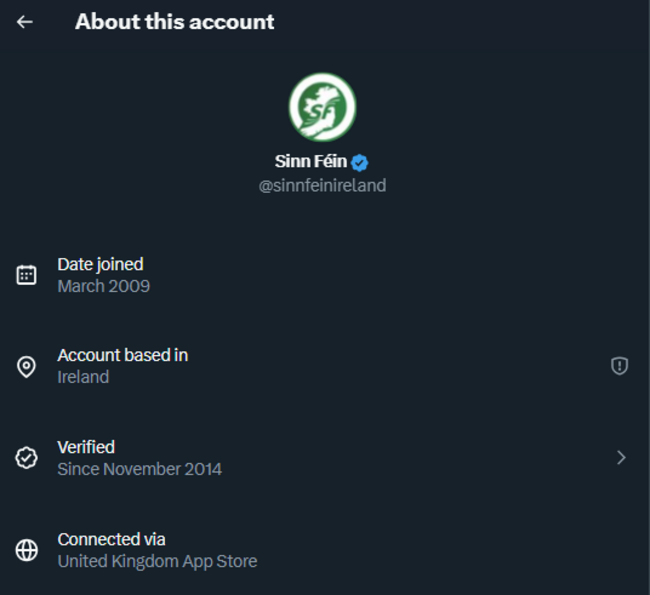
This has already been weaponised by critics of Sinn Féin, whose account information says its profile is based in Ireland but that it is connected to X via the United Kingdom App Store.

Despite having elected representatives in both jurisdictions and a headquarters in Northern Ireland, critics of the party posted screenshots of its locations and suggested that it had been caught out and was misleading voters.

Screenshot 2025-11-26 114305 Sinn Féin's location data is a tale of two jurisdictions @sinnfeinireland / X.com @sinnfeinireland / X.com / X.com

But there are also wider problems than the nuances posed by the border. 

In a watering down of the purpose for which the feature was intended, users around the world can set their location to a region or continent rather than an individual country.

X says this is to protect dissidents and protesters in autocratic states, though the upshot is that regionalising location data gives bad actors another mask to hide behind.

Arguably the biggest drawback about the new feature is that it’s possible for users to change their location by connecting to X via a VPN, a tool which allows users to side-step limitations of an IP address in one country by letting them browse via an IP address in another country.

X has attempted to counter this with notices saying that certain accounts “may have used a proxy such as a VPN” to log in to X.

This flag is useful for flagging potentially suspicious accounts, but it is far from definitive, but the label has been applied a little too liberally to be completely reliable (again, The Journal’s account was one of those flagged despite no use of a VPN).

Rather than offering more certainty, these problems allow anything to be dismissed as inauthentic activity if it suits a particular argument.

A user who is genuinely posting from Ireland can be accused of using a VPN if someone wants to claim they’re a bot.

An Irish person who accesses X while they’re on holidays can be accused of being a foreign agent working from the country they’re sightseeing in.

And foreign-based accounts can pay a small amount for a VPN to pose as Irish users and make online influence operations appear more legitimate than they did previously.

It was impossible to know the extent to which influence operations and bot accounts were operating in Ireland before, but it could be even more difficult now.

The Journal checked whether the new tool sheds any light on the origins of users that have driven online narratives on X in recent years – such as those which spread far-right and anti-immigrant misinformation.

Account location information says that the overwhelming majority of users that push such narratives are based in Ireland, including the most prominent accounts with tens of thousands of followers and which post dozens of times a day.

That being said, many of those flagged by X as using VPNs or proxies to access its platform. This isn’t definitive proof that those accounts are operating from abroad, but it indicates that they could be.

Out of more than 100 accounts checked by The Journal whose location is listed as Ireland, around two-thirds were flagged as using VPNs or proxies to log in to X.

A handful of accounts that post talking points of Ireland’s far-right were found to be based on locations like Singapore, Hungary, the Netherlands, and the United States, but they tended to have followers in the hundreds or low thousands.

They included an account set up in April 2024 that described itself as belonging to a “proud Irish man” based in Rathcullen, which stopped posting just before the local and European elections in June that year.

Its location was listed as the United States at the weekend, though this has since changed to Ireland (X has flagged the profile as potentially using a VPN). 

Another account that used to post about Ireland is now ‘located’ in Greece and posts exclusively in Greek about issues in that country, while another account called Belfastian Irish continues to post as if it is Irish, despite its transparency info claiming that it is based in Vietnam.

The phenomenon wasn’t limited to accounts pushing talking points from Ireland’s far-right movement either.

A US-based account called Trapjaw that posts what it claims are its owner’s drawings was previously called ‘Ireland Stands With Palestine’ and posted pro-Palestinian talking points; all of its posts before 10 August this year have been deleted.

These examples are few and far between, but they do show the power of the new features at spotting dodgy accounts when users are a bit sloppy at covering their tracks.

There’s some cause for hope that things will improve over time, though it will ultimately take a bit more from X to clean up its reputation around bots and inauthentic accounts – and we’re likely to see even more misinformation spread on the platform until it does.

Readers like you are keeping these stories free for everyone...
A mix of advertising and supporting contributions helps keep paywalls away from valuable information like this article. Over 5,000 readers like you have already stepped up and support us with a monthly payment or a once-off donation.

Close
JournalTv
News in 60 seconds