We need your help now

Support from readers like you keeps The Journal open.

You are visiting us because we have something you value. Independent, unbiased news that tells the truth. Advertising revenue goes some way to support our mission, but this year it has not been enough.

If you've seen value in our reporting, please contribute what you can, so we can continue to produce accurate and meaningful journalism. For everyone who needs it.

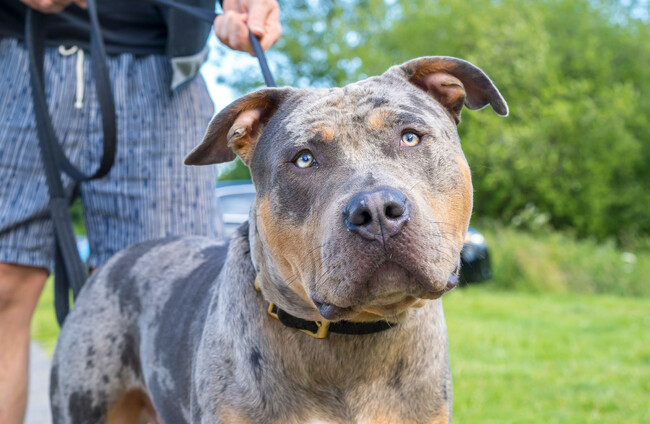
The XL Bully ban came into effect in October 2024 Alamy Stock Photo

More than 100 XL Bully dogs euthanised by local authorities in first year of ban

Animal welfare organisations have argued that breed bans don’t address the core of the problem.

OVER 100 XL Bully dogs have been euthanised by local authorities in the year since the ban on the breed came into effect.

Figures released to The Journal by the Department of Agriculture show that 114 dogs were euthanised between October 2024 and October 2025 after the dogs were surrendered to and seized by council dog wardens.

The ban on importing, breeding, selling and re-homing of XL Bully dogs came into effect on 1 October last year.

Further regulations introduced from February this year mean that it’s now illegal to own an XL Bully type dog without a certificate of exemption issued by the local authority.

More than 1,400 of these certificates have been granted over the same period to owners.

The ban on XL Bully dogs was introduced by former Minister for Social Protection Heather Humphries amid public safety concerns following a number of high-profile dog attacks involving the breed.

But some animal welfare organisations say that a blanket ban on a particular breed of dog will not address the problem.

In June 2024, Nicole Morey, a 23-year-old woman from Limerick, was killed in an attack by an XL Bully. A nine-year-old boy was also left with severe injuries after being attacked by another XL Bully in Wexford in 2022.

Earlier in December this year, a woman was hospitalised in Limerick after receiving serious injuries from a dog attack believed to be an XL Bully.

Fingal and Limerick highest for dogs put down

Fingal County Council has put down 18 XL Bullies since the introduction of the regulations in October 2024, the most of any local authority.

This is followed by Limerick City & County Council (16), Louth County Council (11) and Cork County Council (10), which have euthanised 37 dogs between them.

Eight councils have not had to put down any of these dogs during the year, as none have been surrendered to the local authority.

These figures don’t include the number of dogs euthanised whilst under the care of animal welfare organisations and so the true figure is likely to be higher.

Sinn Féin Senator Chris Andrews told The Journal that the number of dogs being euthanised is “pretty devastating” and “a sign of a failed policy”.

He added that bans on specific breeds don’t work because “bad owners just move on to different dogs”, and so the focus should be on the owners, not the dogs themselves.

“What we need to do, in my view, is we need to train the owners and have responsible ownership,” rather than have a breed-specific ban, Andrews said.

A total of 1,440 certificates of exemption – which allow owners to keep their XL Bullies – have also been granted by local authorities.

Fingal County Council (148), South Dublin County Council (140) and Dublin City Council (132) account for almost 30% of the total.

Just 79 applications have been refused by local authorities, sometimes due to the dog involved not actually being an XL Bully.

In order to apply for an exemption, owners must show that their dog is licensed, microchipped and neutered.

Animal welfare organisations were unable to apply for a certificate of exemption for XL Bullies in their care, as they couldn’t rehome them after October 2024.

Disagreements with the ban remain

The provisions that allow for XL Bullies under the care of these organisations to be euthanised was subject to a High Court case earlier this year.

Six animal welfare charities secured an injunction against the regulations at the end of January – a day before the final part of the legislation came into force – over concerns that dogs misidentified as XL Bullies could have been unnecessarily euthanised.

The charities argued that the regulations lacked clear criteria for how dog wardens would identify XL Bullies.

The case was settled after the government agreed to amend the rules to introduce a review process in circumstances where a dog owner may disagree with the determination of a dog warden.

But disagreements with the legislation remain.

Dublin dog rescue charity Working Animal Guardians was one of the charities that took the case against the legislation.

Brenda Fitzgerald, co-founder of the charity, told The Journal that the ban by the government was a “populist move” to get rid of the problem, but “blanketly killing a whole population of dogs simply does not work.”

“The problem was never with the dogs,” she argues. “The problem is with the people who have the dogs,” and the lack of individual responsibility from owners.

Fitzgerald says that instead of a blanket ban, the government should introduce a state-supported programme of neutering and spaying alongside “real penalties for people who break the law [and] who are not responsible owners”.

Because with this ban, Fitzgerald said, irresponsible owners still exist and “all the government is succeeding in doing is replacing one breed of dog for another breed of dog”.

A joint statement from Dogs Trust Ireland, Irish Blue Cross, the ISPCA and MADRA issued earlier this year also raised concerns about the effectiveness of the ban.

“There is consistent evidence that breed bans fail to reduce the number of dog bite incidents and instead present significant challenges for dog owners and the animal welfare sector,” the statement reads.

Instead of the ban, it calls for legislation that addresses the root causes of dog aggression, which includes “tackling unscrupulous breeders, penalising irresponsible owners of dangerously out-of-control dogs, and educating and empowering responsible dog owners”.

Conor O’Carroll is an investigative reporter with The Journal Investigates.

Our investigative unit is dedicated to lifting the lid on how Ireland works. This takes time and it takes resources. Find out how you can help:

Readers like you are keeping these stories free for everyone...
A mix of advertising and supporting contributions helps keep paywalls away from valuable information like this article. Over 5,000 readers like you have already stepped up and support us with a monthly payment or a once-off donation.

Close
99 Comments
This is YOUR comments community. Stay civil, stay constructive, stay on topic. Please familiarise yourself with our comments policy here before taking part.
Leave a Comment
    Submit a report
    Please help us understand how this comment violates our community guidelines.
    Thank you for the feedback
    Your feedback has been sent to our team for review.

    Leave a commentcancel

     
    JournalTv
    News in 60 seconds